

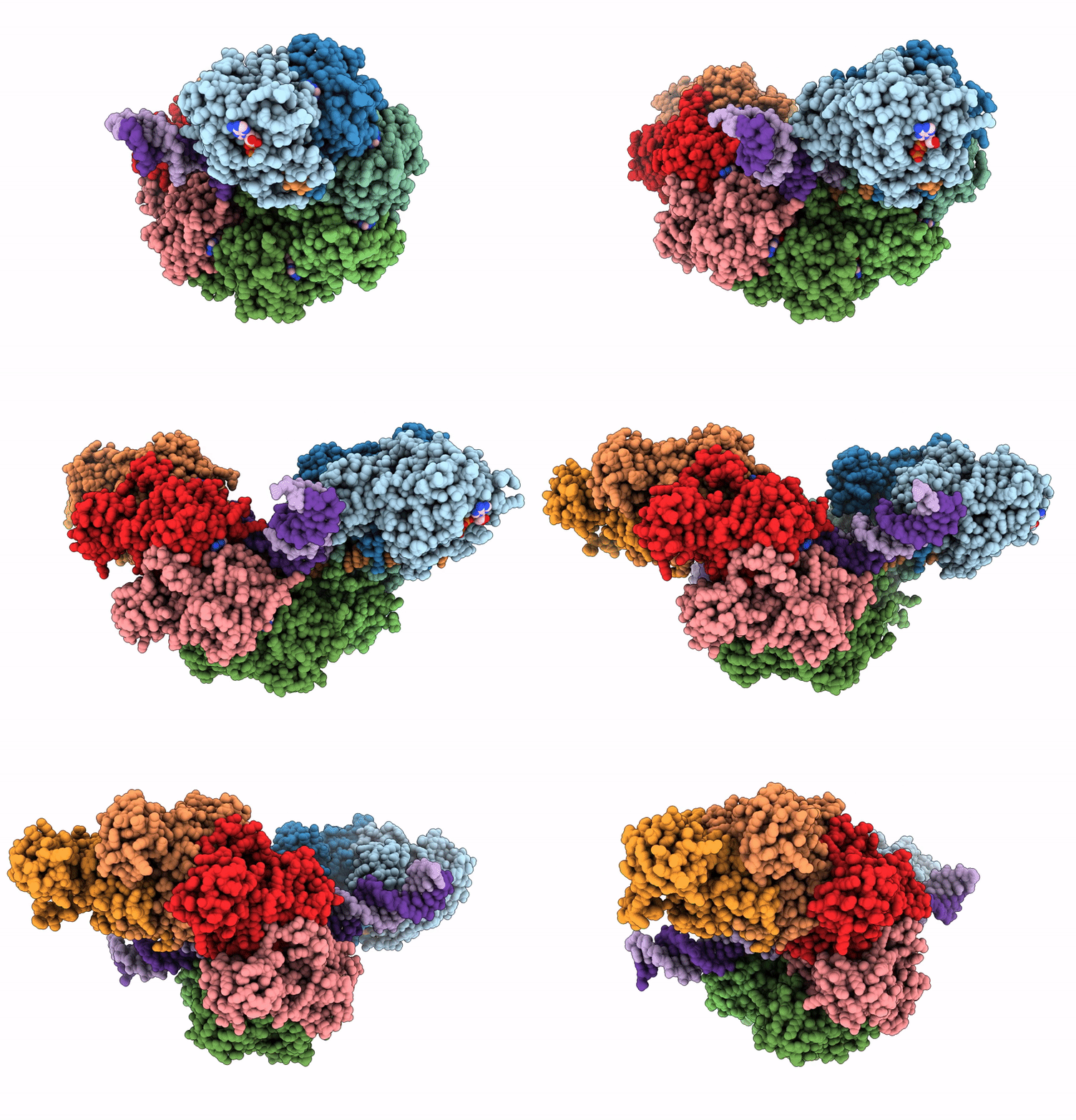
9I62 image
Deposition Date 2025-01-29
Release Date 2025-06-04
Last Version Date 2025-06-04
Entry Detail
PDB ID:
9I62
Title:
CryoEM structure of a RAD51 D-loop
Biological Source:
Source Organism(s):
Expression System(s):
Method Details:
Experimental Method:
Resolution:
2.64 Å
Aggregation State:
PARTICLE
Reconstruction Method:
SINGLE PARTICLE
Macromolecular Entities
Structures with similar UniProt ID
Protein Blast
Polymer Type:polypeptide(L)
Molecule:DNA repair protein RAD51 homo
Gene (Uniprot):RAD51
Chain IDs:A, B, C, D, E, F, G, H, I
Chain Length:339
Number of Molecules:9
Biological Source:Homo sapiens
Polymer Type:polydeoxyribonucleotide
Molecule:DNA (26-MER)
Chain IDs:J
Chain Length:32
Number of Molecules:1
Biological Source:synthetic construct
Polymer Type:polydeoxyribonucleotide
Molecule:DNA (41-MER)
Chain IDs:K
Chain Length:50
Number of Molecules:1
Biological Source:synthetic construct
Polymer Type:polydeoxyribonucleotide
Molecule:DNA (41-MER)
Chain IDs:L
Chain Length:50
Number of Molecules:1
Biological Source:synthetic construct
Primary Citation
Structural mechanism of strand exchange by the RAD51 filament.
Elife 14 ? ? (2025)
PMID: 40820711 DOI: 10.7554/eLife.107114

Abstact

Homologous recombination (HR) preserves genomic stability by repairing double-strand DNA breaks and ensuring efficient DNA replication. Central to HR is the strand-exchange reaction taking place within the three-stranded synapsis wherein a RAD51 nucleoprotein filament binds to a donor DNA. Here, we present the cryoEM structure of a displacement loop of human RAD51 that captures the synaptic state when the filament has become tightly bound to the donor DNA. The structure elucidates the mechanism of strand exchange by RAD51, including the filament engagement with the donor DNA, the strand invasion and pairing with the complementary sequence of the donor DNA, the capture of the non-complementary strand and the polarity of the strand-exchange reaction. Our findings provide fundamental mechanistic insights into the biochemical reaction of eukaryotic HR.

Legend

Protein

Chemical

Disease

Primary Citation of related structures
Feedback Form
Name
Email
Institute
Feedback