

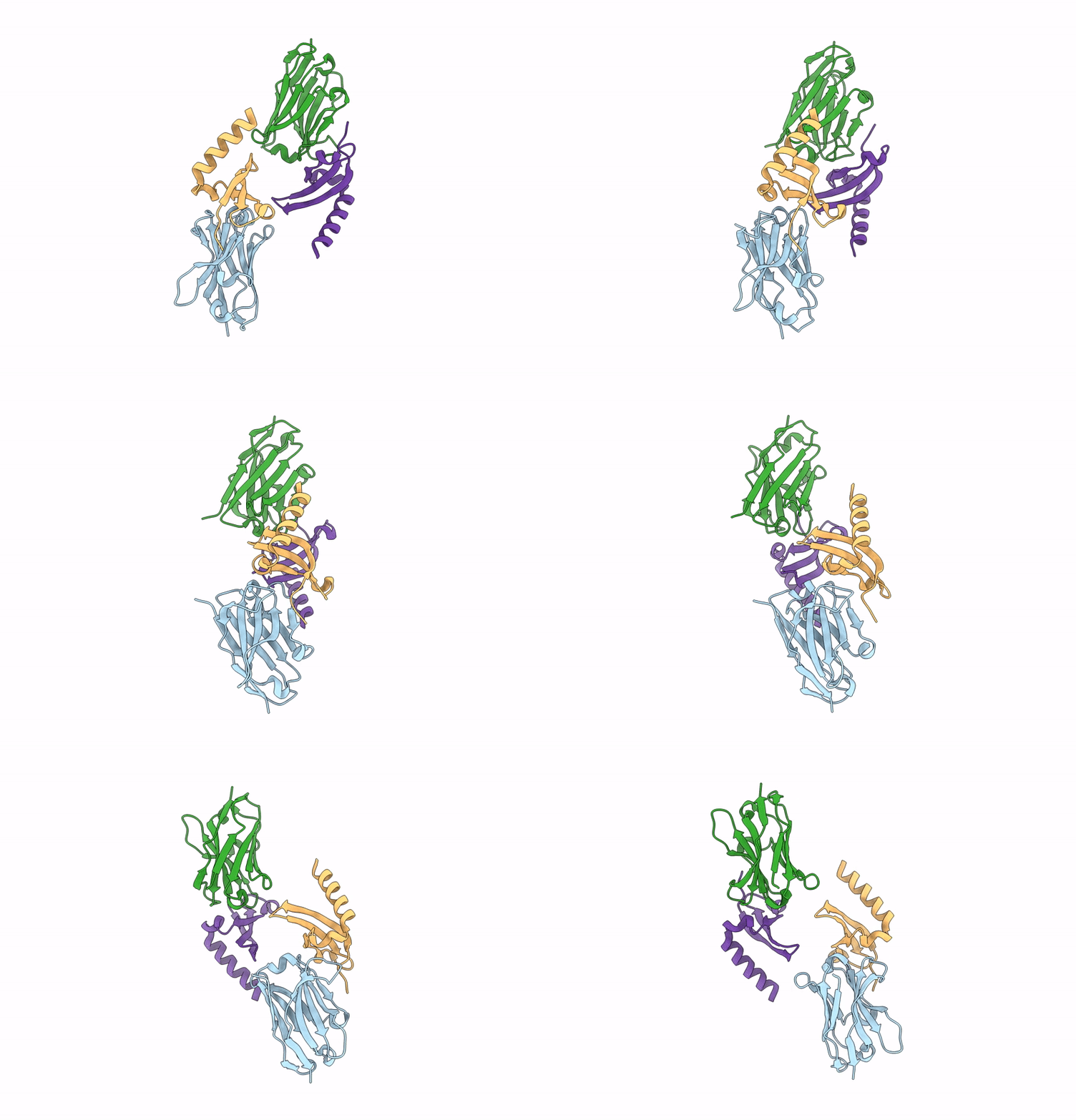
9H77 image
Deposition Date 2024-10-26
Release Date 2025-11-05
Last Version Date 2026-01-14
Entry Detail
PDB ID:
9H77
Keywords:
Title:
MPP8 chromodomain in complex with nanobody 3A02
Biological Source:
Source Organism(s):
Lama glama (Taxon ID: 9844)
Homo sapiens (Taxon ID: 9606)
Expression System(s):
Method Details:
Experimental Method:
Resolution:
2.01 Å
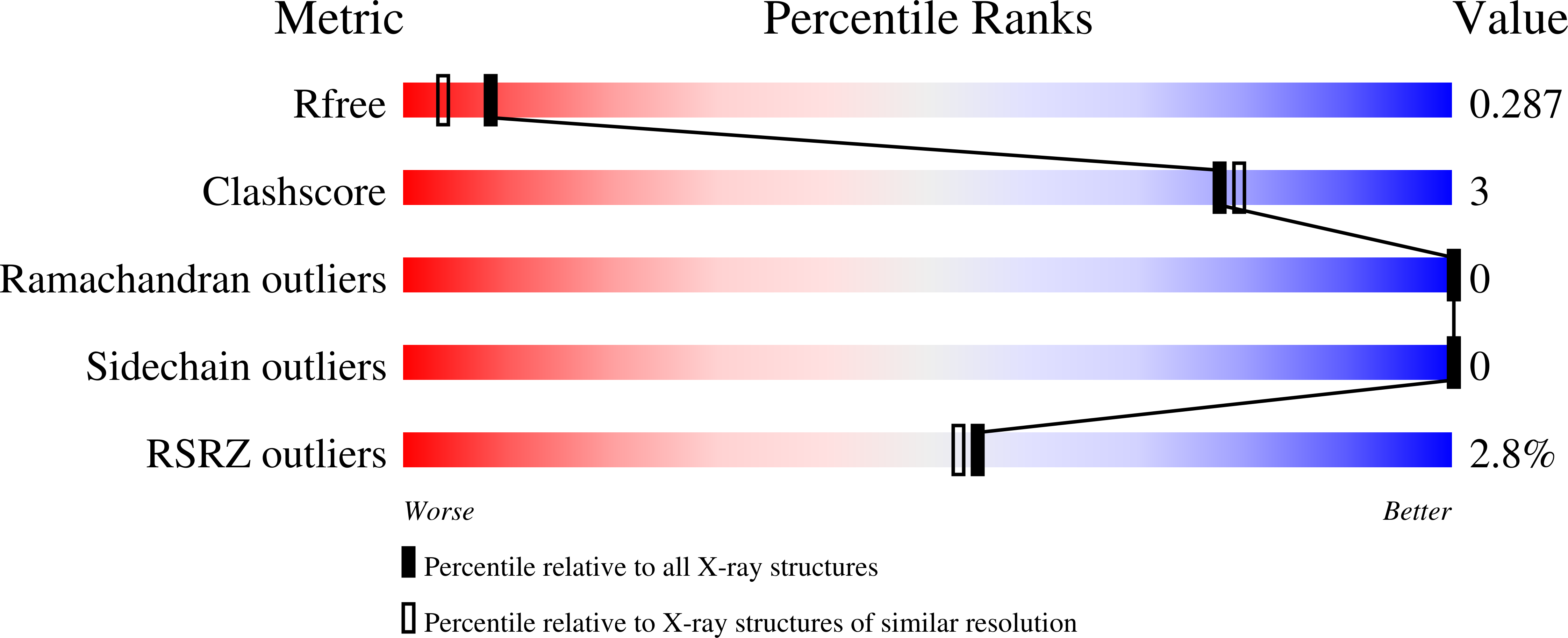
R-Value Free:
0.28
R-Value Work:
0.25
R-Value Observed:
0.25
Space Group:
P 21 21 21
Macromolecular Entities
Structures with similar UniProt ID
Protein Blast
Polymer Type:polypeptide(L)
Molecule:Nb 3A02
Mutagens:S8N, Q14K, T117M
Chain IDs:A, B
Chain Length:122
Number of Molecules:2
Biological Source:Lama glama
Structures with similar UniProt ID
Protein Blast
Polymer Type:polypeptide(L)
Molecule:M-phase phosphoprotein 8
Gene (Uniprot):MPHOSPH8
Chain IDs:C, D
Chain Length:68
Number of Molecules:2
Biological Source:Homo sapiens
Primary Citation
Gluebodies Offer a Route To Improve Crystal Reliability and Diversity through Transferable Nanobody Mutations That Introduce Constitutive Close Contacts.
Acs Cent.Sci. 11 2385 2399 (2025)
PMID: 41473800 DOI: 10.1021/acscentsci.5c00937

Abstact

Design of modular, transferable protein assemblies has broad applicability and in structural biology could help with the ever-troublesome crystallization bottleneck, including finding robustly behaved protein crystals for rapidly characterizing ligands or drug candidates or generating multiple polymorphs to illuminate diverse conformations. Nanobodies as crystallization chaperones are well-established but still unreliable, as we show here. Instead, we show an exemplar of how robust crystallization behavior can be engineered by exploring many combinations (>200) of nanobody surface mutations over several iterations. Critically, what needed testing was crystallization and diffraction quality, since target-nanobody binding affinity is decoupled from crystallizability enhancement. Our study yielded multiple polymorphs, all mediated by the same interface, with dramatically improved resolution and diffraction reliability for some mutants; we thus name them 'Gluebodies' (Gbs). We further demonstrate that these Gb mutations do transfer to some other targets, both for achieving robust crystallization in alternative packing forms and for establishing the ability to crystallize a key early stage readout. Since the Gb interface is evidently a favored interaction, it may be broadly applicable for modular assembly; more specifically, this work suggests that Gbs should be routinely attempted for crystallization whenever nanobodies are available.

Legend

Protein

Chemical

Disease

Primary Citation of related structures
Feedback Form
Name
Email
Institute
Feedback