

9GLC image
Deposition Date 2024-08-27
Release Date 2025-09-10
Last Version Date 2026-03-11
Entry Detail
PDB ID:
9GLC
Keywords:
Title:
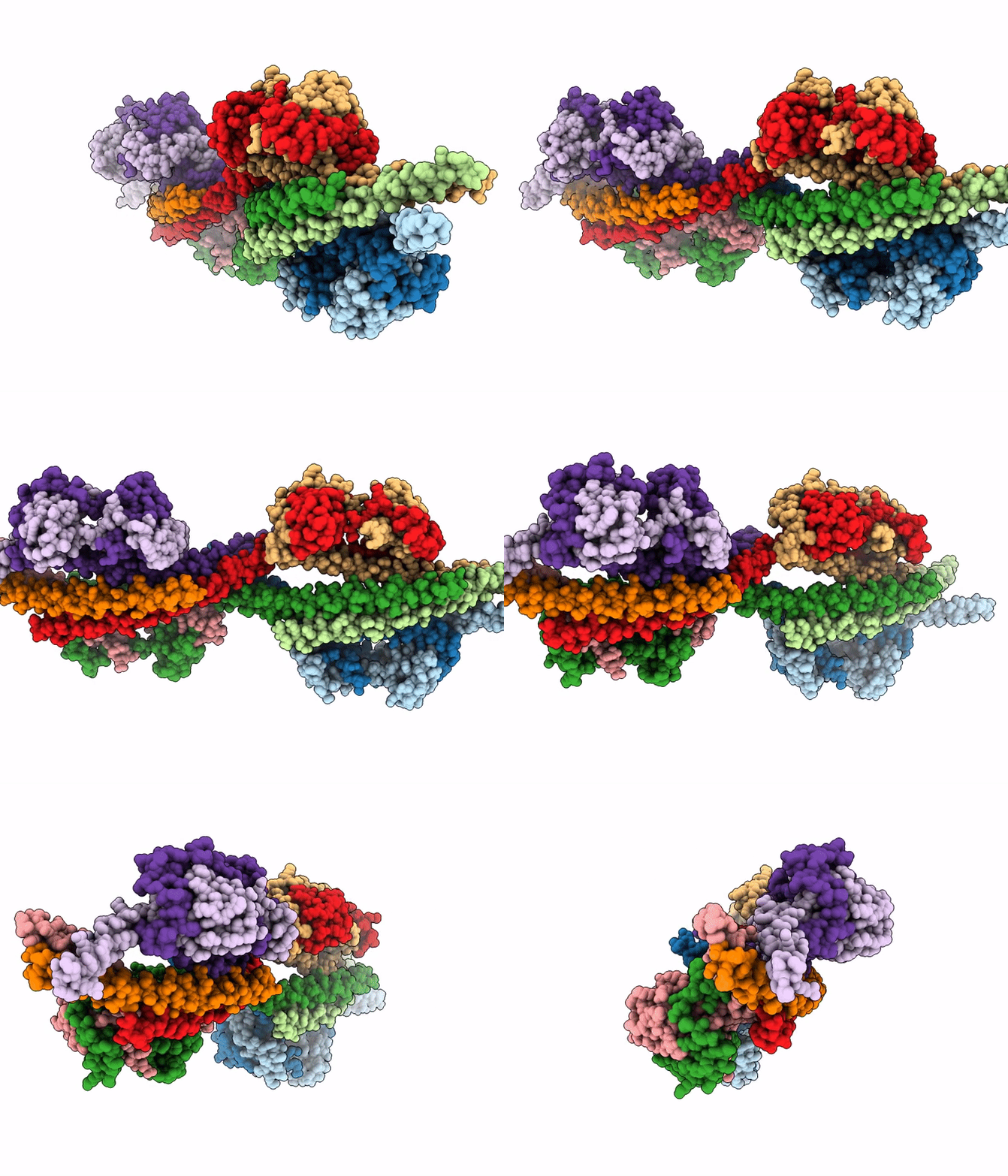
NONO/SFPQ filament: local refinement central units (strand 1)
Biological Source:
Source Organism(s):
Method Details:
Experimental Method:
Resolution:
3.30 Å
Aggregation State:
FILAMENT
Reconstruction Method:
SINGLE PARTICLE
Macromolecular Entities
Structures with similar UniProt ID
Protein Blast
Polymer Type:polypeptide(L)
Molecule:Splicing factor proline/gluta
Gene (Uniprot):Sfpq
Chain IDs:A (auth: BC), C (auth: BE), E (auth: AC), G (auth: AE), H (auth: CC), I (auth: CE)
Chain Length:703
Number of Molecules:6
Biological Source:Cricetulus griseus
Structures with similar UniProt ID
Protein Blast
Polymer Type:polypeptide(L)
Molecule:Non-POU domain containing oct
Gene (Uniprot):Nono
Chain IDs:B (auth: BD), D (auth: BF), F (auth: AD), J (auth: CF)
Chain Length:472
Number of Molecules:4
Biological Source:Cricetulus griseus
Ligand Molecules
Primary Citation
The gene-regulating proteins NONO and SFPQ assemble into ordered filaments.
Commun Biol 9 117 117 (2025)
PMID: 41476260 DOI: 10.1038/s42003-025-09396-8

Abstact

Proteins of the Drosophila behaviour/human splicing (DBHS) family are involved in many aspects of gene regulation and maintenance like transcription, splicing and DNA repair. DBHS proteins form obligate homo- and heterodimers through interactions within a globular domain and can further dynamically oligomerise through alpha-helical coiled-coils, which is crucial for many functions. While the atomic structures of the dimers are established, the arrangement in higher oligomers is unknown. Here we present the structure of a filamentous NONO/SFPQ heterooligomer resolved by cryo-EM. The filaments form a double helix which is stabilized by an interdigitating network of coiled-coil interactions.

Legend

Protein

Chemical

Disease

Primary Citation of related structures
Feedback Form
Name
Email
Institute
Feedback