

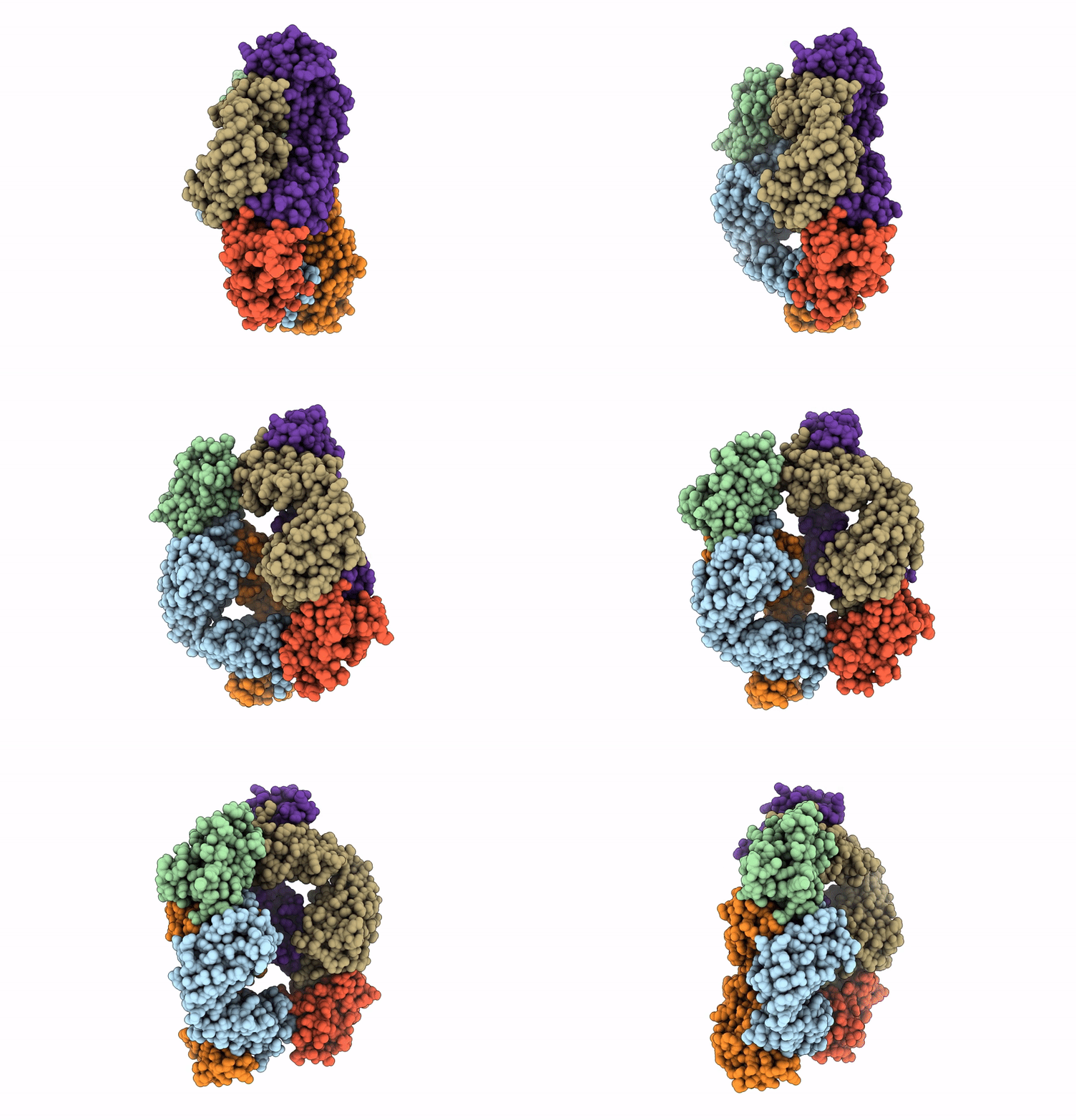
9DL0 image
Deposition Date 2024-09-10
Release Date 2025-06-11
Last Version Date 2025-06-11
Entry Detail
PDB ID:
9DL0
Title:
Crystal structure of a synthetic Fab (R3H8) in complex with the FRB domain of mTOR
Biological Source:
Source Organism(s):
Homo sapiens (Taxon ID: 9606)
Expression System(s):
Method Details:
Experimental Method:
Resolution:
2.00 Å
R-Value Free:
0.23
R-Value Work:
0.20
R-Value Observed:
0.20
Space Group:
P 21 2 21
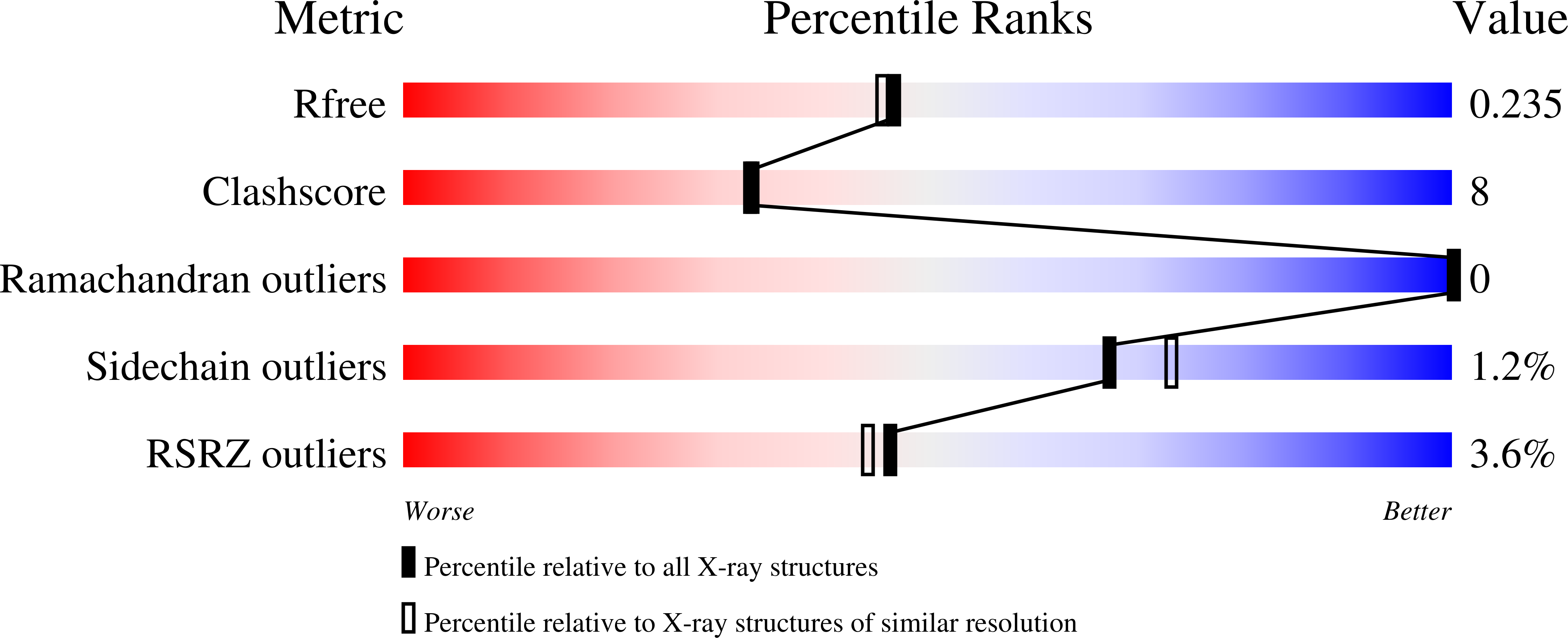
Macromolecular Entities
Structures with similar UniProt ID
Protein Blast
Polymer Type:polypeptide(L)
Molecule:Fab heavy chain
Chain IDs:A, C (auth: H)
Chain Length:224
Number of Molecules:2
Biological Source:Homo sapiens
Structures with similar UniProt ID
Protein Blast
Polymer Type:polypeptide(L)
Molecule:Serine/threonine-protein kina
Gene (Uniprot):MTOR
Chain IDs:B (auth: G), D (auth: I)
Chain Length:98
Number of Molecules:2
Biological Source:Homo sapiens
Structures with similar UniProt ID
Protein Blast
Polymer Type:polypeptide(L)
Molecule:Fab light chain
Chain IDs:E (auth: Y), F (auth: Z)
Chain Length:212
Number of Molecules:2
Biological Source:Homo sapiens
Primary Citation
Conformation-specific synthetic intrabodies modulate mTOR signaling with subcellular spatial resolution.
Proc. Natl. Acad. Sci. U.S.A. 122 e2424679122 e2424679122 (2025)
PMID: 40489625 DOI: 10.1073/pnas.2424679122

Abstact

Subcellular compartmentalization is integral to the spatial regulation of mechanistic target of rapamycin (mTOR) signaling. However, the biological outputs associated with location-specific mTOR signaling events are poorly understood and challenging to decouple. Here, we engineered synthetic intracellular antibodies (intrabodies) that are capable of modulating mTOR signaling with genetically programmable spatial resolution. Epitope-directed phage display was exploited to generate high affinity synthetic antibody fragments (Fabs) against the FKBP12-Rapamycin binding site of mTOR (mTORFRB). We determined high-resolution crystal structures of two unique Fabs that discriminate distinct conformational states of mTORFRB through recognition of its substrate recruitment interface. By leveraging these conformation-specific binders as intracellular probes, we uncovered the structural basis for an allosteric mechanism governing mTOR complex 1 (mTORC1) stability mediated by subtle structural adjustments within mTORFRB. Furthermore, our results demonstrated that synthetic binders emulate natural substrates by employing divergent yet complementary hydrophobic residues at defined positions, underscoring the broad molecular recognition capability of mTORFRB. Intracellular signaling studies showed differential time-dependent inhibition of S6 kinase 1 and Akt phosphorylation by genetically encoded intrabodies, thus supporting a mechanism of inhibition analogous to the natural product rapamycin. Finally, we implemented a feasible approach to selectively modulate mTOR signaling in the nucleus through spatially programmed intrabody expression. These findings establish intrabodies as versatile tools for dissecting the conformational regulation of mTORC1 and should be useful to explore how location-specific mTOR signaling influences disease progression.

Legend

Protein

Chemical

Disease

Primary Citation of related structures
Feedback Form
Name
Email
Institute
Feedback