

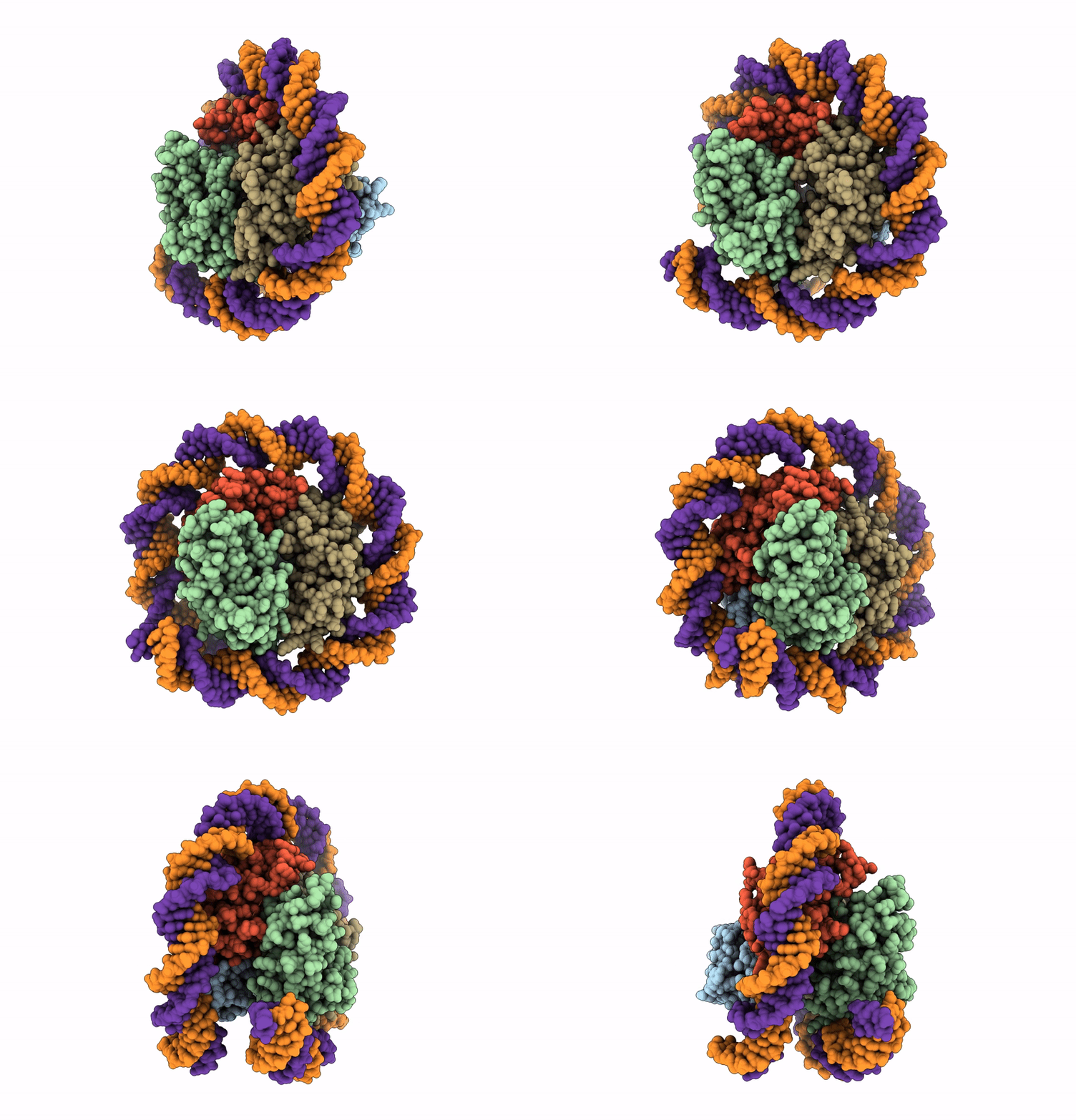
9CVT image
Deposition Date 2024-07-29
Release Date 2025-07-30
Last Version Date 2025-07-30
Entry Detail
PDB ID:
9CVT
Title:
Melbournevirus Mini variant Nucleosome
Biological Source:
Source Organism(s):
Expression System(s):
Method Details:
Experimental Method:
Resolution:
4.41 Å
Aggregation State:
PARTICLE
Reconstruction Method:
SINGLE PARTICLE

Macromolecular Entities
Structures with similar UniProt ID
Protein Blast
Polymer Type:polypeptide(L)
Molecule:Histone doublet miniH2B-H2A
Gene (Uniprot):MEL_149
Chain IDs:A, B
Chain Length:168
Number of Molecules:2
Biological Source:Melbournevirus
Structures with similar UniProt ID
Protein Blast
Polymer Type:polypeptide(L)
Molecule:Histone doublet H4-H3
Gene (Uniprot):MEL_368
Chain IDs:C, D
Chain Length:216
Number of Molecules:2
Biological Source:Melbournevirus
Polymer Type:polydeoxyribonucleotide
Molecule:Widom 601 Strand 1
Chain IDs:E (auth: I)
Chain Length:147
Number of Molecules:1
Biological Source:synthetic construct
Polymer Type:polydeoxyribonucleotide
Molecule:Widom 601 Strand 2
Chain IDs:F (auth: J)
Chain Length:147
Number of Molecules:1
Biological Source:synthetic construct
Ligand Molecules
Primary Citation
Melbournevirus encodes a shorter H2B-H2A doublet histone variant that forms structurally distinct nucleosome structures.
Nat Commun 16 6903 6903 (2025)
PMID: 40715086 DOI: 10.1038/s41467-025-62031-2

Abstact

Unique among viruses, some giant viruses utilize histones to organize their genomes into nucleosomes. Melbournevirus encodes a distinct H2B-H2A histone doublet variant in addition to the canonical H4-H3 and H2B-H2A doublets. This viral histone variant has a truncated H2B portion and its amino acid sequence deviates from that of the main viral H2B-H2A throughout the entire coding region. It is less abundant than the main H2B-H2A doublet, is likely essential for melbournevirus fitness, and is conserved in all Marseilleviridae. The cryo-EM structure of a nucleosome-like particle reconstituted with this H2B-H2A variant and viral H4-H3 reveals that only 90 base pairs of DNA are stably bound, significantly less than in eukaryotic nucleosomes and viral nucleosomes made with the main fused viral histone doublets. The reduced ability to bind DNA can be attributed to structural differences between variant and main H2B-H2A. Variant melbournevirus nucleosomes are less stable, possibly aiding rapid genome unpacking to initiate gene expression. Our results highlight the remarkable propensity of giant viruses to appropriate the utility of histones for their specialized purposes.

Legend

Protein

Chemical

Disease

Primary Citation of related structures
Feedback Form
Name
Email
Institute
Feedback