

8ZNG image
Deposition Date 2024-05-26
Release Date 2024-06-12
Last Version Date 2024-06-12
Entry Detail
PDB ID:
8ZNG
Keywords:
Title:
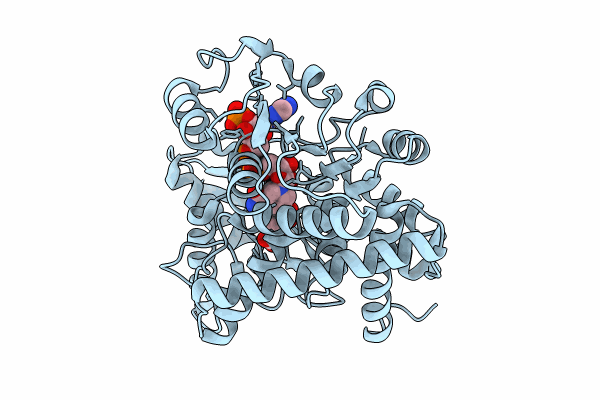
Cryo-EM structure of W89F mutated Glutamate dehydrogenase from Thermococcus profundus in complex with NADPH and AKG in the steady stage of reaction
Biological Source:
Source Organism(s):
Expression System(s):
Method Details:
Experimental Method:
Resolution:
2.50 Å
Aggregation State:
PARTICLE
Reconstruction Method:
SINGLE PARTICLE
Macromolecular Entities
Structures with similar UniProt ID
Protein Blast
Polymer Type:polypeptide(L)
Molecule:Glutamate dehydrogenase
Gene (Uniprot):gdhA
Mutagens:W89F
Chain IDs:A
Chain Length:416
Number of Molecules:1
Biological Source:Thermococcus profundus
Primary Citation
CryoEM and crystal structure analyses reveal the indirect role played by Trp89 in glutamate dehydrogenase enzymatic reactions.
FEBS J. 292 2071 2094 (2025)
PMID: 39891504 DOI: 10.1111/febs.17415

Abstact

Glutamate dehydrogenase from Thermococcus profundus is a homo-hexameric enzyme that catalyzes the reversible deamination of glutamate to 2-oxoglutarate in the presence of a cofactor. In each subunit, a large active-site cleft is formed between the two functional domains, one of which displays motion to open and close the cleft. Trp89 in the cleft displays two sidechain conformers in the open cleft and a single conformer in the closed cleft. To reveal the role of the Trp89 sidechain in the domain motion, we mutated Trp89 to phenylalanine. Despite the Trp89 sidechain being located away from the reaction center, the catalytic constant decreased to 1/38-fold of that of the wild-type without a fatal reduction of the affinities to the cofactor and ligand molecules. To understand the molecular mechanism underlying this reduction, we determined the crystal structure in the unliganded state and the metastable conformations appearing in the steady stage of the reaction using cryo-electron microscopy (cryoEM). The four identified metastable conformations were similar to the three conformations observed in the wild-type, but their populations were different from those of the wild-type. In addition, a conformation with a completely closed active-site cleft necessary for the reaction to proceed was quite rare. The crystal structure and the four metastable conformations suggested that the reduction in the catalytic constant could be attributed to changes in the interactions between Gln13 and the 89th side chains, preventing the closing domain motion.

Legend

Protein

Chemical

Disease

Primary Citation of related structures
Feedback Form
Name
Email
Institute
Feedback