

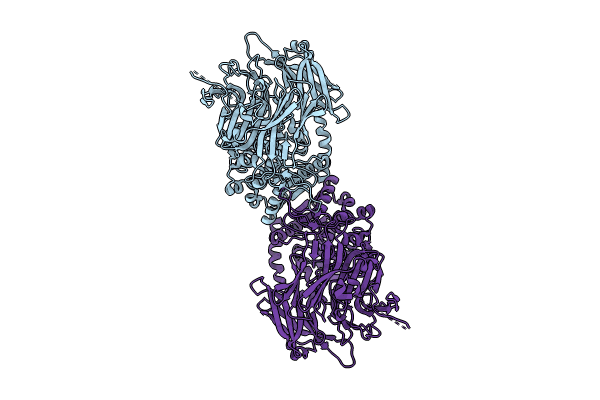
8PBA image
Deposition Date 2023-06-08
Release Date 2024-06-26
Last Version Date 2025-01-15
Entry Detail
PDB ID:
8PBA
Keywords:
Title:
Cryo-EM structure of Caenorhabditis elegans DPF-3 (apo)
Biological Source:
Source Organism(s):
Expression System(s):
Method Details:
Experimental Method:
Resolution:
2.64 Å
Aggregation State:
PARTICLE
Reconstruction Method:
SINGLE PARTICLE

Macromolecular Entities
Structures with similar UniProt ID
Protein Blast
Polymer Type:polypeptide(L)
Molecule:Dipeptidyl Peptidase Four (IV
Gene (Uniprot):dpf-3
Chain IDs:A, B
Chain Length:935
Number of Molecules:2
Biological Source:Caenorhabditis elegans
Ligand Molecules
Primary Citation
Deep quantification of substrate turnover defines protease subsite cooperativity.
Mol.Syst.Biol. 20 1303 1328 (2024)
PMID: 39468329 DOI: 10.1038/s44320-024-00071-4

Abstact

Substrate specificity determines protease functions in physiology and in clinical and biotechnological applications, yet quantitative cleavage information is often unavailable, biased, or limited to a small number of events. Here, we develop qPISA (quantitative Protease specificity Inference from Substrate Analysis) to study Dipeptidyl Peptidase Four (DPP4), a key regulator of blood glucose levels. We use mass spectrometry to quantify >40,000 peptides from a complex, commercially available peptide mixture. By analyzing changes in substrate levels quantitatively instead of focusing on qualitative product identification through a binary classifier, we can reveal cooperative interactions within DPP4's active pocket and derive a sequence motif that predicts activity quantitatively. qPISA distinguishes DPP4 from the related C. elegans DPF-3 (a DPP8/9-orthologue), and we relate the differences to the structural features of the two enzymes. We demonstrate that qPISA can direct protein engineering efforts like the stabilization of GLP-1, a key DPP4 substrate used in the treatment of diabetes and obesity. Thus, qPISA offers a versatile approach for profiling protease and especially exopeptidase specificity, facilitating insight into enzyme mechanisms and biotechnological and clinical applications.

Legend

Protein

Chemical

Disease

Primary Citation of related structures
Feedback Form
Name
Email
Institute
Feedback