

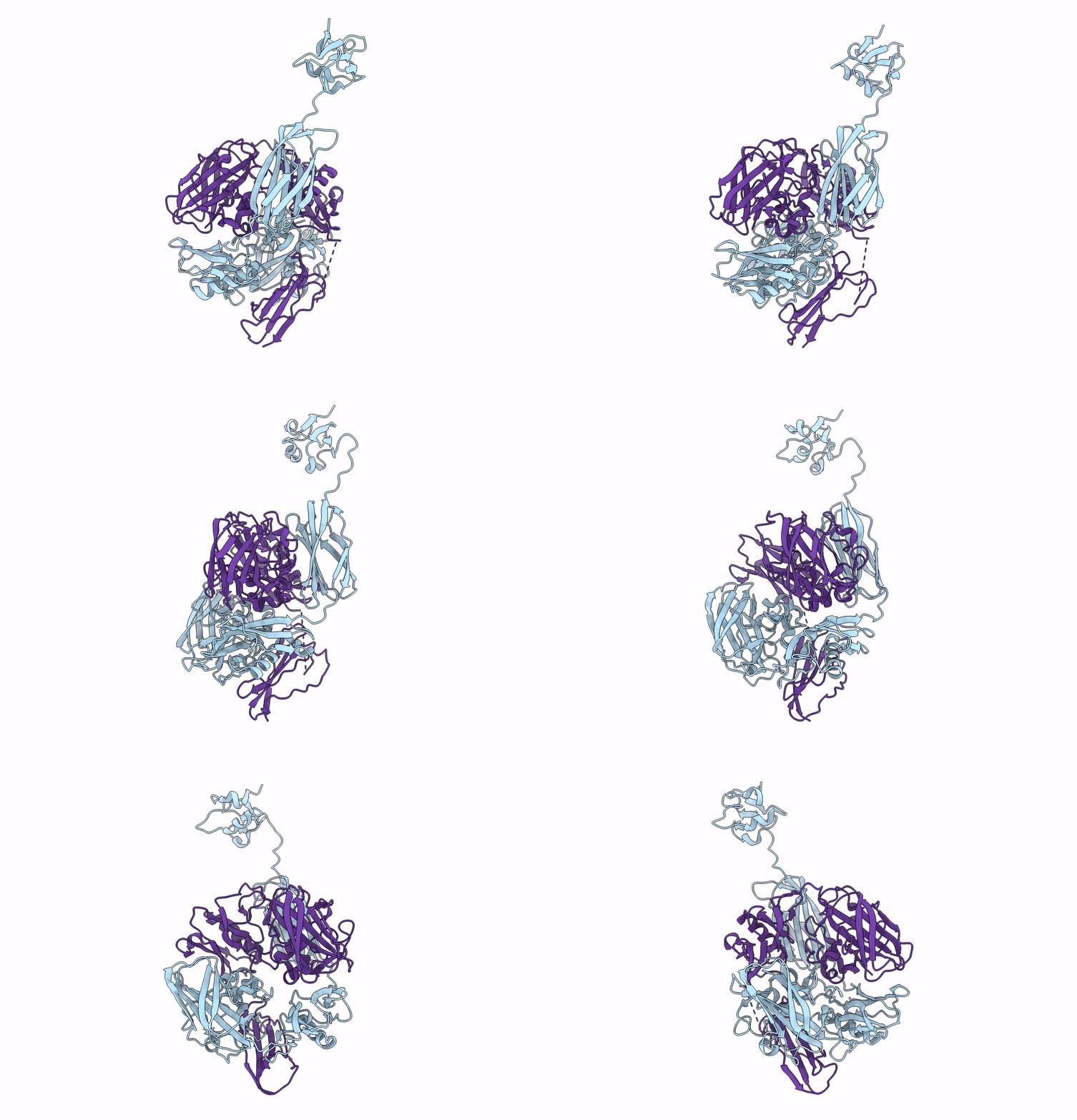
8GUM image
Deposition Date 2022-09-12
Release Date 2023-06-21
Last Version Date 2024-11-06
Entry Detail
PDB ID:
8GUM
Title:
Chitin-active AA10 LPMO (GbpA) from Vibrio campbellii
Biological Source:
Source Organism(s):
Expression System(s):
Method Details:
Experimental Method:
Resolution:
2.35 Å
R-Value Free:
0.26
R-Value Work:
0.21
R-Value Observed:
0.22
Space Group:
P 41 21 2
Macromolecular Entities
Structures with similar UniProt ID
Protein Blast
Polymer Type:polypeptide(L)
Molecule:GlcNAc-binding protein A
Gene (Uniprot):gbpA
Chain IDs:A, B
Chain Length:464
Number of Molecules:2
Biological Source:Vibrio campbellii ATCC BAA-1116
Primary Citation
Structural and binding studies of a new chitin-active AA10 lytic polysaccharide monooxygenase from the marine bacterium Vibrio campbellii.
Acta Crystallogr D Struct Biol 79 479 497 (2023)
PMID: 37259836 DOI: 10.1107/S2059798323003261

Abstact

Vibrio spp. play a crucial role in the global recycling of the highly abundant recalcitrant biopolymer chitin in marine ecosystems through their ability to secrete chitin-degrading enzymes to efficiently hydrolyse chitinous materials and use them as their major carbon source. In this study, the first crystal structures of a complete four-domain chitin-active AA10 lytic polysaccharide monooxygenase from the chitinolytic bacterium Vibrio campbellii type strain ATCC BAA-1116 are reported. The crystal structures of apo and copper-bound VhLPMO10A were resolved as homodimers with four distinct domains: an N-terminal AA10 catalytic (CatD) domain connected to a GlcNAc-binding (GbpA_2) domain, followed by a module X domain and a C-terminal carbohydrate-binding module (CBM73). Size-exclusion chromatography and small-angle X-ray scattering analysis confirmed that VhLPMO10A exists as a monomer in solution. The active site of VhLPMO10A is located on the surface of the CatD domain, with three conserved residues (His1, His98 and Phe170) forming the copper(II)-binding site. Metal-binding studies using synchrotron X-ray absorption spectroscopy and X-ray fluorescence, together with electron paramagnetic resonance spectroscopy, gave consistently strong copper(II) signals in the protein samples, confirming that VhLPMO10A is a copper-dependent enzyme. ITC binding data showed that VhLPMO10A could bind various divalent cations but bound most strongly to copper(II) ions, with a Kd of 0.1 ± 0.01 µM. In contrast, a Kd of 1.9 nM was estimated for copper(I) ions from redox-potential measurements. The presence of ascorbic acid is essential for H2O2 production in the reaction catalysed by VhLPMO10A. MALDI-TOF MS identified VhLPMO10A as a C1-specific LPMO, generating oxidized chitooligosaccharide products with different degrees of polymerization (DP2ox-DP8ox). This new member of the chitin-active AA10 LPMOs could serve as a powerful biocatalyst in biofuel production from chitin biomass.

Legend

Protein

Chemical

Disease

Primary Citation of related structures
Feedback Form
Name
Email
Institute
Feedback