

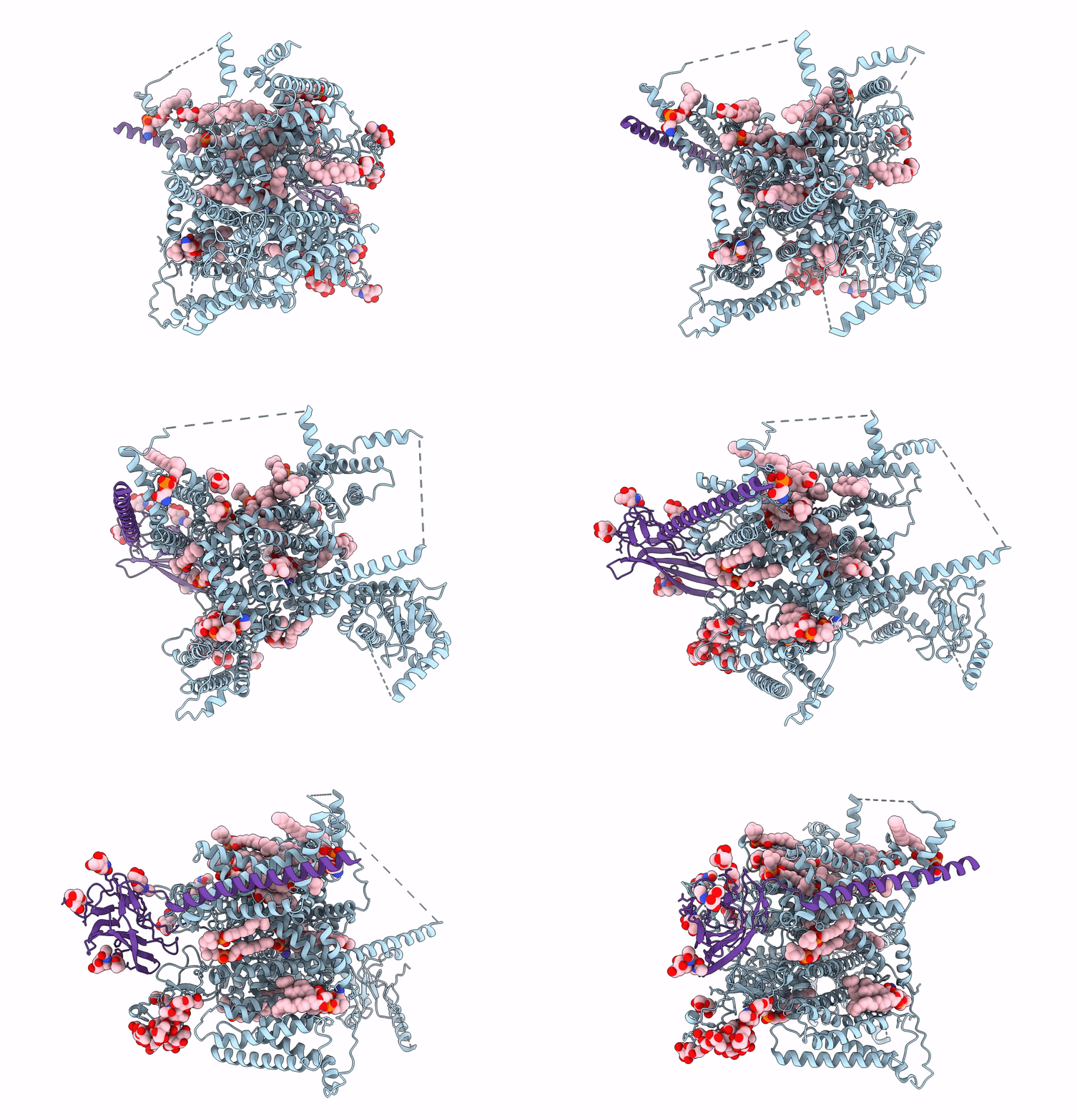
8FHD image
Deposition Date 2022-12-14
Release Date 2023-02-08
Last Version Date 2024-11-13
Entry Detail
PDB ID:
8FHD
Title:
Cryo-EM structure of human voltage-gated sodium channel Nav1.6
Biological Source:
Source Organism(s):
Homo sapiens (Taxon ID: 9606)
Expression System(s):
Method Details:
Experimental Method:
Resolution:
3.10 Å
Aggregation State:
PARTICLE
Reconstruction Method:
SINGLE PARTICLE
Macromolecular Entities
Structures with similar UniProt ID
Protein Blast
Polymer Type:polypeptide(L)
Molecule:Sodium channel protein type 8
Gene (Uniprot):SCN8A
Chain IDs:A
Chain Length:1980
Number of Molecules:1
Biological Source:Homo sapiens
Structures with similar UniProt ID
Protein Blast
Polymer Type:polypeptide(L)
Molecule:Sodium channel subunit beta-1
Gene (Uniprot):SCN1B
Chain IDs:B (auth: C)
Chain Length:218
Number of Molecules:1
Biological Source:Homo sapiens
Primary Citation
Cryo-EM structure of human voltage-gated sodium channel Na v 1.6.
Proc. Natl. Acad. Sci. U.S.A. 120 e2220578120 e2220578120 (2023)
PMID: 36696443 DOI: 10.1073/pnas.2220578120

Abstact

Voltage-gated sodium channel Nav1.6 plays a crucial role in neuronal firing in the central nervous system (CNS). Aberrant function of Nav1.6 may lead to epilepsy and other neurological disorders. Specific inhibitors of Nav1.6 thus have therapeutic potentials. Here we present the cryo-EM structure of human Nav1.6 in the presence of auxiliary subunits β1 and fibroblast growth factor homologous factor 2B (FHF2B) at an overall resolution of 3.1 Å. The overall structure represents an inactivated state with closed pore domain (PD) and all "up" voltage-sensing domains. A conserved carbohydrate-aromatic interaction involving Trp302 and Asn326, together with the β1 subunit, stabilizes the extracellular loop in repeat I. Apart from regular lipids that are resolved in the EM map, an unprecedented Y-shaped density that belongs to an unidentified molecule binds to the PD, revealing a potential site for developing Nav1.6-specific blockers. Structural mapping of disease-related Nav1.6 mutations provides insights into their pathogenic mechanism.

Legend

Protein

Chemical

Disease

Primary Citation of related structures
Feedback Form
Name
Email
Institute
Feedback