

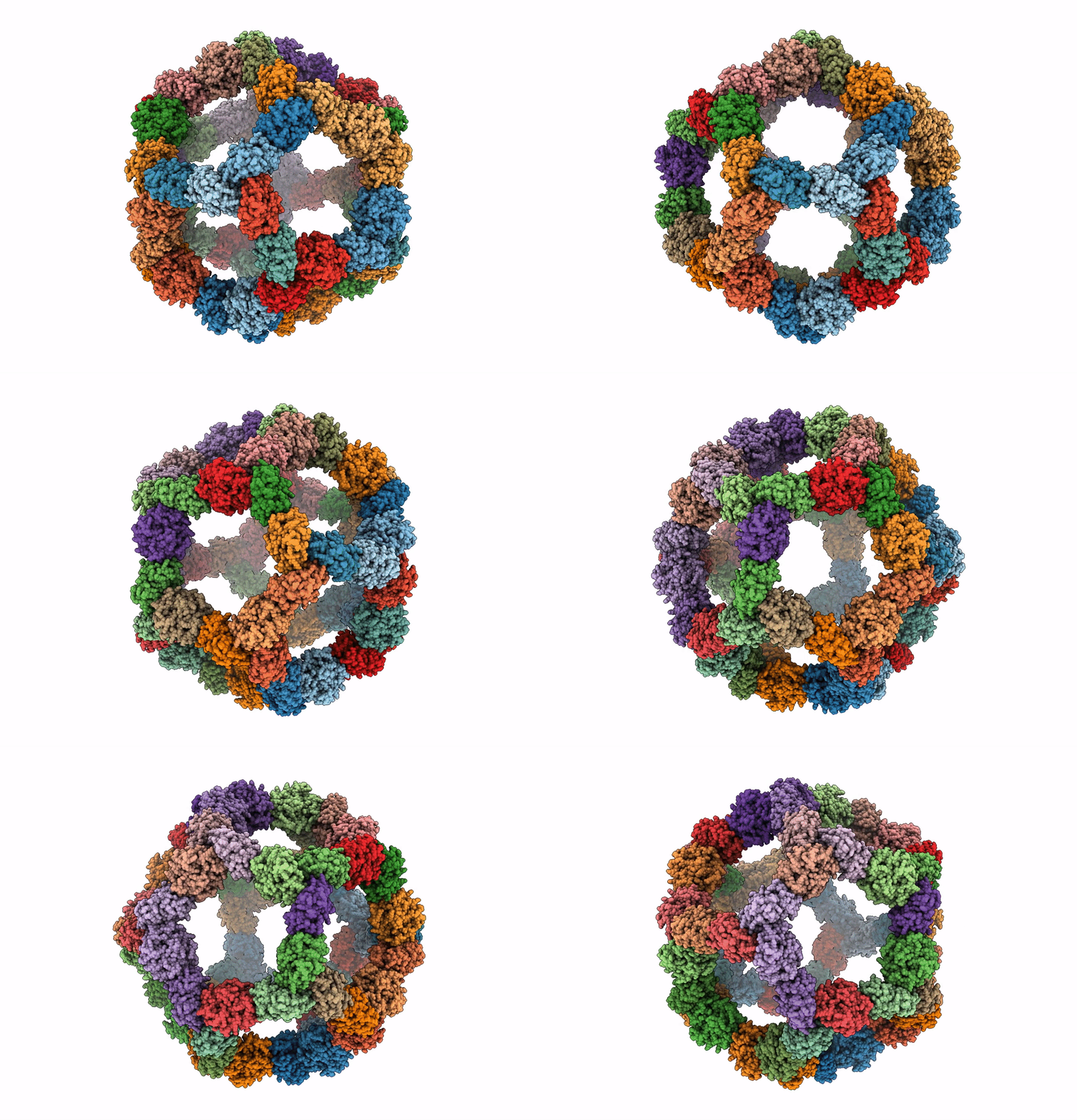
8ED3 image
Deposition Date 2022-09-02
Release Date 2023-01-11
Last Version Date 2024-11-06
Entry Detail
PDB ID:
8ED3
Keywords:
Title:
Structure of a nanoparticle with icosahedral symmetry
Biological Source:
Source Organism(s):
Expression System(s):
Method Details:
Experimental Method:
Resolution:
3.50 Å
Aggregation State:
PARTICLE
Reconstruction Method:
SINGLE PARTICLE

Macromolecular Entities
Structures with similar UniProt ID
Protein Blast
Polymer Type:polypeptide(L)
Molecule:Designed I3-01 icosahedron
Chain IDs:A, B, C, D, E, F, G, H, I, J, K, L, M, N, O, P, Q, R, S, T, U, V, W, X, Y, Z, AA (auth: 0), BA (auth: 1), CA (auth: 2), DA (auth: 3), EA (auth: 4), FA (auth: 5), GA (auth: 6), HA (auth: 7), IA (auth: 8), JA (auth: 9), KA (auth: a), LA (auth: b), MA (auth: c), NA (auth: d), OA (auth: e), PA (auth: f), QA (auth: g), RA (auth: h), SA (auth: i), TA (auth: j), UA (auth: k), VA (auth: l), WA (auth: m), XA (auth: n), YA (auth: o), ZA (auth: p), AB (auth: q), BB (auth: r), CB (auth: s), DB (auth: t), EB (auth: u), FB (auth: v), GB (auth: w), HB (auth: x)
Chain Length:201
Number of Molecules:60
Biological Source:Thermotoga maritima MSB8
Ligand Molecules
Primary Citation
Improved interface packing and design opportunities revealed by CryoEM analysis of a designed protein nanocage.
Heliyon 8 e12280 e12280 (2022)
PMID: 36590526 DOI: 10.1016/j.heliyon.2022.e12280

Abstact

Symmetric protein assemblies play important roles in nature which makes them an attractive target for engineering. De novo symmetric protein complexes can be created through computational protein design to tailor their properties from first principles, and recently several protein nanocages have been created by bringing together protein components through hydrophobic interactions. Accurate experimental structures of newly-developed proteins are essential to validate their design, improve assembly stability, and tailor downstream applications. We describe the CryoEM structure of the nanocage I3-01, at an overall resolution of 3.5 Å. I3-01, comprising 60 aldolase subunits arranged with icosahedral symmetry, has resisted high-resolution characterization. Some key differences between the refined structure and the original design are identified, such as improved packing of hydrophobic sidechains, providing insight to the resistance of I3-01 to high-resolution averaging. Based on our analysis, we suggest factors important in the design and structural processing of new assemblies.

Legend

Protein

Chemical

Disease

Primary Citation of related structures
Feedback Form
Name
Email
Institute
Feedback