

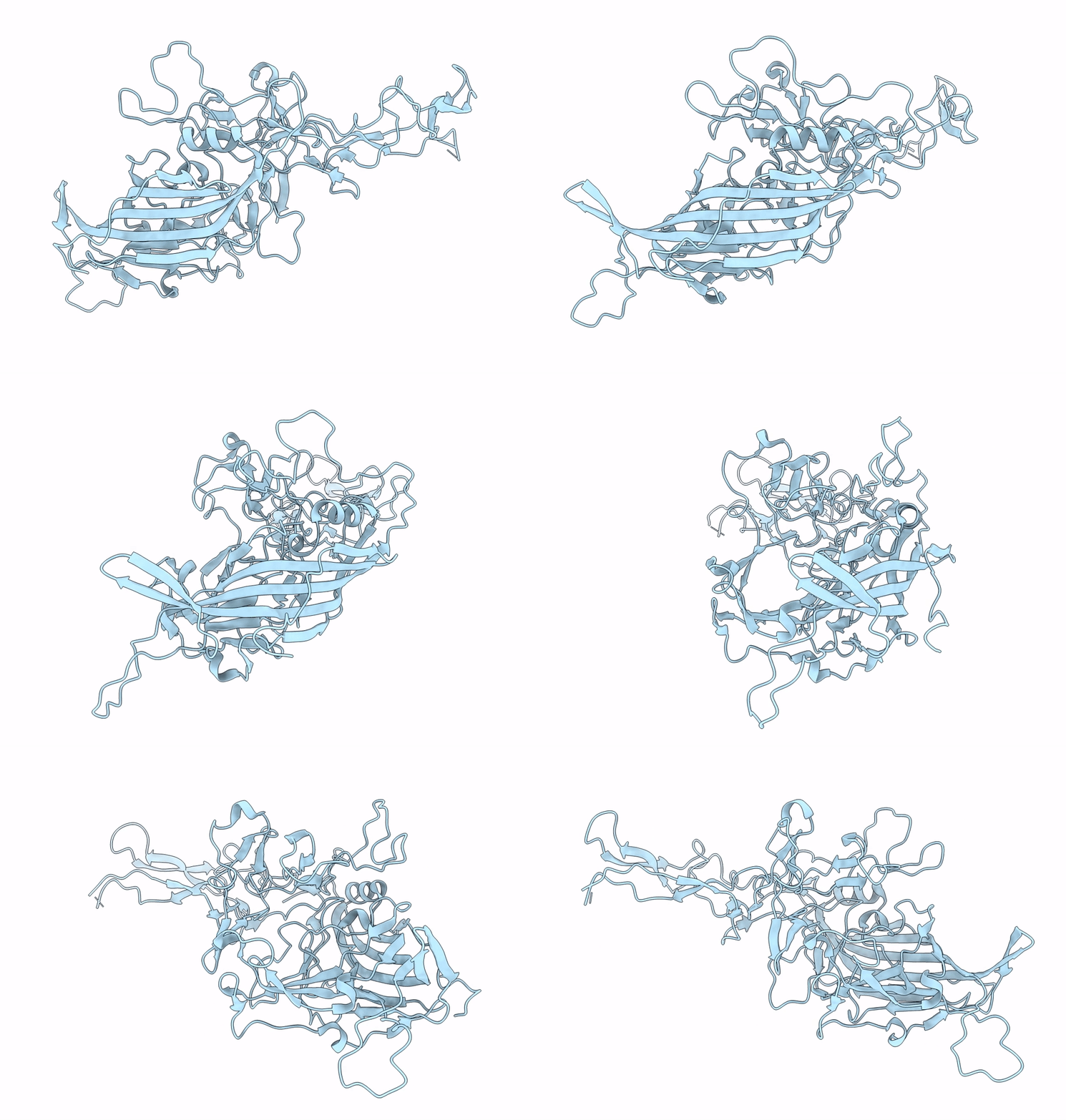
7UD4 image
Deposition Date 2022-03-18
Release Date 2022-09-21
Last Version Date 2024-06-12
Entry Detail
PDB ID:
7UD4
Keywords:
Title:
Cryo-EM structure of AAV-PHP.eB
Biological Source:
Source Organism(s):
Expression System(s):
Method Details:
Experimental Method:
Resolution:
2.24 Å
Aggregation State:
PARTICLE
Reconstruction Method:
SINGLE PARTICLE
Macromolecular Entities
Structures with similar UniProt ID
Protein Blast
Polymer Type:polypeptide(L)
Molecule:Capsid protein VP1
Gene (Uniprot):cap
Chain IDs:A
Chain Length:743
Number of Molecules:1
Biological Source:Adeno-associated virus
Ligand Molecules
Primary Citation
Structural basis of receptor usage by the engineered capsid AAV-PHP.eB.
Mol Ther Methods Clin Dev 26 343 354 (2022)
PMID: 36034770 DOI: 10.1016/j.omtm.2022.07.011

Abstact

Adeno-associated virus serotype 9 (AAV9) is a promising gene therapy vector for treating neurodegenerative diseases due to its ability to penetrate the blood-brain barrier. PHP.eB was engineered from AAV9 by insertion of a 7-amino acid peptide and point mutation of neighboring residues, thereby enhancing potency in the central nervous system. Here, we report a 2.24-Å resolution cryo-electron microscopy structure of PHP.eB, revealing conformational differences from other 7-mer insertion capsid variants. In PHP.eB, the 7-mer loop adopts a bent conformation, mediated by an interaction between engineered lysine and aspartate residues. Further, we identify PKD2 as the main AAV receptor (AAVR) domain recognizing both AAV9 and PHP.eB and find that the PHP.eB 7-mer partially destabilizes this interaction. Analysis of previously reported AAV structures together with our pull-down data demonstrate that the 7-mer topology determined by the lysine-aspartate interaction dictates AAVR binding strength. Our results suggest that PHP.eB's altered tropism may arise from both an additional interaction with LY6A and weakening of its AAVR interaction. Changing the insertion length, but not sequence, modifies PKD2 binding affinity, suggesting that a steric clash impedes AAVR binding. This research suggests improved library designs for future AAV selections to identify non-LY6A-dependent vectors and modulate AAVR interaction strength.

Legend

Protein

Chemical

Disease

Primary Citation of related structures
Feedback Form
Name
Email
Institute
Feedback