

7KJN image
Deposition Date 2020-10-26
Release Date 2021-11-17
Last Version Date 2025-08-27
Entry Detail
PDB ID:
7KJN
Title:
CRYSTAL STRUCTURE OF HUMAN MDMX IN COMPLEX WITH D-PEPTIDE INHIBITOR (DPMI-OMEGA)
Biological Source:
Source Organism(s):
Method Details:
Experimental Method:
Resolution:
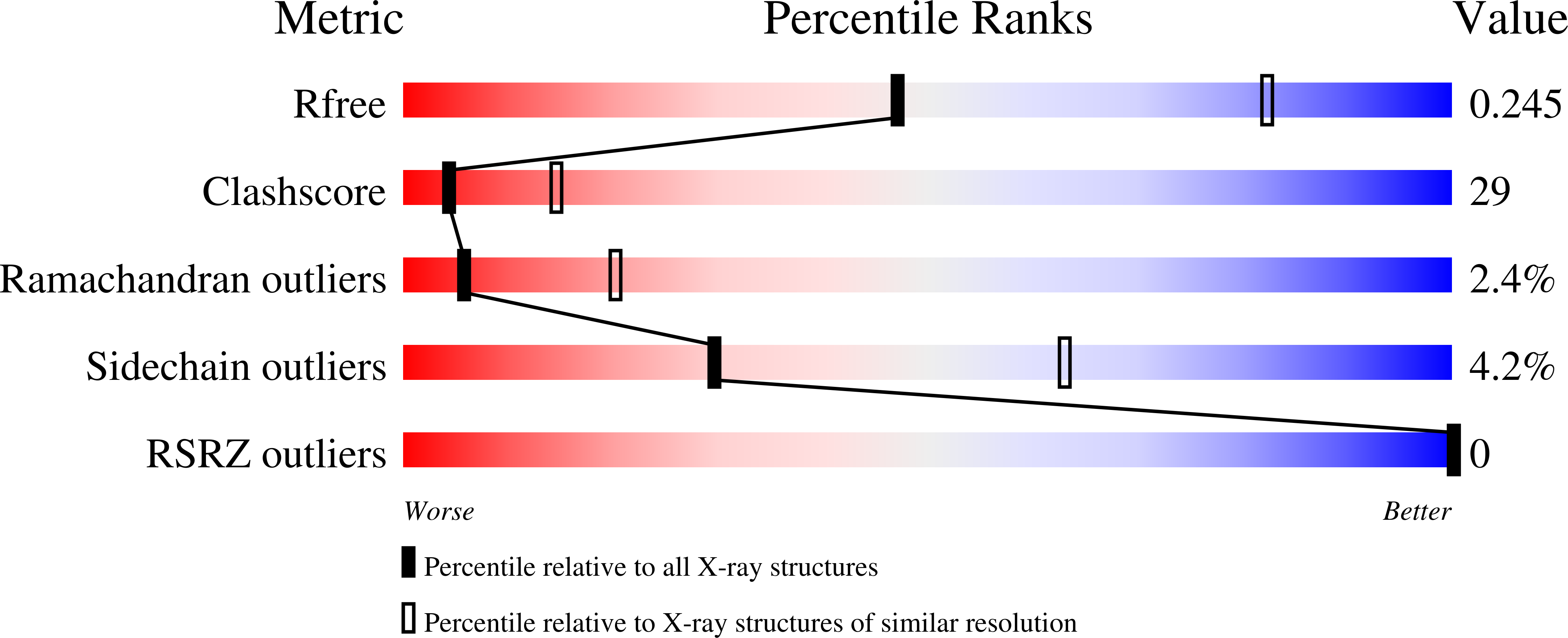
2.80 Å
R-Value Free:
0.24
R-Value Work:
0.20
R-Value Observed:
0.20
Space Group:
P 31 2 1
Macromolecular Entities
Structures with similar UniProt ID
Protein Blast
Polymer Type:polypeptide(L)
Molecule:Protein Mdm4
Gene (Uniprot):MDM4
Mutagens:Q68A, Q69A, E70A
Chain IDs:A
Chain Length:85
Number of Molecules:1
Biological Source:Homo sapiens
Structures with similar UniProt ID
Protein Blast
Polymer Type:polypeptide(D)
Molecule:D-PMI-omega
Chain IDs:B, C
Chain Length:12
Number of Molecules:2
Biological Source:synthetic construct
Ligand Molecules
Peptide-like Molecules
PRD_002455
Primary Citation
A Dual-Specificity d-Peptide Antagonist of MDM2 and MDMX for Antitumor Immunotherapy.
J. Med. Chem. ? ? ? (2025)
PMID: 40824889 DOI: 10.1021/acs.jmedchem.4c02057

Abstact

Designing metabolically stable peptides to target interactions of the tumor suppressor protein p53 with the two oncogenic proteins MDM2 and MDMX represents an attractive approach to harvesting "high-hanging fruits" often inaccessible to traditional anticancer drug discovery and development efforts. Here, we report the design of a proteolysis-resistant d-dodecapeptide, termed DPMI-ω (EFWYVEp-ClFEKLLR), capable of disrupting the p53-MDM2/MDMX complex by antagonizing MDM2 and MDMX. DPMI-ω, upon fabrication on gold nanoparticles, efficiently traversed tumor cells and killed them by reactivating the p53 signaling pathway. Further, DPMI-ω inhibited B16 melanoma growth in vivo and, when combined with an anti-PD1 antibody, powerfully augmented the efficacy of immunotherapy by expanding CD3+/CD8+ cytotoxic T cells and suppressing CD4+/CD25+ regulatory T cells. Our work validates the design of a therapeutically viable anticancer peptide, showcasing its potential in combination therapy to treat patients with tumors that are otherwise resistant or poorly responsive to antitumor immunotherapy.

Legend

Protein

Chemical

Disease

Primary Citation of related structures
Feedback Form
Name
Email
Institute
Feedback