

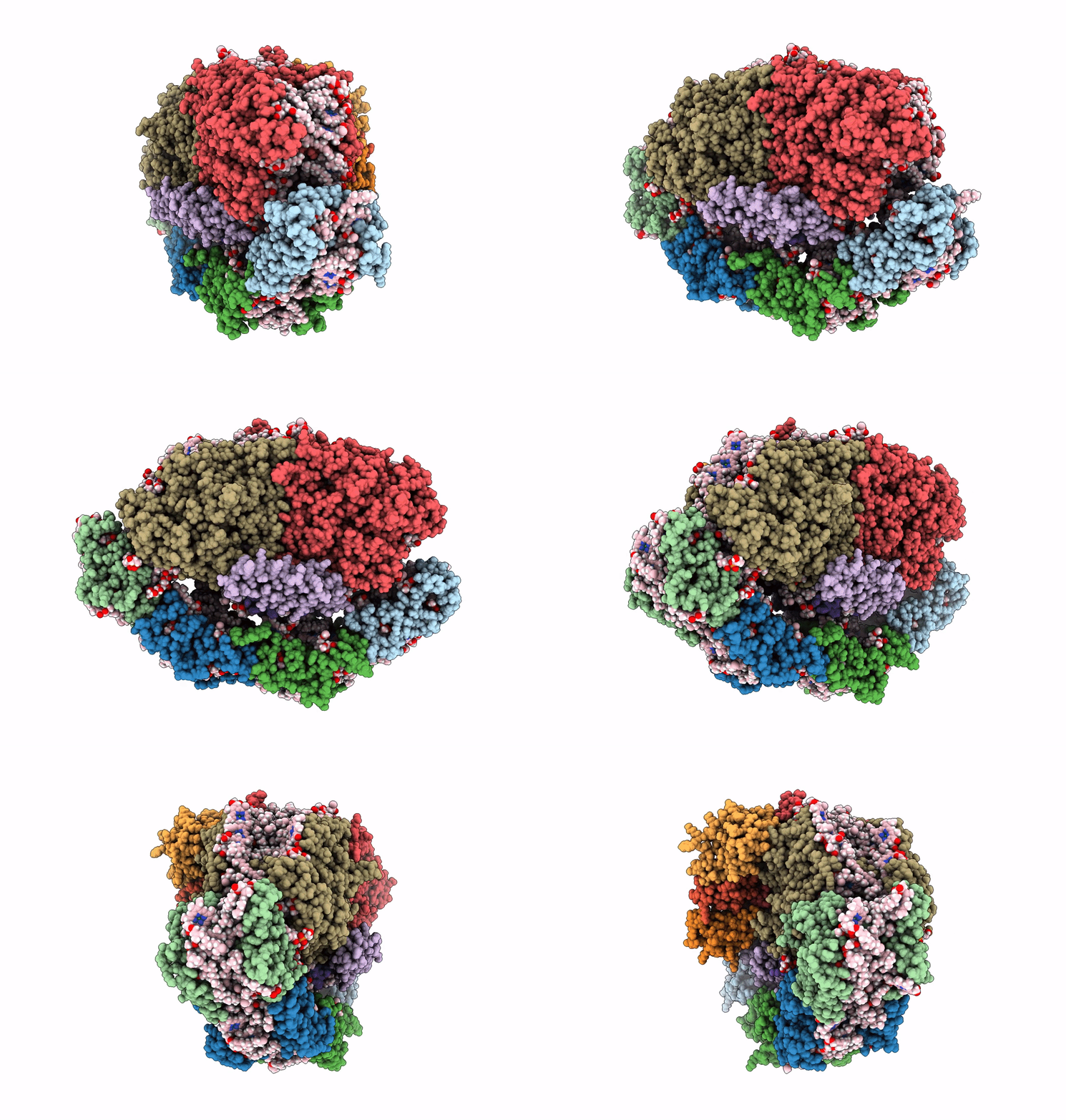
6rhz image
Deposition Date 2019-04-23
Release Date 2020-02-19
Last Version Date 2025-10-01
Entry Detail
PDB ID:
6RHZ
Keywords:
Title:
Structure of a minimal photosystem I from a green alga
Biological Source:
Source Organism(s):
Method Details:
Experimental Method:
Resolution:
3.20 Å
Aggregation State:
PARTICLE
Reconstruction Method:
SINGLE PARTICLE

Macromolecular Entities
Structures with similar UniProt ID
Protein Blast
Polymer Type:polypeptide(L)
Molecule:Chlorophyll a-b binding prote
Gene (Uniprot):Lhca2
Chain IDs:A (auth: 1)
Chain Length:197
Number of Molecules:1
Biological Source:Dunaliella salina
Structures with similar UniProt ID
Protein Blast
Polymer Type:polypeptide(L)
Molecule:Chlorophyll a-b binding prote
Chain IDs:B (auth: 2)
Chain Length:208
Number of Molecules:1
Biological Source:Dunaliella salina
Structures with similar UniProt ID
Protein Blast
Polymer Type:polypeptide(L)
Molecule:Chlorophyll a-b binding prote
Gene (Uniprot):Lhca3
Chain IDs:C (auth: 3)
Chain Length:210
Number of Molecules:1
Biological Source:Dunaliella salina
Structures with similar UniProt ID
Protein Blast
Polymer Type:polypeptide(L)
Molecule:Chlorophyll a-b binding prote
Chain IDs:D (auth: 4)
Chain Length:211
Number of Molecules:1
Biological Source:Dunaliella salina
Structures with similar UniProt ID
Protein Blast
Polymer Type:polypeptide(L)
Molecule:Photosystem I P700 chlorophyl
Gene (Uniprot):psaA
Chain IDs:E (auth: A)
Chain Length:739
Number of Molecules:1
Biological Source:Dunaliella salina
Structures with similar UniProt ID
Protein Blast
Polymer Type:polypeptide(L)
Molecule:Photosystem I P700 chlorophyl
Gene (Uniprot):psaB
Chain IDs:F (auth: B)
Chain Length:730
Number of Molecules:1
Biological Source:Dunaliella salina
Structures with similar UniProt ID
Protein Blast
Polymer Type:polypeptide(L)
Molecule:Photosystem I iron-sulfur cen
Gene (Uniprot):psaC
Chain IDs:G (auth: C)
Chain Length:80
Number of Molecules:1
Biological Source:Dunaliella salina
Structures with similar UniProt ID
Protein Blast
Polymer Type:polypeptide(L)
Molecule:Photosystem I reaction center
Chain IDs:H (auth: D)
Chain Length:141
Number of Molecules:1
Biological Source:Dunaliella salina
Structures with similar UniProt ID
Protein Blast
Polymer Type:polypeptide(L)
Molecule:Photosystem I reaction center
Chain IDs:I (auth: E)
Chain Length:64
Number of Molecules:1
Biological Source:Dunaliella salina
Structures with similar UniProt ID
Protein Blast
Polymer Type:polypeptide(L)
Molecule:Photosystem I reaction center
Chain IDs:J (auth: F)
Chain Length:163
Number of Molecules:1
Biological Source:Dunaliella salina
Structures with similar UniProt ID
Protein Blast
Polymer Type:polypeptide(L)
Molecule:Photosystem I reaction center
Gene (Uniprot):psaJ
Chain IDs:K (auth: J)
Chain Length:40
Number of Molecules:1
Biological Source:Dunaliella salina
Primary Citation
Structure of a minimal photosystem I from the green alga Dunaliella salina.
Nat.Plants 6 321 327 (2020)
PMID: 32123351 DOI: 10.1038/s41477-020-0611-9

Abstact

Solar energy harnessed by oxygenic photosynthesis supports most of the life forms on Earth. In eukaryotes, photosynthesis occurs in chloroplasts and is achieved by membrane-embedded macromolecular complexes that contain core and peripheral antennae with multiple pigments. The structure of photosystem I (PSI) comprises the core and light-harvesting (LHCI) complexes, which together form PSI-LHCI. Here we determined the structure of PSI-LHCI from the salt-tolerant green alga Dunaliella salina using X-ray crystallography and electron cryo-microscopy. Our results reveal a previously undescribed configuration of the PSI core. It is composed of only 7 subunits, compared with 14-16 subunits in plants and the alga Chlamydomonas reinhardtii, and forms the smallest known PSI. The LHCI is poorly conserved at the sequence level and binds to pigments that form new energy pathways, and the interactions between the individual Lhca1-4 proteins are weakened. Overall, the data indicate the PSI of D. salina represents a different type of the molecular organization that provides important information for reconstructing the plasticity and evolution of PSI.

Legend

Protein

Chemical

Disease

Primary Citation of related structures
Feedback Form
Name
Email
Institute
Feedback