

6SWY image
Deposition Date 2019-09-24
Release Date 2019-11-20
Last Version Date 2024-07-10
Entry Detail
PDB ID:
6SWY
Keywords:
Title:
Structure of active GID E3 ubiquitin ligase complex minus Gid2 and delta Gid9 RING domain
Biological Source:
Method Details:
Experimental Method:
Resolution:
3.20 Å
Aggregation State:
PARTICLE
Reconstruction Method:
SINGLE PARTICLE
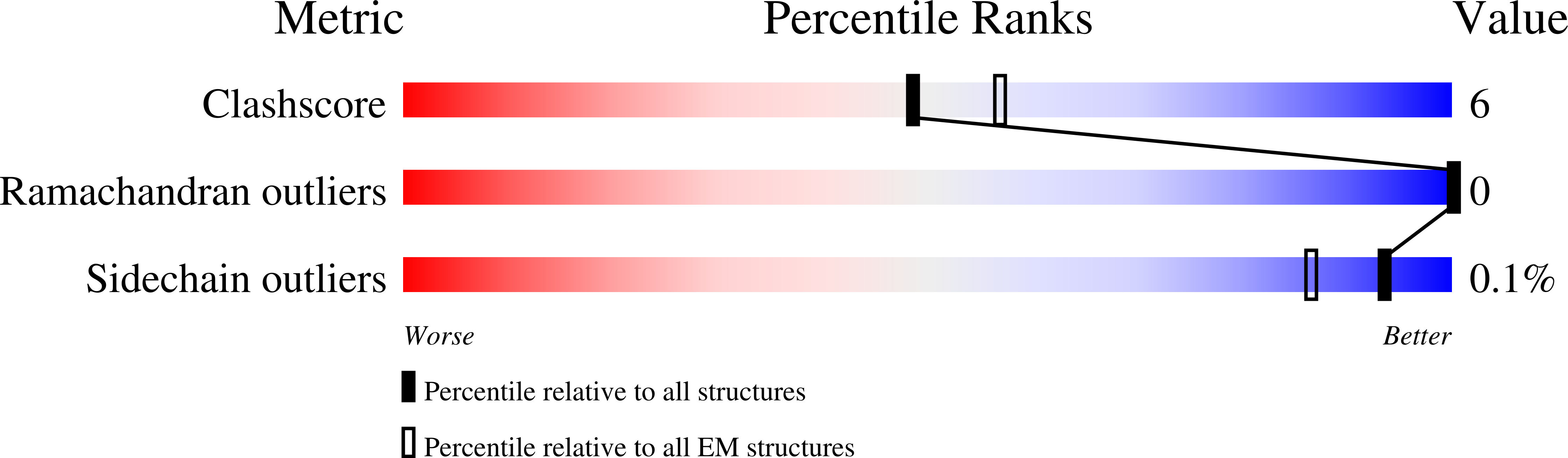
Macromolecular Entities
Structures with similar UniProt ID
Protein Blast
Polymer Type:polypeptide(L)
Molecule:Vacuolar import and degradati
Gene (Uniprot):VID30
Chain IDs:C (auth: 1)
Chain Length:1064
Number of Molecules:1
Biological Source:Saccharomyces cerevisiae S288c, Saccharomyces cerevisiae S288C
Structures with similar UniProt ID
Protein Blast
Polymer Type:polypeptide(L)
Molecule:Vacuolar import and degradati
Gene (Uniprot):VID24
Chain IDs:D (auth: 4)
Chain Length:362
Number of Molecules:1
Biological Source:Saccharomyces cerevisiae S288c
Structures with similar UniProt ID
Protein Blast
Polymer Type:polypeptide(L)
Molecule:Vacuolar import and degradati
Gene (Uniprot):VID28
Chain IDs:A (auth: 5)
Chain Length:921
Number of Molecules:1
Biological Source:Saccharomyces cerevisiae (strain ATCC 204508 / S288c)
Structures with similar UniProt ID
Protein Blast
Polymer Type:polypeptide(L)
Molecule:Glucose-induced degradation p
Gene (Uniprot):GID8
Chain IDs:B (auth: 8)
Chain Length:455
Number of Molecules:1
Biological Source:Saccharomyces cerevisiae S288c
Structures with similar UniProt ID
Protein Blast
Polymer Type:polypeptide(L)
Molecule:Protein FYV10,Protein FYV10,P
Gene (Uniprot):FYV10
Chain IDs:E (auth: 9)
Chain Length:479
Number of Molecules:1
Biological Source:Saccharomyces cerevisiae S288c, Saccharomyces cerevisiae S288C
Ligand Molecules
Primary Citation
Interconversion between Anticipatory and Active GID E3 Ubiquitin Ligase Conformations via Metabolically Driven Substrate Receptor Assembly
Mol. Cell 77 1 14 (2020)
PMID: 31708416 DOI: 10.1016/j.molcel.2019.10.009

Abstact

Cells respond to environmental changes by toggling metabolic pathways, preparing for homeostasis, and anticipating future stresses. For example, in Saccharomyces cerevisiae, carbon stress-induced gluconeogenesis is terminated upon glucose availability, a process that involves the multiprotein E3 ligase GIDSR4 recruiting N termini and catalyzing ubiquitylation of gluconeogenic enzymes. Here, genetics, biochemistry, and cryoelectron microscopy define molecular underpinnings of glucose-induced degradation. Unexpectedly, carbon stress induces an inactive anticipatory complex (GIDAnt), which awaits a glucose-induced substrate receptor to form the active GIDSR4. Meanwhile, other environmental perturbations elicit production of an alternative substrate receptor assembling into a related E3 ligase complex. The intricate structure of GIDAnt enables anticipating and ultimately binding various N-degron-targeting (i.e., "N-end rule") substrate receptors, while the GIDSR4 E3 forms a clamp-like structure juxtaposing substrate lysines with the ubiquitylation active site. The data reveal evolutionarily conserved GID complexes as a family of multisubunit E3 ubiquitin ligases responsive to extracellular stimuli.

Legend

Protein

Chemical

Disease

Primary Citation of related structures
Feedback Form
Name
Email
Institute
Feedback