

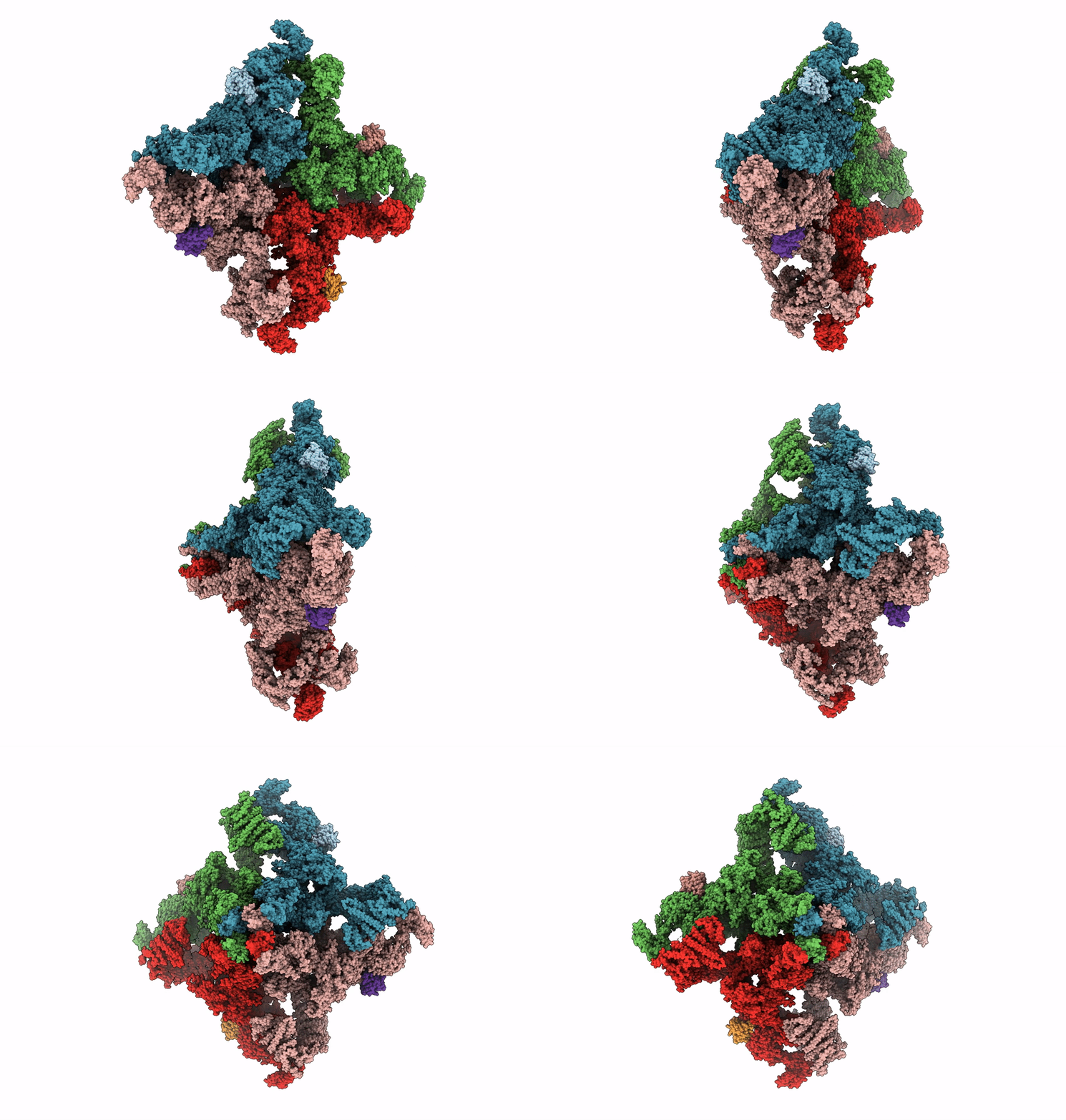
6PV6 image
Deposition Date 2019-07-19
Release Date 2020-08-12
Last Version Date 2024-03-20
Entry Detail
PDB ID:
6PV6
Title:
Functional Pathways of Biomolecules Retrieved from Single-particle Snapshots
Biological Source:
Source Organism(s):
Expression System(s):
Method Details:
Experimental Method:
Resolution:
4.50 Å
Aggregation State:
3D ARRAY
Reconstruction Method:
SINGLE PARTICLE
Macromolecular Entities
Polymer Type:polypeptide(L)
Molecule:Ryanodine receptor 1
Chain IDs:A (auth: B), B (auth: E), C (auth: I), D (auth: G)
Chain Length:4687
Number of Molecules:4
Biological Source:Oryctolagus cuniculus
Structures with similar UniProt ID
Protein Blast
Polymer Type:polypeptide(L)
Molecule:Peptidyl-prolyl cis-trans iso
Gene (Uniprot):FKBP1B
Chain IDs:E (auth: F), F (auth: A), G (auth: H), H (auth: J)
Chain Length:108
Number of Molecules:4
Biological Source:Homo sapiens
Primary Citation
Retrieving functional pathways of biomolecules from single-particle snapshots.
Nat Commun 11 4734 4734 (2020)
PMID: 32948759 DOI: 10.1038/s41467-020-18403-x

Abstact

A primary reason for the intense interest in structural biology is the fact that knowledge of structure can elucidate macromolecular functions in living organisms. Sustained effort has resulted in an impressive arsenal of tools for determining the static structures. But under physiological conditions, macromolecules undergo continuous conformational changes, a subset of which are functionally important. Techniques for capturing the continuous conformational changes underlying function are essential for further progress. Here, we present chemically-detailed conformational movies of biological function, extracted data-analytically from experimental single-particle cryo-electron microscopy (cryo-EM) snapshots of ryanodine receptor type 1 (RyR1), a calcium-activated calcium channel engaged in the binding of ligands. The functional motions differ substantially from those inferred from static structures in the nature of conformationally active structural domains, the sequence and extent of conformational motions, and the way allosteric signals are transduced within and between domains. Our approach highlights the importance of combining experiment, advanced data analysis, and molecular simulations.

Legend

Protein

Chemical

Disease

Primary Citation of related structures
Feedback Form
Name
Email
Institute
Feedback