

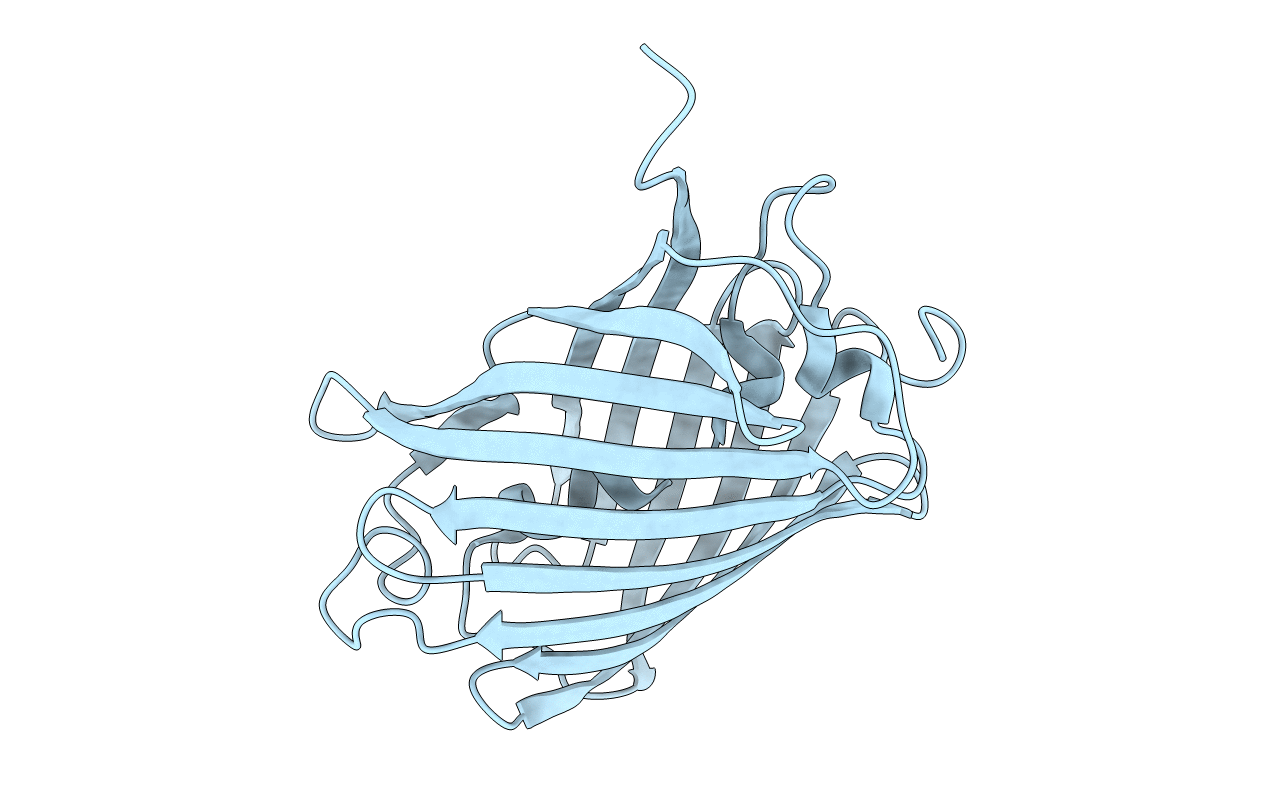
6MZ3 image
Deposition Date 2018-11-03
Release Date 2019-10-09
Last Version Date 2026-03-18
Entry Detail
PDB ID:
6MZ3
Title:
mCherry pH sensitive mutant - M66T (mCherryTYG)
Biological Source:
Source Organism(s):
Discosoma sp. (Taxon ID: 86600)
Expression System(s):
Method Details:
Experimental Method:
Resolution:
1.09 Å
R-Value Free:
0.17
R-Value Work:
0.16
R-Value Observed:
0.16
Space Group:
P 1 21 1

Macromolecular Entities
Structures with similar UniProt ID
Protein Blast
Polymer Type:polypeptide(L)
Molecule:PAmCherry1 protein
Gene (Uniprot):PAmCherry, PAmCherry1
Mutagens:M66T
Chain IDs:A
Chain Length:270
Number of Molecules:1
Biological Source:Discosoma sp.
Modified Residue
Compound ID Chain ID Parent Comp ID Details 2D Image
CRO A GLY chromophore
Primary Citation
Quantifying Acute Fuel and Respiration Dependent pH Homeostasis in Live Cells Using the mCherryTYG Mutant as a Fluorescence Lifetime Sensor.
Anal.Chem. 91 8466 8475 (2019)
PMID: 31247720 DOI: 10.1021/acs.analchem.9b01562

Abstact

Intracellular pH plays a key role in physiology, and its measurement in living specimens remains a crucial task in biology. Fluorescent protein-based pH sensors have gained widespread use, but there is limited spectral diversity for multicolor detection, and it remains a challenge to measure absolute pH values. Here we demonstrate that mCherryTYG is an excellent fluorescence lifetime pH sensor that significantly expands the modalities available for pH quantification in live cells. We first report the 1.09 Å X-ray crystal structure of mCherryTYG, exhibiting a fully matured chromophore. We next determine that it has an extraordinarily large dynamic range with a 2 ns lifetime change from pH 5.5 to 9.0. Critically, we find that the sensor maintains a p Ka of 6.8 independent of environment, whether as the purified protein in solution or expressed in live cells. Furthermore, the lifetime measurements are robustly independent of total fluorescence intensity and scatter. We demonstrate that mCherryTYG is a highly effective sensor using time-resolved fluorescence spectroscopy on live-cell suspensions, which has been previously overlooked as an easily accessible approach for quantifying intracellular pH. As a red fluorescent sensor, we also demonstrate that mCherryTYG is spectrally compatible with the ATeam sensor and EGFP for simultaneous dual-color measurements of intracellular pH, ATP, and extracellular pH. In a proof-of-concept, we quantify acute respiration-dependent pH homeostasis that exhibits a stoichiometric relationship with the ATP-generating capacity of the carbon fuel choice in E. coli. Broadly speaking, our work presents a previously unemployed methodology that will greatly facilitate continuous pH quantification.

Legend

Protein

Chemical

Disease

Primary Citation of related structures
Feedback Form
Name
Email
Institute
Feedback