

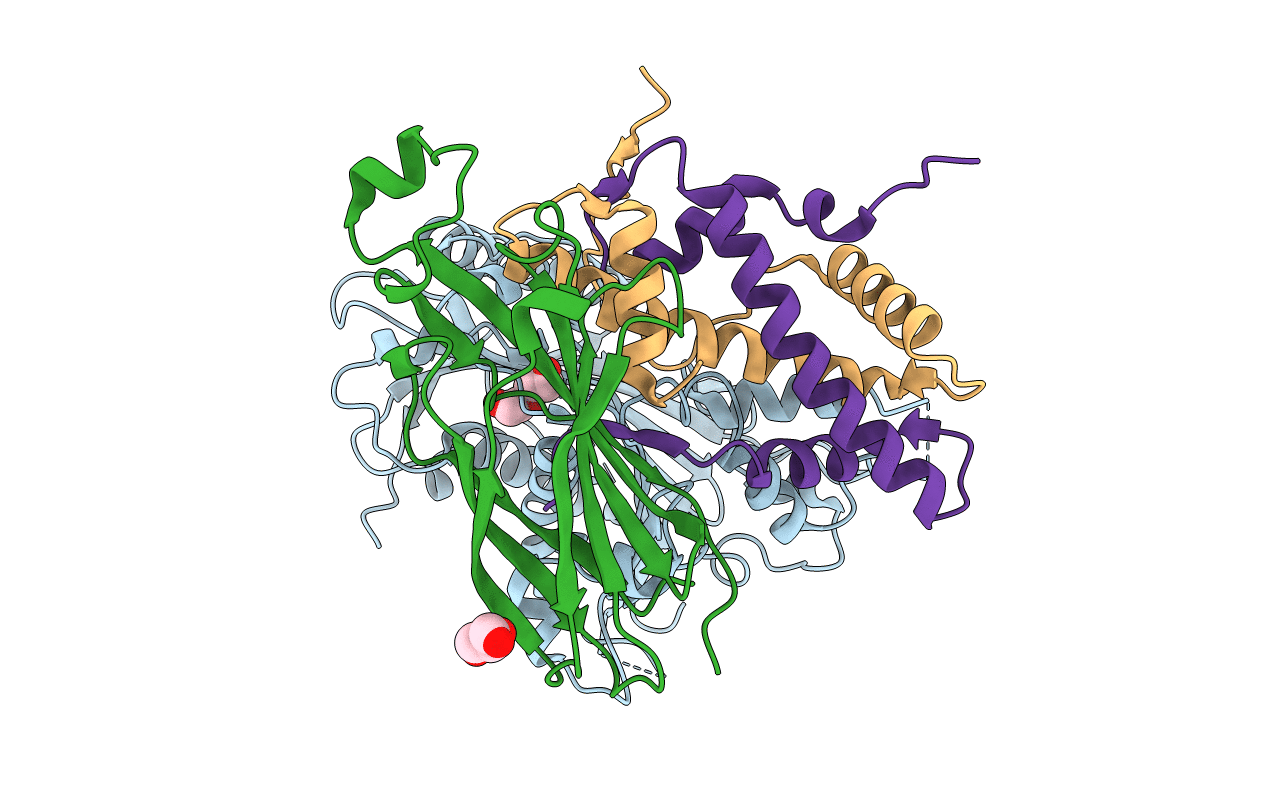
5ZBB image
Deposition Date 2018-02-10
Release Date 2018-07-25
Last Version Date 2024-10-16
Entry Detail
PDB ID:
5ZBB
Title:
Crystal structure of Rtt109-Asf1-H3-H4 complex
Biological Source:
Method Details:
Experimental Method:
Resolution:
3.60 Å
R-Value Free:
0.26
R-Value Work:
0.21
R-Value Observed:
0.21
Space Group:
P 65 2 2

Macromolecular Entities
Structures with similar UniProt ID
Protein Blast
Polymer Type:polypeptide(L)
Molecule:DNA damage response protein R
Gene (Uniprot):AFUA_5G09540
Chain IDs:A
Chain Length:544
Number of Molecules:1
Biological Source:Neosartorya fumigata (strain ATCC MYA-4609 / Af293 / CBS 101355 / FGSC A1100)
Structures with similar UniProt ID
Protein Blast
Polymer Type:polypeptide(L)
Molecule:Histone chaperone asf1
Gene (Uniprot):asf1
Chain IDs:B
Chain Length:188
Number of Molecules:1
Biological Source:Neosartorya fumigata (strain ATCC MYA-4609 / Af293 / CBS 101355 / FGSC A1100)
Structures with similar UniProt ID
Protein Blast
Polymer Type:polypeptide(L)
Molecule:Histone H3
Gene (Uniprot):HHT1, HHT2
Chain IDs:C
Chain Length:136
Number of Molecules:1
Biological Source:Saccharomyces cerevisiae (strain ATCC 204508 / S288c)
Structures with similar UniProt ID
Protein Blast
Polymer Type:polypeptide(L)
Molecule:Histone H4
Gene (Uniprot):HHF1, HHF2
Chain IDs:D
Chain Length:103
Number of Molecules:1
Biological Source:Saccharomyces cerevisiae (strain ATCC 204508 / S288c)
Modified Residue
Compound ID Chain ID Parent Comp ID Details 2D Image
ALY A LYS modified residue
Primary Citation
Multisite Substrate Recognition in Asf1-Dependent Acetylation of Histone H3 K56 by Rtt109.
Cell 174 818 830.e11 (2018)
PMID: 30057113 DOI: 10.1016/j.cell.2018.07.005

Abstact

Rtt109 is a unique histone acetyltransferase acetylating histone H3 lysine 56 (H3K56), a modification critical for DNA replication-coupled nucleosome assembly and genome stability. In cells, histone chaperone Asf1 is essential for H3K56 acetylation, yet the mechanisms for H3K56 specificity and Asf1 requirement remain unknown. We have determined the crystal structure of the Rtt109-Asf1-H3-H4 complex and found that unwinding of histone H3 αN, where K56 is normally located, and stabilization of the very C-terminal β strand of histone H4 by Asf1 are prerequisites for H3K56 acetylation. Unexpectedly, an interaction between Rtt109 and the central helix of histone H3 is also required. The observed multiprotein, multisite substrate recognition mechanism among histone modification enzymes provides mechanistic understandings of Rtt109 and Asf1 in H3K56 acetylation, as well as valuable insights into substrate recognition by histone modification enzymes in general.

Legend

Protein

Chemical

Disease

Primary Citation of related structures
Feedback Form
Name
Email
Institute
Feedback