

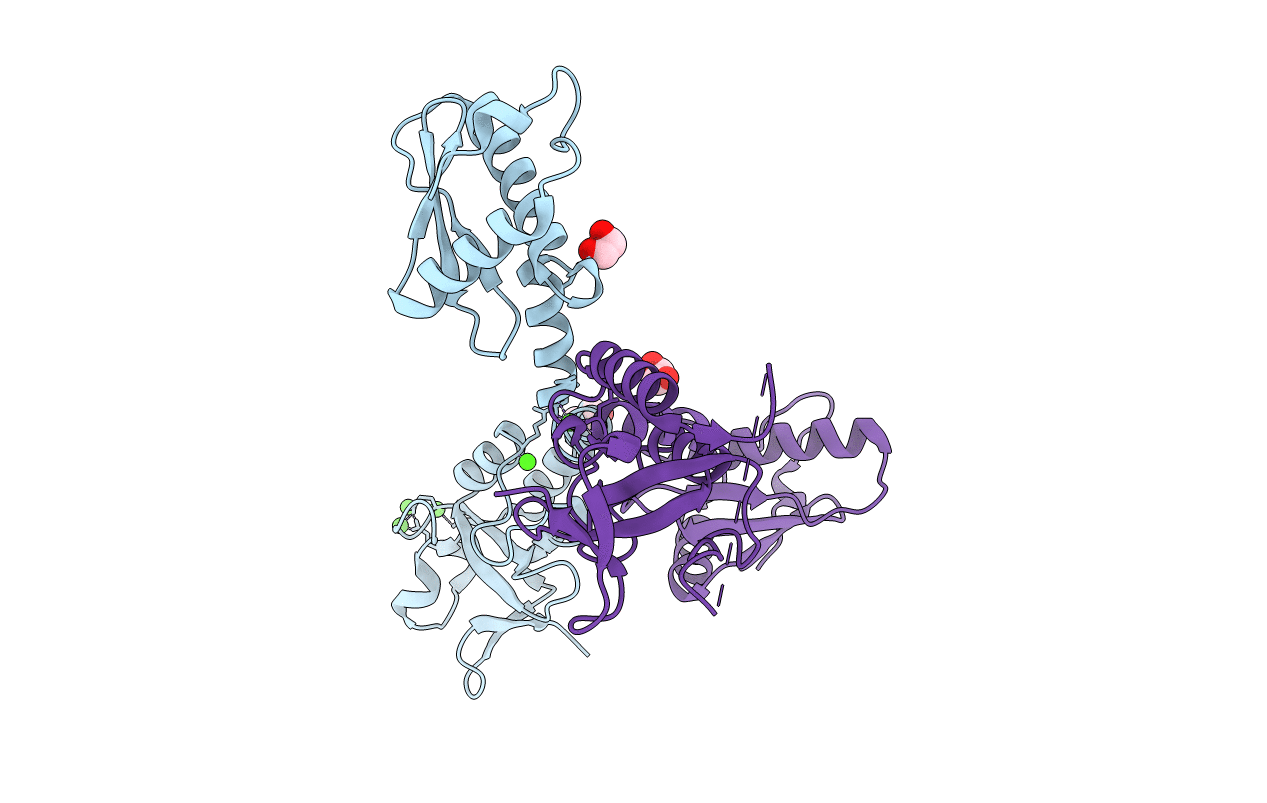
5VGC image
Deposition Date 2017-04-10
Release Date 2018-04-18
Last Version Date 2026-02-25
Entry Detail
PDB ID:
5VGC
Keywords:
Title:
Crystal structure of the NleG5-1 effector (C200A) from Escherichia coli O157:H7 str. Sakai
Biological Source:
Source Organism(s):
Expression System(s):
Method Details:
Experimental Method:
Resolution:
2.60 Å
R-Value Free:
0.29
R-Value Work:
0.24
R-Value Observed:
0.25
Space Group:
P 65 2 2
Macromolecular Entities
Structures with similar UniProt ID
Protein Blast
Polymer Type:polypeptide(L)
Molecule:NleG5-1 effector
Chain IDs:A, B
Chain Length:214
Number of Molecules:2
Biological Source:Enterobacteria phage YYZ-2008
Primary Citation
Functional diversification of the NleG effector family in enterohemorrhagic Escherichia coli.
Proc. Natl. Acad. Sci. U.S.A. 115 10004 10009 (2018)
PMID: 30217892 DOI: 10.1073/pnas.1718350115

Abstact

The pathogenic strategy of Escherichia coli and many other gram-negative pathogens relies on the translocation of a specific set of proteins, called effectors, into the eukaryotic host cell during infection. These effectors act in concert to modulate host cell processes in favor of the invading pathogen. Injected by the type III secretion system (T3SS), the effector arsenal of enterohemorrhagic E. coli (EHEC) O157:H7 features at least eight individual NleG effectors, which are also found across diverse attaching and effacing pathogens. NleG effectors share a conserved C-terminal U-box E3 ubiquitin ligase domain that engages with host ubiquitination machinery. However, their specific functions and ubiquitination targets have remained uncharacterized. Here, we identify host proteins targeted for ubiquitination-mediated degradation by two EHEC NleG family members, NleG5-1 and NleG2-3. NleG5-1 localizes to the host cell nucleus and targets the MED15 subunit of the Mediator complex, while NleG2-3 resides in the host cytosol and triggers degradation of Hexokinase-2 and SNAP29. Our structural studies of NleG5-1 reveal a distinct N-terminal alpha/beta domain that is responsible for interacting with host protein targets. The core of this domain is conserved across the NleG family, suggesting this domain is present in functionally distinct NleG effectors, which evolved diversified surface residues to interact with specific host proteins. This is a demonstration of the functional diversification and the range of host proteins targeted by the most expanded effector family in the pathogenic arsenal of E. coli.

Legend

Protein

Chemical

Disease

Primary Citation of related structures
Feedback Form
Name
Email
Institute
Feedback