

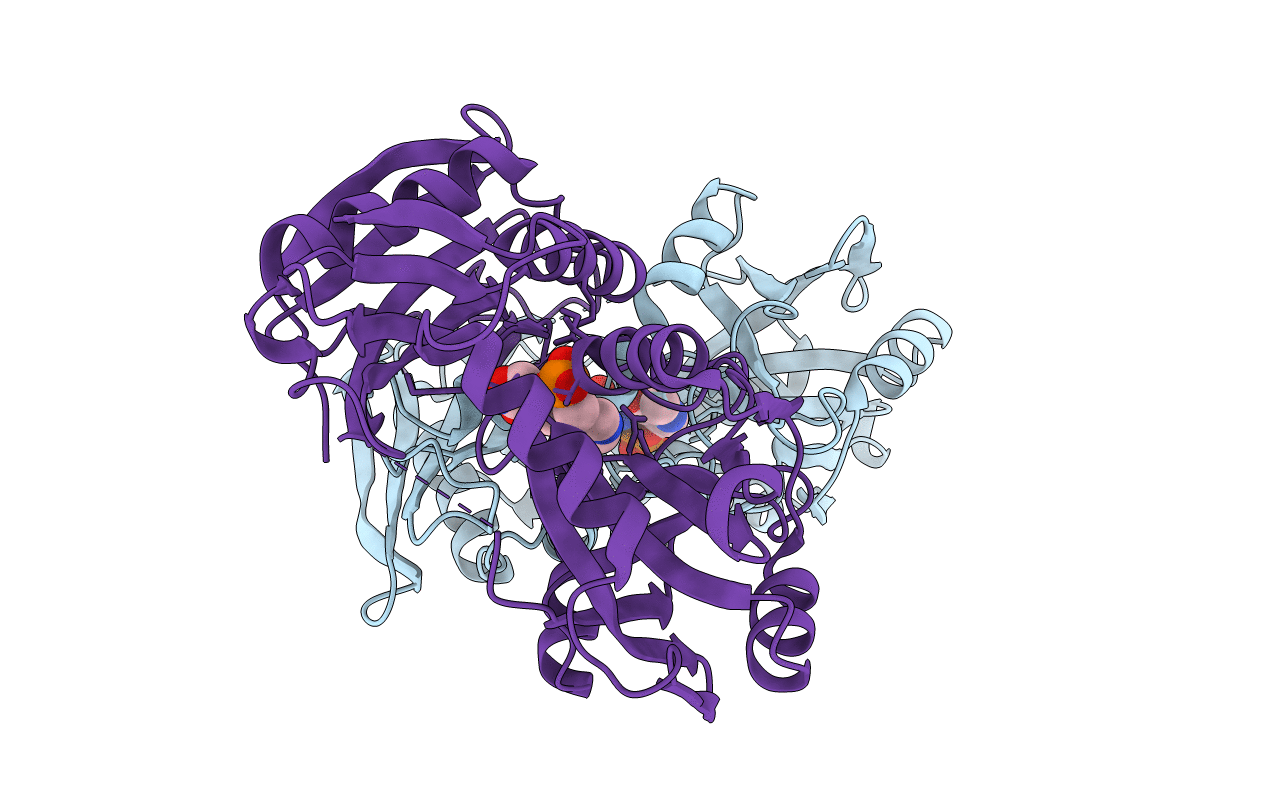
5U3F image
Deposition Date 2016-12-02
Release Date 2017-03-22
Last Version Date 2024-10-30
Entry Detail
PDB ID:
5U3F
Keywords:
Title:
Structure of Mycobacterium tuberculosis IlvE, a branched-chain amino acid transaminase, in complex with D-cycloserine derivative
Biological Source:
Expression System(s):
Method Details:
Experimental Method:
Resolution:
1.70 Å
R-Value Free:
0.20
R-Value Work:
0.17
R-Value Observed:
0.17
Space Group:
P 21 21 21

Macromolecular Entities
Structures with similar UniProt ID
Protein Blast
Polymer Type:polypeptide(L)
Molecule:Branched-chain-amino-acid ami
Gene (Uniprot):ilvE
Chain IDs:A, B
Chain Length:368
Number of Molecules:2
Biological Source:Mycobacterium tuberculosis (strain ATCC 25618 / H37Rv)
Ligand Molecules
Primary Citation
Mechanism-Based Inhibition of the Mycobacterium tuberculosis Branched-Chain Aminotransferase by d- and l-Cycloserine.
ACS Chem. Biol. 12 1235 1244 (2017)
PMID: 28272868 DOI: 10.1021/acschembio.7b00142

Abstact

The branched-chain aminotransferase is a pyridoxal 5'-phosphate (PLP)-dependent enzyme responsible for the final step in the biosynthesis of all three branched-chain amino acids, l-leucine, l-isoleucine, and l-valine, in bacteria. We have investigated the mechanism of inactivation of the branched-chain aminotransferase from Mycobacterium tuberculosis (MtIlvE) by d- and l-cycloserine. d-Cycloserine is currently used only in the treatment of multidrug-drug-resistant tuberculosis. Our results show a time- and concentration-dependent inactivation of MtIlvE by both isomers, with l-cycloserine being a 40-fold better inhibitor of the enzyme. Minimum inhibitory concentration (MIC) studies revealed that l-cycloserine is a 10-fold better inhibitor of Mycobacterium tuberculosis growth than d-cycloserine. In addition, we have crystallized the MtIlvE-d-cycloserine inhibited enzyme, determining the structure to 1.7 Å. The structure of the covalent d-cycloserine-PMP adduct bound to MtIlvE reveals that the d-cycloserine ring is planar and aromatic, as previously observed for other enzyme systems. Mass spectrometry reveals that both the d-cycloserine- and l-cycloserine-PMP complexes have the same mass, and are likely to be the same aromatized, isoxazole product. However, the kinetics of formation of the MtIlvE d-cycloserine-PMP and MtIlvE l-cycloserine-PMP adducts are quite different. While the kinetics of the formation of the MtIlvE d-cycloserine-PMP complex can be fit to a single exponential, the formation of the MtIlvE l-cycloserine-PMP complex occurs in two steps. We propose a chemical mechanism for the inactivation of d- and l-cycloserine which suggests a stereochemically determined structural role for the differing kinetics of inactivation. These results demonstrate that the mechanism of action of d-cycloserine's activity against M. tuberculosis may be more complicated than previously thought and that d-cycloserine may compromise the in vivo activity of multiple PLP-dependent enzymes, including MtIlvE.

Legend

Protein

Chemical

Disease

Primary Citation of related structures
Feedback Form
Name
Email
Institute
Feedback