

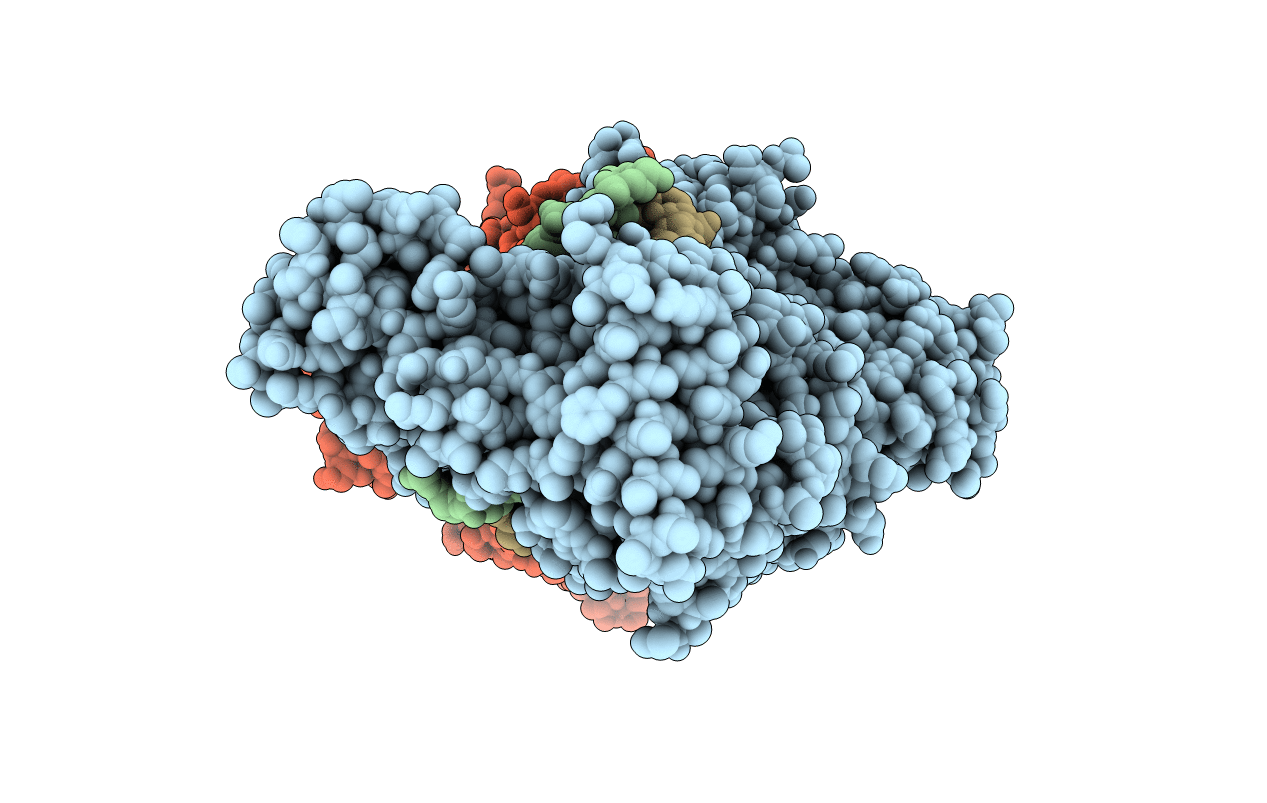
5HR4 image
Deposition Date 2016-01-22
Release Date 2016-04-27
Last Version Date 2024-03-06
Entry Detail
PDB ID:
5HR4
Keywords:
Title:
Structure of Type IIL restriction-modification enzyme MmeI in complex with DNA has implications for engineering of new specificities
Biological Source:
Source Organism(s):
Expression System(s):
Method Details:
Experimental Method:
Resolution:
2.60 Å
R-Value Free:
0.24
R-Value Work:
0.21
R-Value Observed:
0.21
Space Group:
P 1

Macromolecular Entities
Structures with similar UniProt ID
Protein Blast
Polymer Type:polypeptide(L)
Molecule:MmeI
Gene (Uniprot):mmeIRM
Chain IDs:A (auth: C), D (auth: J)
Chain Length:919
Number of Molecules:2
Biological Source:Methylophilus methylotrophus
Polymer Type:polydeoxyribonucleotide
Molecule:DNA (5'-D(P*TP*AP*TP*CP*CP*GP
Chain IDs:B (auth: H), E (auth: K)
Chain Length:13
Number of Molecules:2
Biological Source:Methylophilus methylotrophus
Polymer Type:polydeoxyribonucleotide
Molecule:DNA (5'-D(P*GP*TP*TP*AP*TP*GP
Chain IDs:C (auth: I), F (auth: L)
Chain Length:13
Number of Molecules:2
Biological Source:Methylophilus methylotrophus
Primary Citation
Structure of Type IIL Restriction-Modification Enzyme MmeI in Complex with DNA Has Implications for Engineering New Specificities.
PLoS Biol. 14 e1002442 e1002442 (2016)
PMID: 27082731 DOI: 10.1371/journal.pbio.1002442

Abstact

The creation of restriction enzymes with programmable DNA-binding and -cleavage specificities has long been a goal of modern biology. The recently discovered Type IIL MmeI family of restriction-and-modification (RM) enzymes that possess a shared target recognition domain provides a framework for engineering such new specificities. However, a lack of structural information on Type IIL enzymes has limited the repertoire that can be rationally engineered. We report here a crystal structure of MmeI in complex with its DNA substrate and an S-adenosylmethionine analog (Sinefungin). The structure uncovers for the first time the interactions that underlie MmeI-DNA recognition and methylation (5'-TCCRAC-3'; R = purine) and provides a molecular basis for changing specificity at four of the six base pairs of the recognition sequence (5'-TCCRAC-3'). Surprisingly, the enzyme is resilient to specificity changes at the first position of the recognition sequence (5'-TCCRAC-3'). Collectively, the structure provides a basis for engineering further derivatives of MmeI and delineates which base pairs of the recognition sequence are more amenable to alterations than others.

Legend

Protein

Chemical

Disease

Primary Citation of related structures
Feedback Form
Name
Email
Institute
Feedback