

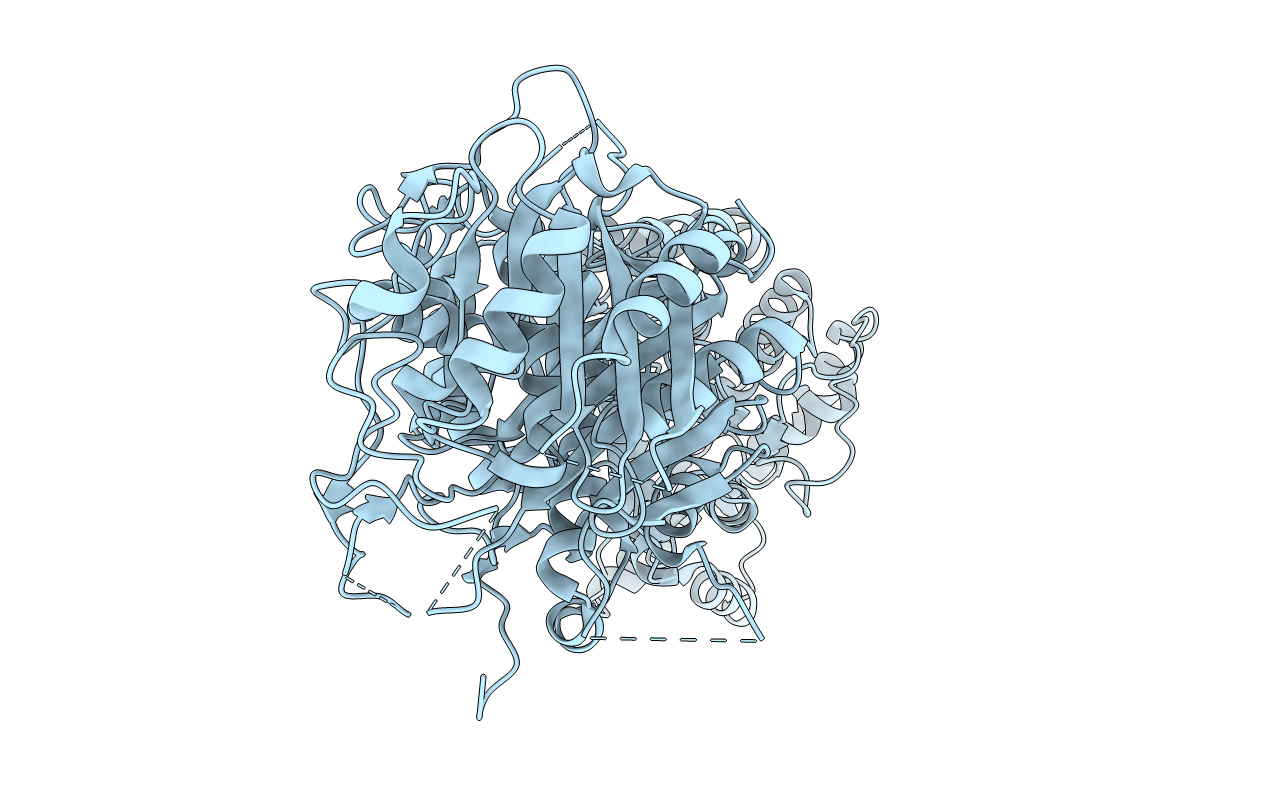
5BP1 image
Deposition Date 2015-05-27
Release Date 2016-03-09
Last Version Date 2024-01-10
Entry Detail
PDB ID:
5BP1
Keywords:
Title:
Condensing di-domain (KS-AT) of a mycocerosic acid synthase-like (MAS-like) PKS
Biological Source:
Expression System(s):
Method Details:
Experimental Method:
Resolution:
2.20 Å
R-Value Free:
0.22
R-Value Work:
0.20
R-Value Observed:
0.20
Space Group:
P 41 21 2

Macromolecular Entities
Structures with similar UniProt ID
Protein Blast
Polymer Type:polypeptide(L)
Molecule:Mycocerosic acid synthase
Gene (Uniprot):pks5
Chain IDs:A
Chain Length:893
Number of Molecules:1
Biological Source:Mycobacterium smegmatis (strain ATCC 700084 / mc(2)155)
Primary Citation
Mycocerosic acid synthase exemplifies the architecture of reducing polyketide synthases.
Nature 531 533 537 (2016)
PMID: 26976449 DOI: 10.1038/nature16993

Abstact

Polyketide synthases (PKSs) are biosynthetic factories that produce natural products with important biological and pharmacological activities. Their exceptional product diversity is encoded in a modular architecture. Modular PKSs (modPKSs) catalyse reactions colinear to the order of modules in an assembly line, whereas iterative PKSs (iPKSs) use a single module iteratively as exemplified by fungal iPKSs (fiPKSs). However, in some cases non-colinear iterative action is also observed for modPKSs modules and is controlled by the assembly line environment. PKSs feature a structural and functional separation into a condensing and a modifying region as observed for fatty acid synthases. Despite the outstanding relevance of PKSs, the detailed organization of PKSs with complete fully reducing modifying regions remains elusive. Here we report a hybrid crystal structure of Mycobacterium smegmatis mycocerosic acid synthase based on structures of its condensing and modifying regions. Mycocerosic acid synthase is a fully reducing iPKS, closely related to modPKSs, and the prototype of mycobacterial mycocerosic acid synthase-like PKSs. It is involved in the biosynthesis of C20-C28 branched-chain fatty acids, which are important virulence factors of mycobacteria. Our structural data reveal a dimeric linker-based organization of the modifying region and visualize dynamics and conformational coupling in PKSs. On the basis of comparative small-angle X-ray scattering, the observed modifying region architecture may be common also in modPKSs. The linker-based organization provides a rationale for the characteristic variability of PKS modules as a main contributor to product diversity. The comprehensive architectural model enables functional dissection and re-engineering of PKSs.

Legend

Protein

Chemical

Disease

Primary Citation of related structures
Feedback Form
Name
Email
Institute
Feedback