

4K8W image
Deposition Date 2013-04-19
Release Date 2013-06-26
Last Version Date 2024-02-28
Entry Detail
PDB ID:
4K8W
Keywords:
Title:
An arm-swapped dimer of the S. pyogenes pilin specific assembly factor SipA
Biological Source:
Source Organism(s):
Expression System(s):
Method Details:
Experimental Method:
Resolution:
1.67 Å
R-Value Free:
0.21
R-Value Work:
0.18
R-Value Observed:
0.18
Space Group:
P 41 21 2
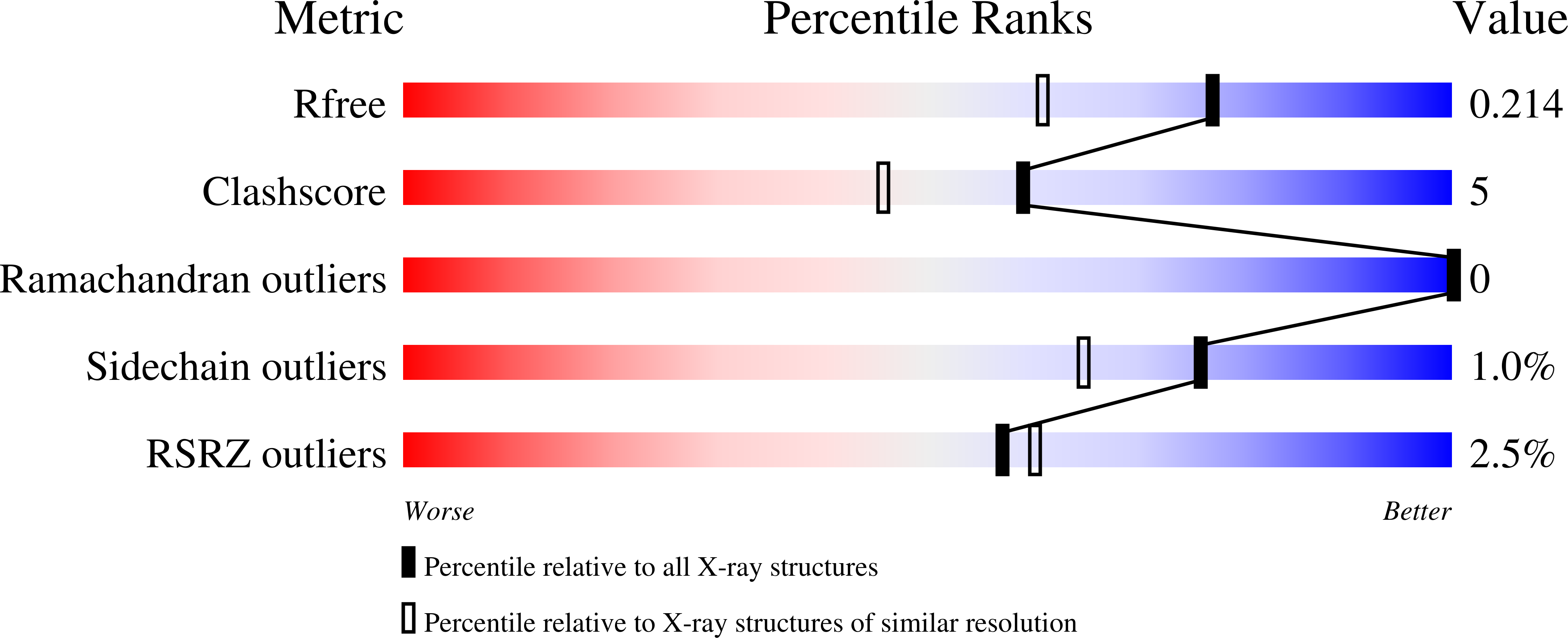
Macromolecular Entities
Structures with similar UniProt ID
Protein Blast
Polymer Type:polypeptide(L)
Molecule:LepA
Gene (Uniprot):lepA
Chain IDs:A
Chain Length:129
Number of Molecules:1
Biological Source:Streptococcus pyogenes
Primary Citation
An arm-swapped dimer of the Streptococcus pyogenes pilin specific assembly factor SipA.
J. Struct. Biol. 183 99 104 (2013)
PMID: 23747392 DOI: 10.1016/j.jsb.2013.05.021

Abstact

Streptococcus pyogenes (group A streptococcus [GAS]) is a major human pathogen. Attachment of GAS to host cells depends in large part on pili. These assemblies are built from multiple covalently linked subunits of a backbone protein (FctA), which forms the shaft of the pilus, and two minor pilin proteins, FctB anchoring the pilus to the cell wall and Cpa functioning as the adhesin at the tip. Polymerisation of the pilin subunits is mediated by a specific sortase, which catalyzes the formation of peptide bonds linking successive subunits. An additional gene, SipA, is also essential for GAS pilus polymerisation, but its function remains undefined. Here we report the crystal structure of a truncated SipA protein from GAS, determined at 1.67Å resolution. The structure reveals that SipA has the same core fold as the Escherichia coli type-I signal peptidase (SPase-I), but has a much smaller non-catalytic domain. The truncated protein, which lacks 9 N-terminal residues, forms an arm-swapped dimer in which the C-terminal β-strand of each monomer crosses over to interact with an N-terminal strand from the other monomer. In addition, there is no peptide binding cleft and significant differences in the putative membrane association region.

Legend

Protein

Chemical

Disease

Primary Citation of related structures
Feedback Form
Name
Email
Institute
Feedback