

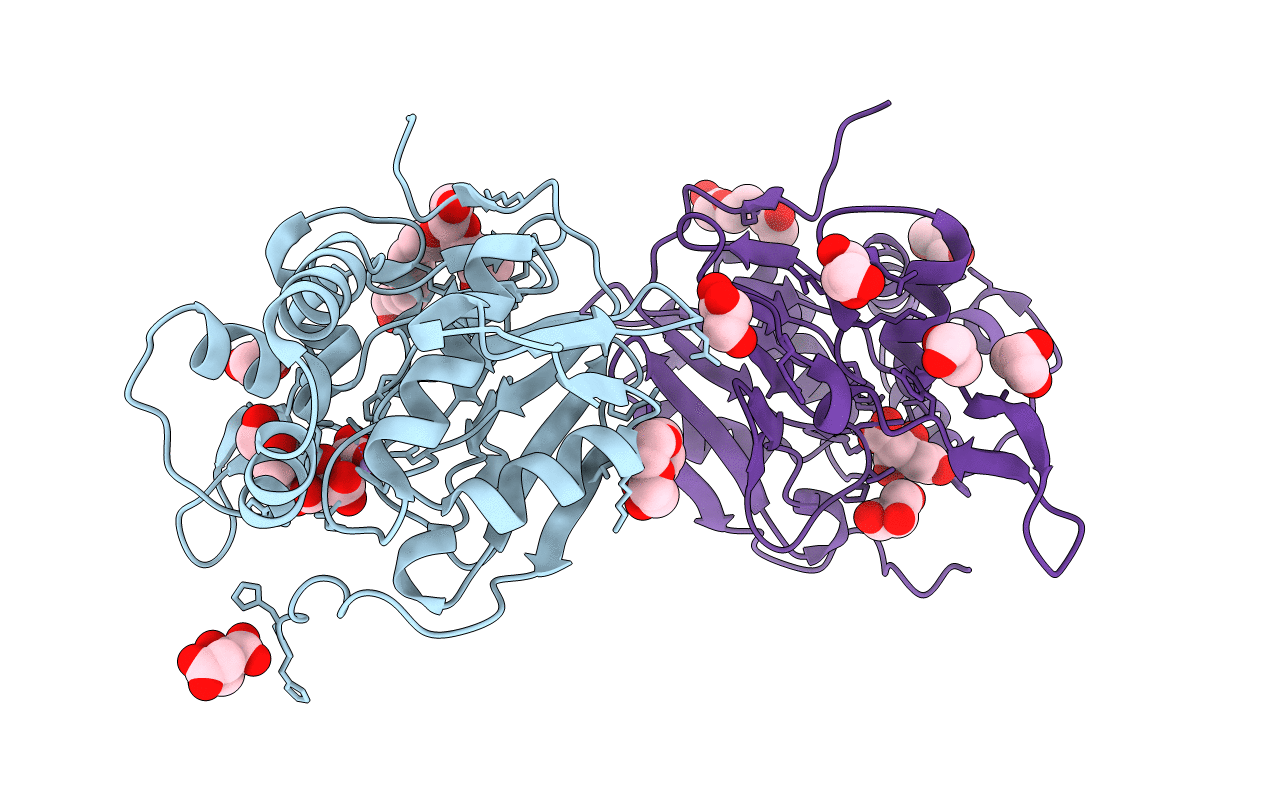
4J6O image
Deposition Date 2013-02-11
Release Date 2013-04-10
Last Version Date 2024-02-28
Entry Detail
PDB ID:
4J6O
Keywords:
Title:
Crystal Structure of the Phosphatase Domain of C. thermocellum (Bacterial) PnkP
Biological Source:
Source Organism(s):
Expression System(s):
Method Details:
Experimental Method:
Resolution:
1.60 Å
R-Value Free:
0.20
R-Value Work:
0.16
R-Value Observed:
0.16
Space Group:
P 1 21 1

Macromolecular Entities
Structures with similar UniProt ID
Protein Blast
Polymer Type:polypeptide(L)
Molecule:Metallophosphoesterase
Gene (Uniprot):Cthe_2768
Chain IDs:A, B
Chain Length:264
Number of Molecules:2
Biological Source:Clostridium thermocellum
Primary Citation
Structure and mechanism of the 2',3' phosphatase component of the bacterial Pnkp-Hen1 RNA repair system.
Nucleic Acids Res. 41 5864 5873 (2013)
PMID: 23595150 DOI: 10.1093/nar/gkt221

Abstact

Pnkp is the end-healing and end-sealing component of an RNA repair system present in diverse bacteria from many phyla. Pnkp is composed of three catalytic modules: an N-terminal polynucleotide 5' kinase, a central 2',3' phosphatase and a C-terminal ligase. The phosphatase module is a Mn(2+)-dependent phosphodiesterase-monoesterase that dephosphorylates 2',3'-cyclic phosphate RNA ends. Here we report the crystal structure of the phosphatase domain of Clostridium thermocellum Pnkp with Mn(2+) and citrate in the active site. The protein consists of a core binuclear metallo-phosphoesterase fold (exemplified by bacteriophage λ phosphatase) embellished by distinctive secondary structure elements. The active site contains a single Mn(2+) in an octahedral coordination complex with Asp187, His189, Asp233, two citrate oxygens and a water. The citrate fills the binding site for the scissile phosphate, wherein it is coordinated by Arg237, Asn263 and His264. The citrate invades the site normally occupied by a second metal (engaged by Asp233, Asn263, His323 and His376), and thereby dislocates His376. A continuous tract of positive surface potential flanking the active site suggests an RNA binding site. The structure illuminates a large body of mutational data regarding the metal and substrate specificity of Clostridium thermocellum Pnkp phosphatase.

Legend

Protein

Chemical

Disease

Primary Citation of related structures
Feedback Form
Name
Email
Institute
Feedback