

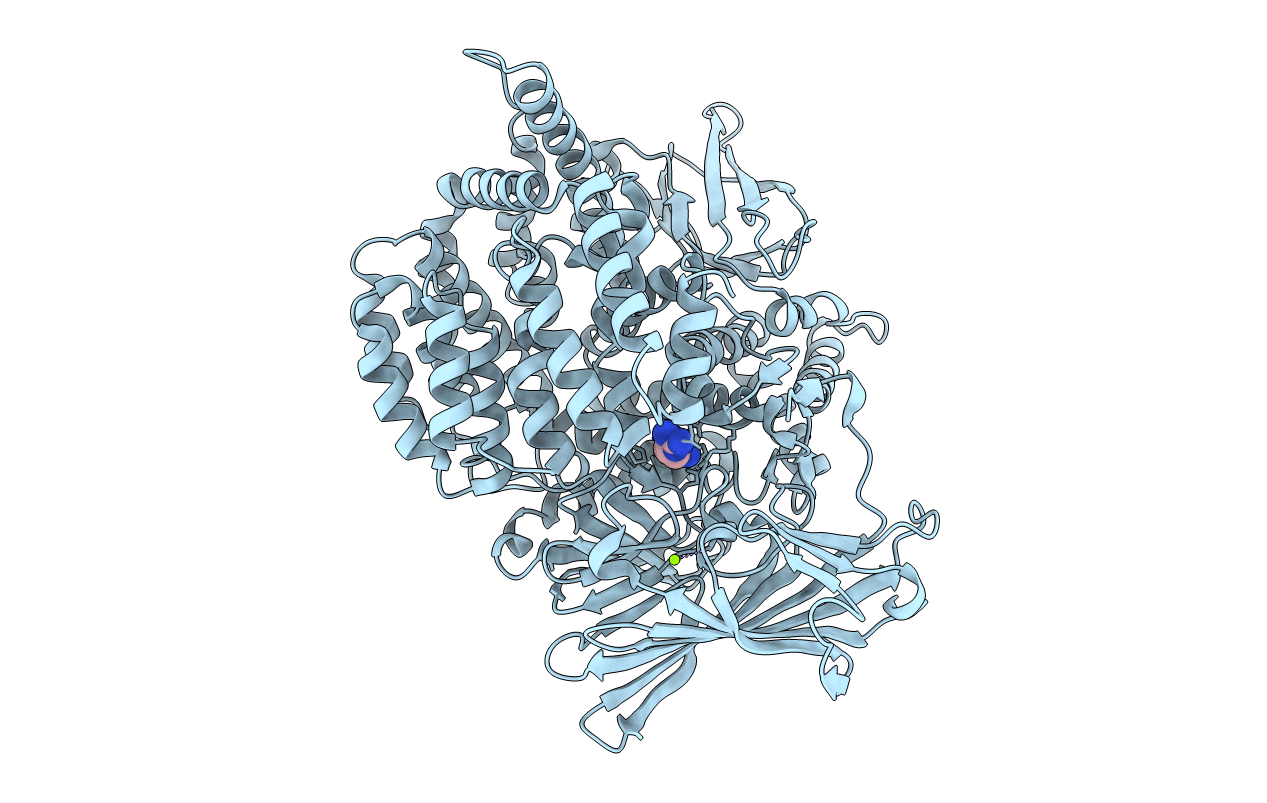
4J3B image
Deposition Date 2013-02-05
Release Date 2013-08-07
Last Version Date 2023-09-20
Entry Detail
PDB ID:
4J3B
Keywords:
Title:
A naturally variable residue in the S1 subsite of M1-family aminopeptidases modulates catalytic properties and promotes functional specialization
Biological Source:
Source Organism(s):
Expression System(s):
Method Details:
Experimental Method:
Resolution:
2.20 Å
R-Value Free:
0.20
R-Value Work:
0.16
R-Value Observed:
0.16
Space Group:
P 21 21 21

Macromolecular Entities
Structures with similar UniProt ID
Protein Blast
Polymer Type:polypeptide(L)
Molecule:M1 family aminopeptidase
Gene (Uniprot):M1AAP
Mutagens:V459P
Chain IDs:A
Chain Length:889
Number of Molecules:1
Biological Source:Plasmodium falciparum
Primary Citation
A naturally variable residue in the s1 subsite of m1 family aminopeptidases modulates catalytic properties and promotes functional specialization.
J. Biol. Chem. 288 26004 26012 (2013)
PMID: 23897806 DOI: 10.1074/jbc.M113.465625

Abstact

M1 family metallo-aminopeptidases fulfill a wide range of critical and in some cases medically relevant roles in humans and human pathogens. The specificity of M1-aminopeptidases is dominated by the interaction of the well defined S1 subsite with the side chain of the first (P1) residue of the substrate and can vary widely. Extensive natural variation occurs at one of the residues that contributes to formation of the cylindrical S1 subsite. We investigated whether this natural variation contributes to diversity in S1 subsite specificity. Effects of 11 substitutions of the S1 subsite residue valine 459 in the Plasmodium falciparum aminopeptidase PfA-M1 and of three substitutions of the homologous residue methionine 260 in Escherichia coli aminopeptidase N were characterized. Many of these substitutions altered steady-state kinetic parameters for dipeptide hydrolysis and remodeled S1 subsite specificity. The most dramatic change in specificity resulted from substitution with proline, which collapsed S1 subsite specificity such that only substrates with P1-Arg, -Lys, or -Met were appreciably hydrolyzed. The structure of PfA-M1 V459P revealed that the proline substitution induced a local conformational change in the polypeptide backbone that resulted in a narrowed S1 subsite. The restricted specificity and active site backbone conformation of PfA-M1 V459P mirrored those of endoplasmic reticulum aminopeptidase 2, a human enzyme with proline in the variable S1 subsite position. Our results provide compelling evidence that changes in the variable residue in the S1 subsite of M1-aminopeptidases have facilitated the evolution of new specificities and ultimately novel functions for this important class of enzymes.

Legend

Protein

Chemical

Disease

Primary Citation of related structures
Feedback Form
Name
Email
Institute
Feedback