

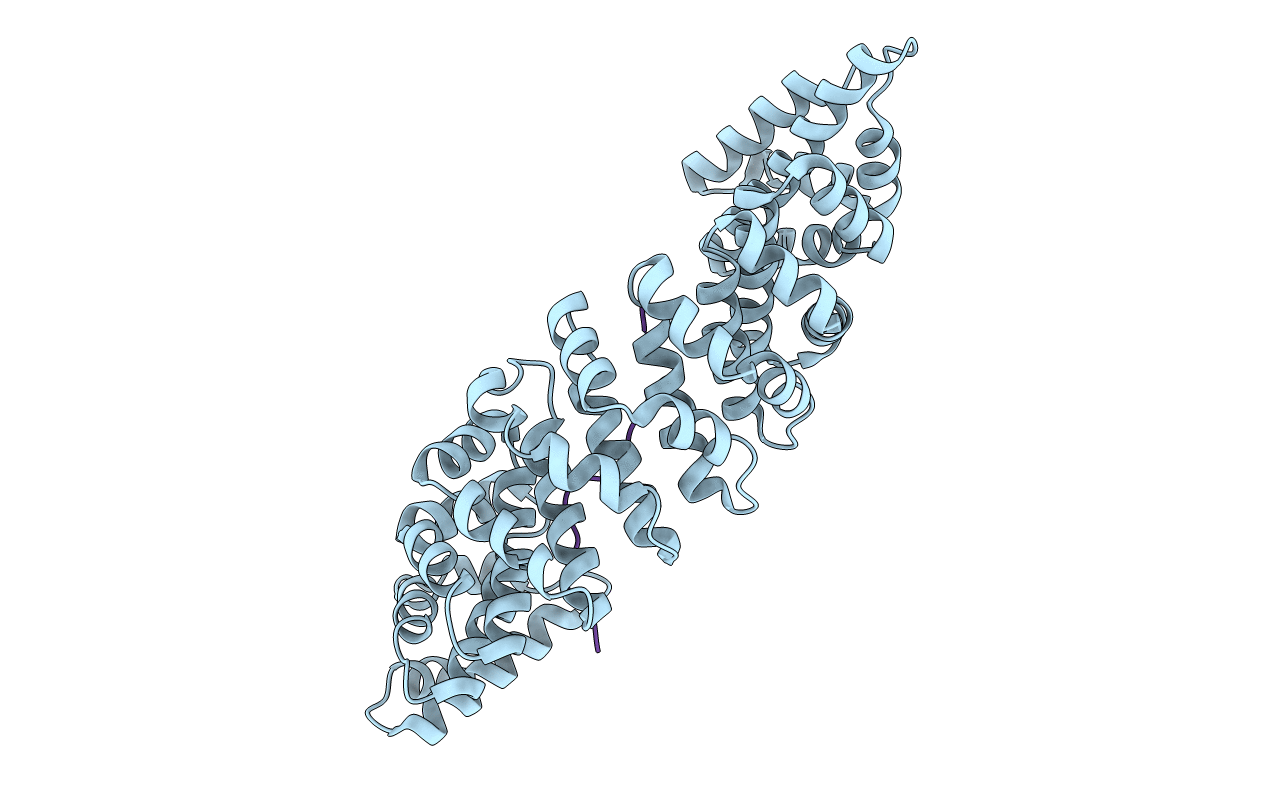
4B18 image
Deposition Date 2012-07-08
Release Date 2013-09-04
Last Version Date 2023-12-20
Entry Detail
PDB ID:
4B18
Title:
The crystal structure of human Importin alpha 5 with TERT NLS peptide
Biological Source:
Source Organism(s):
HOMO SAPIENS (Taxon ID: 9606)
Expression System(s):
Method Details:
Experimental Method:
Resolution:
2.52 Å
R-Value Free:
0.25
R-Value Work:
0.19
R-Value Observed:
0.20
Space Group:
C 1 2 1

Macromolecular Entities
Structures with similar UniProt ID
Protein Blast
Polymer Type:polypeptide(L)
Molecule:IMPORTIN SUBUNIT ALPHA-1
Gene (Uniprot):KPNA1
Chain IDs:A
Chain Length:447
Number of Molecules:1
Biological Source:HOMO SAPIENS
Structures with similar UniProt ID
Protein Blast
Polymer Type:polypeptide(L)
Molecule:TELOMERASE REVERSE TRANSCRIPT
Gene (Uniprot):TERT
Chain IDs:B
Chain Length:20
Number of Molecules:1
Biological Source:HOMO SAPIENS
Primary Citation
Akt-Mediated Phosphorylation Increases the Binding Affinity of Htert for Importin Alpha to Promote Nuclear Translocation.
J. Cell. Sci. 128 2287 ? (2015)
PMID: 25999477 DOI: 10.1242/JCS.166132

Abstact

Telomeres are essential for chromosome integrity and protection, and their maintenance requires the ribonucleoprotein enzyme telomerase. Previously, we have shown that human telomerase reverse transcriptase (hTERT) contains a bipartite nuclear localization signal (NLS; residues 222-240) that is responsible for nuclear import, and that Akt-mediated phosphorylation of residue S227 is important for efficient nuclear import of hTERT. Here, we show that hTERT binds to importin-α proteins through the bipartite NLS and that this heterodimer then forms a complex with importin-β proteins to interact with the nuclear pore complex. Depletion of individual importin-α proteins results in a failure of hTERT nuclear import, and the resulting cytoplasmic hTERT is degraded by ubiquitin-dependent proteolysis. Crystallographic analysis reveals that the bipartite NLS interacts with both the major and minor sites of importin-α proteins. We also show that Akt-mediated phosphorylation of S227 increases the binding affinity for importin-α proteins and promotes nuclear import of hTERT, thereby resulting in increased telomerase activity. These data provide details of a binding mechanism that enables hTERT to interact with the nuclear import receptors and of the control of the dynamic nuclear transport of hTERT through phosphorylation.

Legend

Protein

Chemical

Disease

Primary Citation of related structures
Feedback Form
Name
Email
Institute
Feedback