

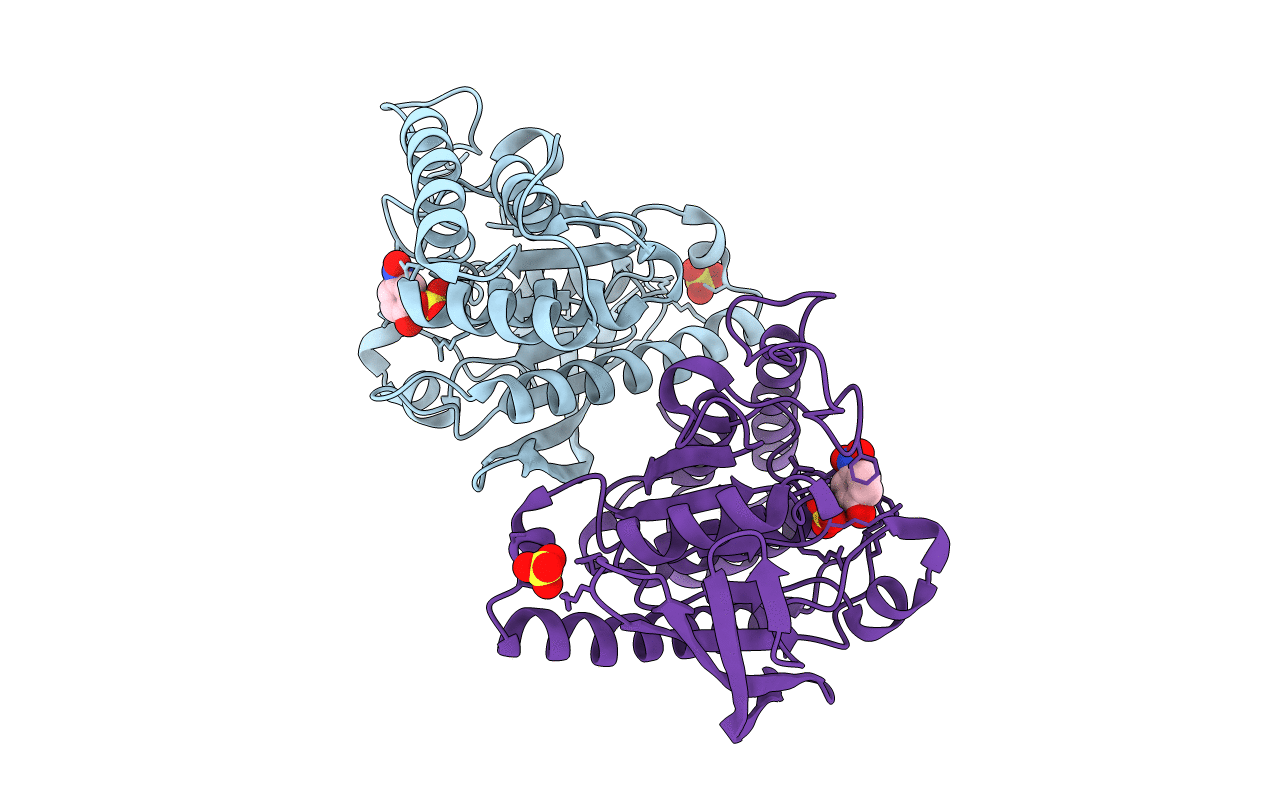
3U96 image
Deposition Date 2011-10-17
Release Date 2012-08-29
Last Version Date 2024-03-20
Entry Detail
PDB ID:
3U96
Keywords:
Title:
Crystal Structure of YopHQ357F(Catalytic Domain, Residues 163-468) in complex with pNCS
Biological Source:
Source Organism(s):
Expression System(s):
Method Details:
Experimental Method:
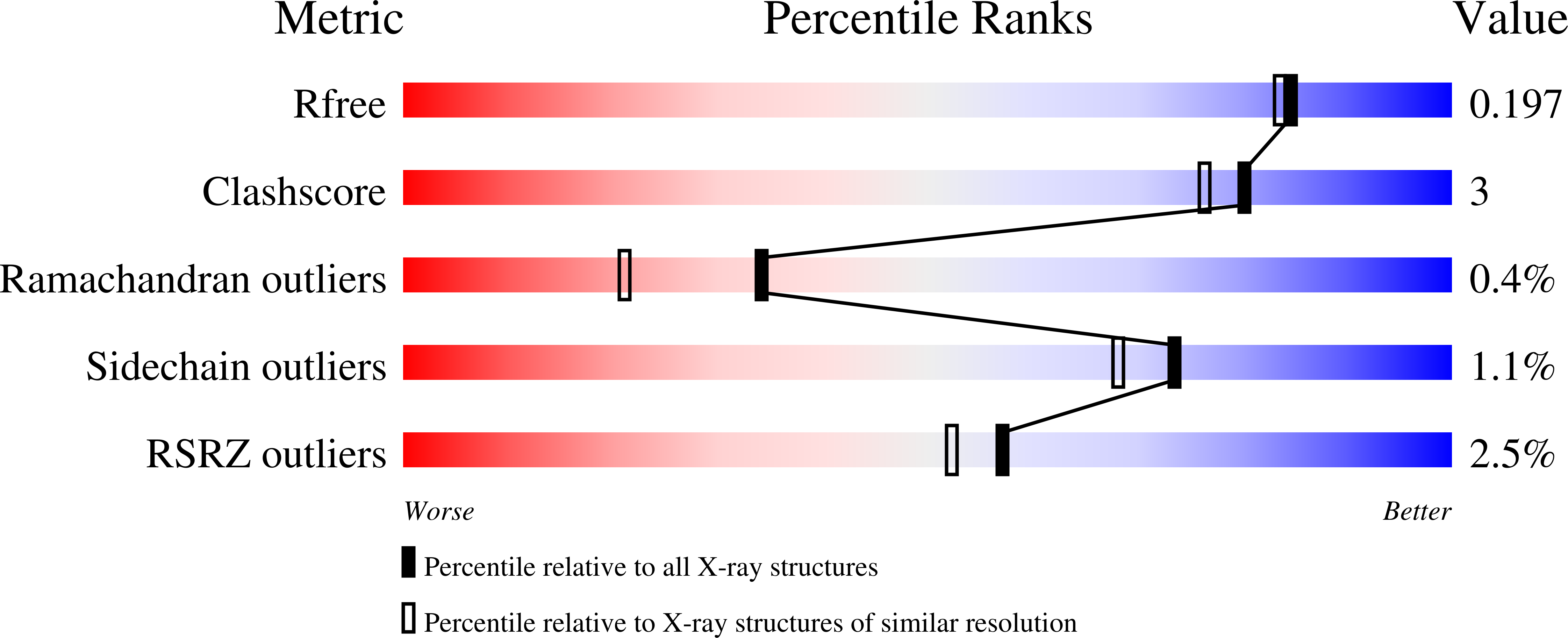
Resolution:
1.80 Å
R-Value Free:
0.20
R-Value Work:
0.17
R-Value Observed:
0.18
Space Group:
P 1
Macromolecular Entities
Structures with similar UniProt ID
Protein Blast
Polymer Type:polypeptide(L)
Molecule:Tyrosine-protein phosphatase
Gene (Uniprot):yopH
Mutagens:Q357F
Chain IDs:A, B
Chain Length:306
Number of Molecules:2
Biological Source:Yersinia enterocolitica
Primary Citation
Investigation of catalytic loop structure, dynamics, and function relationship of Yersinia protein tyrosine phosphatase by temperature-jump relaxation spectroscopy and X-ray structural determination.
J Phys Chem B 116 6166 6176 (2012)
PMID: 22564106 DOI: 10.1021/jp3037846

Abstact

Yersinia protein tyrosine phosphatase (YopH) is the most efficient enzyme among all PTPases. YopH is hyperactive compared to human PTPases, interfering with mammalian cellular pathways to achieve the pathogenicity of Yersinia. Two properties related to the catalytic loop structure differences have been proposed to affect its dynamics and enzyme efficiency. One is the ability of the loop to form stabilizing interactions to bound ligand after loop closure, which has long been recognized. In addition, the loop flexibility/mobility was suggested in a previous study to be a factor as well, based on the observation that incremental changes in PTPase loop structure by single point mutations to alanine often induce incremental changes in enzyme catalytic efficiency. In this study, the temperature jump relaxation spectroscopy (T-jump) has been used to discern the subtle changes of the loop dynamics due to point loop mutations. As expected, our results suggest a correlation between loop dynamics and the size of the residue on the catalytic loop. The stabilization of the enzyme-ligand complex is often enthalpy driven, achieved by formation of additional favorable hydrogen bonding/ionic interactions after loop closure. Interestingly, our T-jump and X-ray crystallography studies on YopH suggest that the elimination of some ligand-protein interactions by mutation does not necessarily destabilize the ligand-enzyme complex after loop closure, since the increased entropy in the forms of more mobile protein residues may be sufficient to compensate the free energy loss due to lost interactions and may even lead to enhanced efficiency of the enzyme catalysis. How these competing loop properties may affect loop dynamics and enzyme function are discussed.

Legend

Protein

Chemical

Disease

Primary Citation of related structures
Feedback Form
Name
Email
Institute
Feedback