

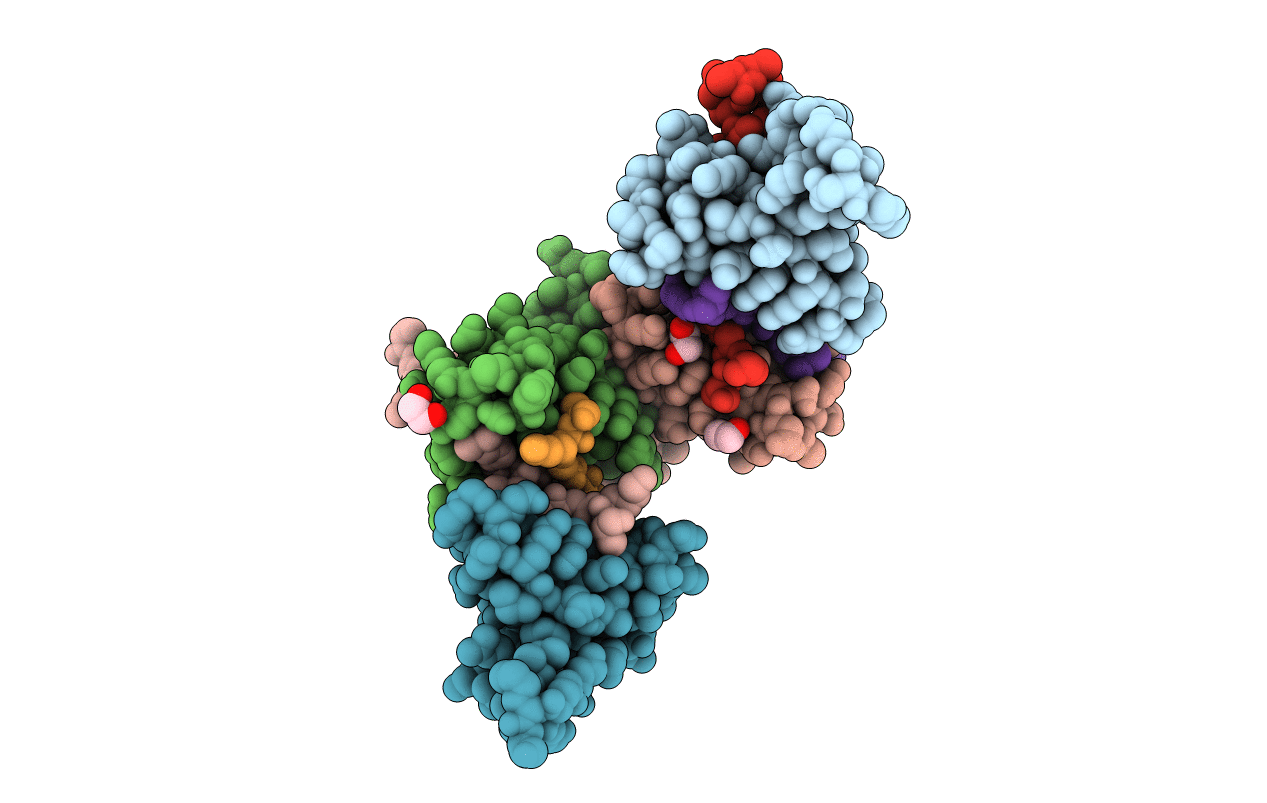
3QO2 image
Deposition Date 2011-02-09
Release Date 2011-04-06
Last Version Date 2023-09-13
Entry Detail
PDB ID:
3QO2
Title:
Structural insights for MPP8 chromodomain interaction with histone H3 lysine 9
Biological Source:
Source Organism(s):
Expression System(s):
Method Details:
Experimental Method:
Resolution:
2.49 Å
R-Value Free:
0.28
R-Value Work:
0.21
R-Value Observed:
0.21
Space Group:
P 43 21 2

Macromolecular Entities
Structures with similar UniProt ID
Protein Blast
Polymer Type:polypeptide(L)
Molecule:M-phase phosphoprotein 8
Gene (Uniprot):MPHOSPH8
Chain IDs:A, C (auth: B), E (auth: C), G (auth: D)
Chain Length:64
Number of Molecules:4
Biological Source:Homo sapiens
Structures with similar UniProt ID
Protein Blast
Polymer Type:polypeptide(L)
Molecule:Histone H3 peptide
Chain IDs:B (auth: P), D (auth: Q), F (auth: R), H (auth: S)
Chain Length:15
Number of Molecules:4
Biological Source:synthetic construct
Modified Residue
Compound ID Chain ID Parent Comp ID Details 2D Image
M3L B LYS N-TRIMETHYLLYSINE
Ligand Molecules
Primary Citation
Structural insights for MPP8 chromodomain interaction with histone H3 lysine 9: potential effect of phosphorylation on methyl-lysine binding.
J. Mol. Biol. 408 807 814 (2011)
PMID: 21419134 DOI: 10.1016/j.jmb.2011.03.018

Abstact

M-phase phosphoprotein 8 (MPP8) harbors an N-terminal chromodomain and a C-terminal ankyrin repeat domain. MPP8, via its chromodomain, binds histone H3 peptide tri- or di-methylated at lysine 9 (H3K9me3/H3K9me2) in submicromolar affinity. We determined the crystal structure of MPP8 chromodomain in complex with H3K9me3 peptide. MPP8 interacts with at least six histone H3 residues from glutamine 5 to serine 10, enabling its ability to distinguish lysine-9-containing peptide (QTARKS) from that of lysine 27 (KAARKS), both sharing the ARKS sequence. A partial hydrophobic cage with three aromatic residues (Phe59, Trp80 and Tyr83) and one aspartate (Asp87) encloses the methylated lysine 9. MPP8 has been reported to be phosphorylated in vivo, including the cage residue Tyr83 and the succeeding Thr84 and Ser85. Modeling a phosphate group onto the side-chain hydroxyl oxygen of Tyr83 suggests that the negatively charged phosphate group could enhance the binding of positively charged methyl-lysine or create a regulatory signal by allowing or inhibiting binding of other protein(s).

Legend

Protein

Chemical

Disease

Primary Citation of related structures
Feedback Form
Name
Email
Institute
Feedback