

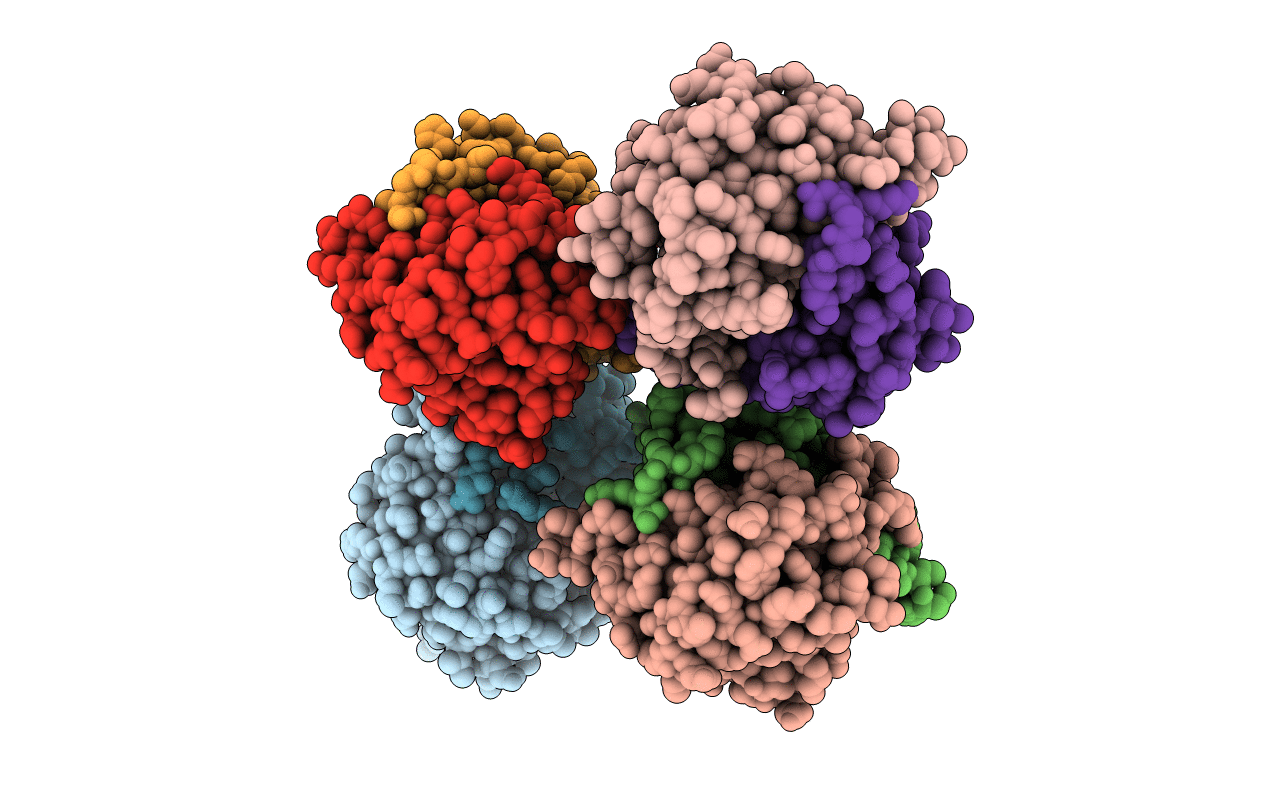
3LMU image
Deposition Date 2010-02-01
Release Date 2010-03-02
Last Version Date 2024-03-20
Entry Detail
PDB ID:
3LMU
Keywords:
Title:
Crystal structure of DTD from Plasmodium falciparum
Biological Source:
Source Organism(s):
Expression System(s):
Method Details:
Experimental Method:
Resolution:
3.30 Å
R-Value Free:
0.25
R-Value Work:
0.18
R-Value Observed:
0.18
Space Group:
P 43

Macromolecular Entities
Structures with similar UniProt ID
Protein Blast
Polymer Type:polypeptide(L)
Molecule:D-tyrosyl-tRNA(Tyr) deacylase
Gene (Uniprot):DTD
Chain IDs:A, B, C, D, E, F, G, H
Chain Length:164
Number of Molecules:8
Biological Source:Plasmodium falciparum
Ligand Molecules
Primary Citation
Structure of D-tyrosyl-tRNATyr deacylase using home-source Cu Kalpha and moderate-quality iodide-SAD data: structural polymorphism and HEPES-bound enzyme states
Acta Crystallogr. D Biol. Crystallogr. 66 584 592 (2010)
PMID: 20445234 DOI: 10.1107/S0907444910006062

Abstact

D-Tyrosyl-tRNA(Tyr) deacylase (DTD) is an editing enzyme that removes D-amino acids from mischarged tRNAs. The crystal structure of Plasmodium falciparum DTD (PfDTD) was determined using the iodide-SAD phasing method. Iodide-derivatized PfDTD crystals were obtained using the quick cryo-soaking procedure in which native crystals were soaked for a short period of 10-30 s in cryoprotectant solution containing 0.2-1 M NaI. Iodide-SAD data sets were collected to 3.3 and 2.74 A resolution from PfDTD crystals that belonged to two different space groups, P4(3) and P1, using an in-house X-ray copper-anode source. This is the first report to detail structure solution using low iodide anomalous signal, modest resolution and redundancy and average solvent content for SAD phasing of 984 and 1312 amino acids in the triclinic P1 and tetragonal P4(3) space groups, respectively. A total of 85% and 56% of the residues were automatically built into the iodide-phased electron-density maps using PHENIX AutoBuild. The structure of HEPES-bound PfDTD was subsequently determined by molecular replacement and refined to 2.83 A resolution. The crystals obtained from various batches of crystallization trials of PfDTD exhibited polymorphism in terms of belonging to different crystal forms and space groups. Even within a given crystal system the unit-cell parameters showed high non-isomorphism. These packing variations were exploited in order to conduct a systematic study of conformational changes in PfDTD. It is shown that the disposition of a ten-residue insertion loop affects packing within the PfDTD crystals and seems to determine the non-isomorphism in unit-cell parameters. By tracking the changes in PfDTD unit cells, it was possible to map conformational differences within PfDTD that may be of significance for enzyme activity.

Legend

Protein

Chemical

Disease

Primary Citation of related structures
Feedback Form
Name
Email
Institute
Feedback