

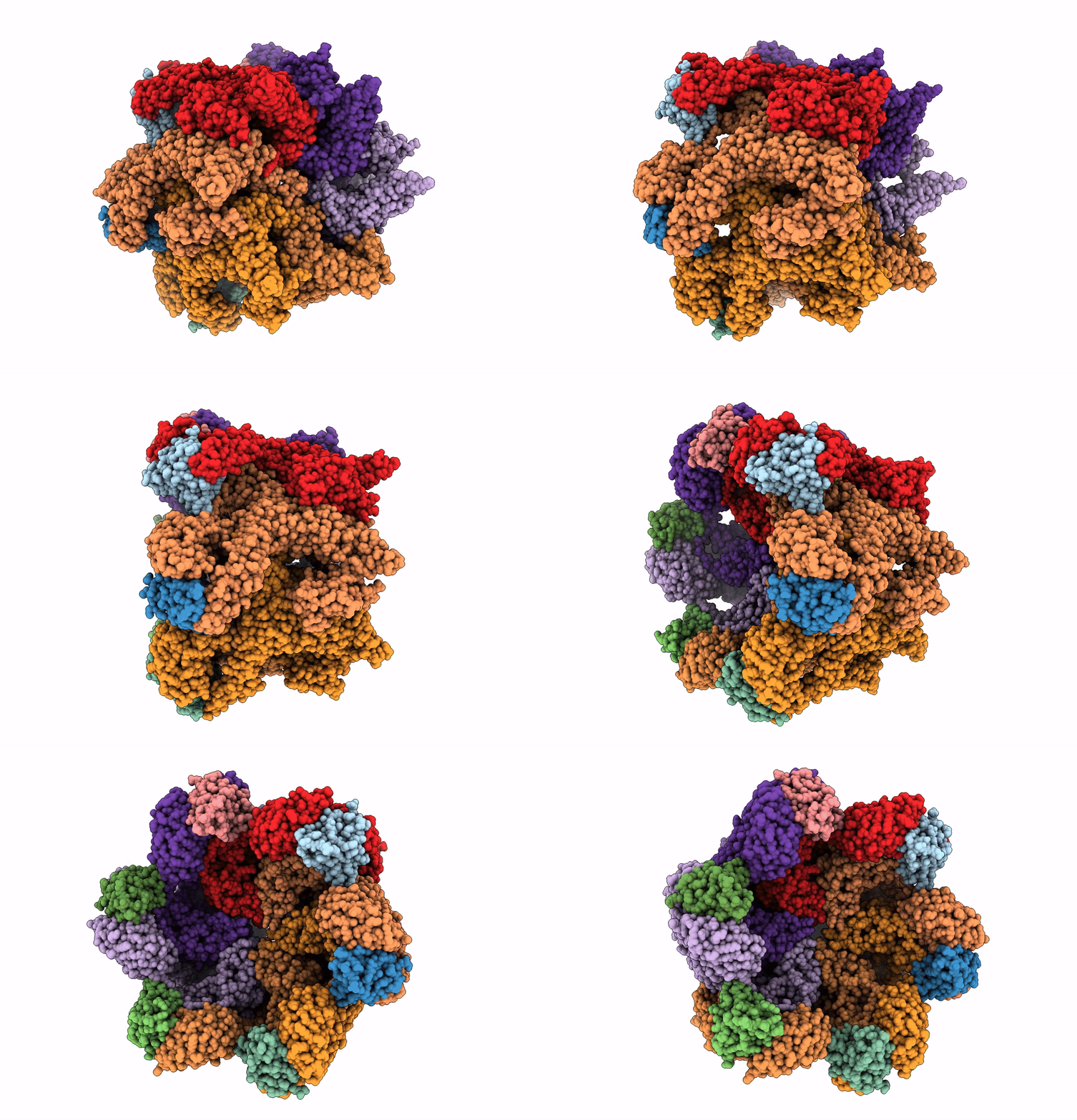
3J3T image
Deposition Date 2013-04-18
Release Date 2013-05-15
Last Version Date 2024-03-20
Entry Detail
PDB ID:
3J3T
Keywords:
Title:
Structural dynamics of the MecA-ClpC complex revealed by cryo-EM
Biological Source:
Source Organism(s):
Expression System(s):
Method Details:
Experimental Method:
Resolution:
9.00 Å
Aggregation State:
PARTICLE
Reconstruction Method:
SINGLE PARTICLE

Macromolecular Entities
Structures with similar UniProt ID
Protein Blast
Polymer Type:polypeptide(L)
Molecule:Adapter protein MecA 1
Gene (Uniprot):mecA
Chain IDs:A (auth: 1), B (auth: 2), C (auth: 3), D (auth: 4), E (auth: 5), F (auth: 6)
Chain Length:218
Number of Molecules:6
Biological Source:Bacillus subtilis
Structures with similar UniProt ID
Protein Blast
Polymer Type:polypeptide(L)
Molecule:Negative regulator of genetic
Gene (Uniprot):clpC
Mutagens:E280A
Chain IDs:G (auth: A), H (auth: B), I (auth: C), J (auth: D), K (auth: E), L (auth: F)
Chain Length:810
Number of Molecules:6
Biological Source:Bacillus subtilis
Ligand Molecules
Primary Citation
Structural dynamics of the MecA-ClpC complex: a type II AAA+ protein unfolding machine.
J. Biol. Chem. 288 17597 17608 (2013)
PMID: 23595989 DOI: 10.1074/jbc.M113.458752

Abstact

The MecA-ClpC complex is a bacterial type II AAA(+) molecular machine responsible for regulated unfolding of substrates, such as transcription factors ComK and ComS, and targeting them to ClpP for degradation. The six subunits of the MecA-ClpC complex form a closed barrel-like structure, featured with three stacked rings and a hollow passage, where substrates are threaded and translocated through successive pores. Although the general concepts of how polypeptides are unfolded and translocated by internal pore loops of AAA(+) proteins have long been conceived, the detailed mechanistic model remains elusive. With cryoelectron microscopy, we captured four different structures of the MecA-ClpC complexes. These complexes differ in the nucleotide binding states of the two AAA(+) rings and therefore might presumably reflect distinctive, representative snapshots from a dynamic unfolding cycle of this hexameric complex. Structural analysis reveals that nucleotide binding and hydrolysis modulate the hexameric complex in a number of ways, including the opening of the N-terminal ring, the axial and radial positions of pore loops, the compactness of the C-terminal ring, as well as the relative rotation between the two nucleotide-binding domain rings. More importantly, our structural and biochemical data indicate there is an active allosteric communication between the two AAA(+) rings and suggest that concerted actions of the two AAA(+) rings are required for the efficiency of the substrate unfolding and translocation. These findings provide important mechanistic insights into the dynamic cycle of the MecA-ClpC unfoldase and especially lay a foundation toward the complete understanding of the structural dynamics of the general type II AAA(+) hexamers.

Legend

Protein

Chemical

Disease

Primary Citation of related structures
Feedback Form
Name
Email
Institute
Feedback