

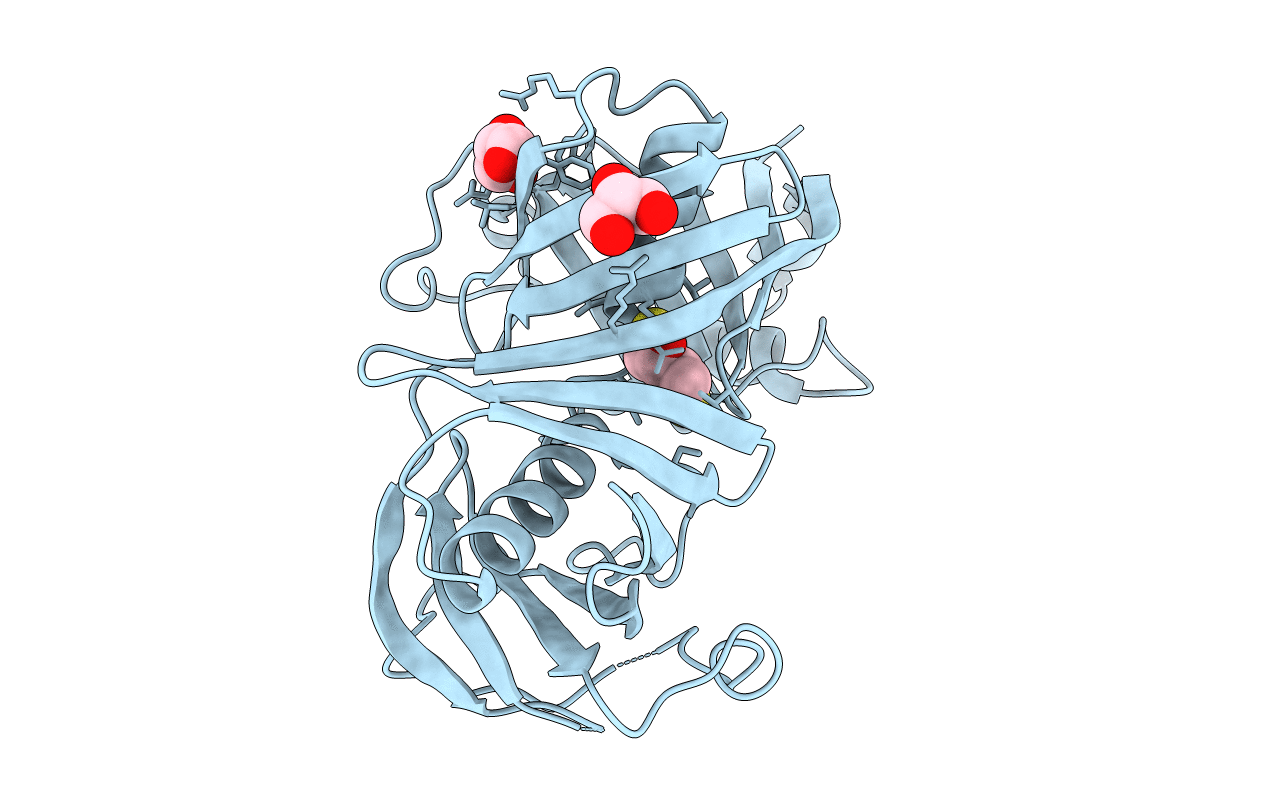
3FVE image
Deposition Date 2009-01-15
Release Date 2009-01-27
Last Version Date 2023-09-06
Entry Detail
PDB ID:
3FVE
Keywords:
Title:
Crystal structure of diaminopimelate epimerase Mycobacterium tuberculosis DapF
Biological Source:
Source Organism(s):
Expression System(s):
Method Details:
Experimental Method:
Resolution:
2.60 Å
R-Value Free:
0.25
R-Value Work:
0.22
R-Value Observed:
0.22
Space Group:
P 65 2 2

Macromolecular Entities
Structures with similar UniProt ID
Protein Blast
Polymer Type:polypeptide(L)
Molecule:Diaminopimelate epimerase
Chain IDs:A
Chain Length:290
Number of Molecules:1
Biological Source:Mycobacterium tuberculosis
Primary Citation
Structure of the diaminopimelate epimerase DapF from Mycobacterium tuberculosis
Acta Crystallogr. D Biol. Crystallogr. 65 383 387 (2009)
PMID: 19307721 DOI: 10.1107/S0907444909002522

Abstact

The meso (or D,L) isomer of diaminopimelic acid (DAP), a precursor of L-lysine, is a key component of the pentapeptide linker in bacterial peptidoglycan. While the peptidoglycan incorporated in the highly complex cell wall of the pathogen Mycobacterium tuberculosis structurally resembles that of Escherichia coli, it is unique in that it can contain penicillin-resistant meso-DAP-->meso-DAP linkages. The interconversion of L,L-DAP and meso-DAP is catalysed by the DAP epimerase DapF, a gene product that is essential in M. tuberculosis. Here, the crystal structure of the ligand-free form of M. tuberculosis DapF (MtDapF) refined to a resolution of 2.6 A is reported. MtDapF shows small if distinct deviations in secondary structure from the two-domain alpha/beta-fold of the known structures of Haemophilus influenzae DapF and Bacillus anthracis DapF, which are in line with its low sequence identity (<or=27%) to the former. Modelling the present structure onto that of L,L-aziridino-DAP-bound H. influenzae DapF illustrates that a rigid-body movement of domain II and a rearrangement of the B4-A2 loop (residues 80-90) of domain I are likely to accompany the transition from the present inactive form to a catalytically competent enzyme. Despite a highly conserved active-site architecture, the model indicates that stabilization of the DAP backbone occurs in MtDapF through a tyrosine residue that is specific to mycobacterial DAP epimerases.

Legend

Protein

Chemical

Disease

Primary Citation of related structures
Feedback Form
Name
Email
Institute
Feedback