

3EAB image
Deposition Date 2008-08-25
Release Date 2008-11-11
Last Version Date 2024-02-21
Entry Detail
PDB ID:
3EAB
Keywords:
Title:
Crystal structure of Spastin MIT in complex with ESCRT III
Biological Source:
Source Organism(s):
Homo sapiens (Taxon ID: 9606)
Expression System(s):
Method Details:
Experimental Method:
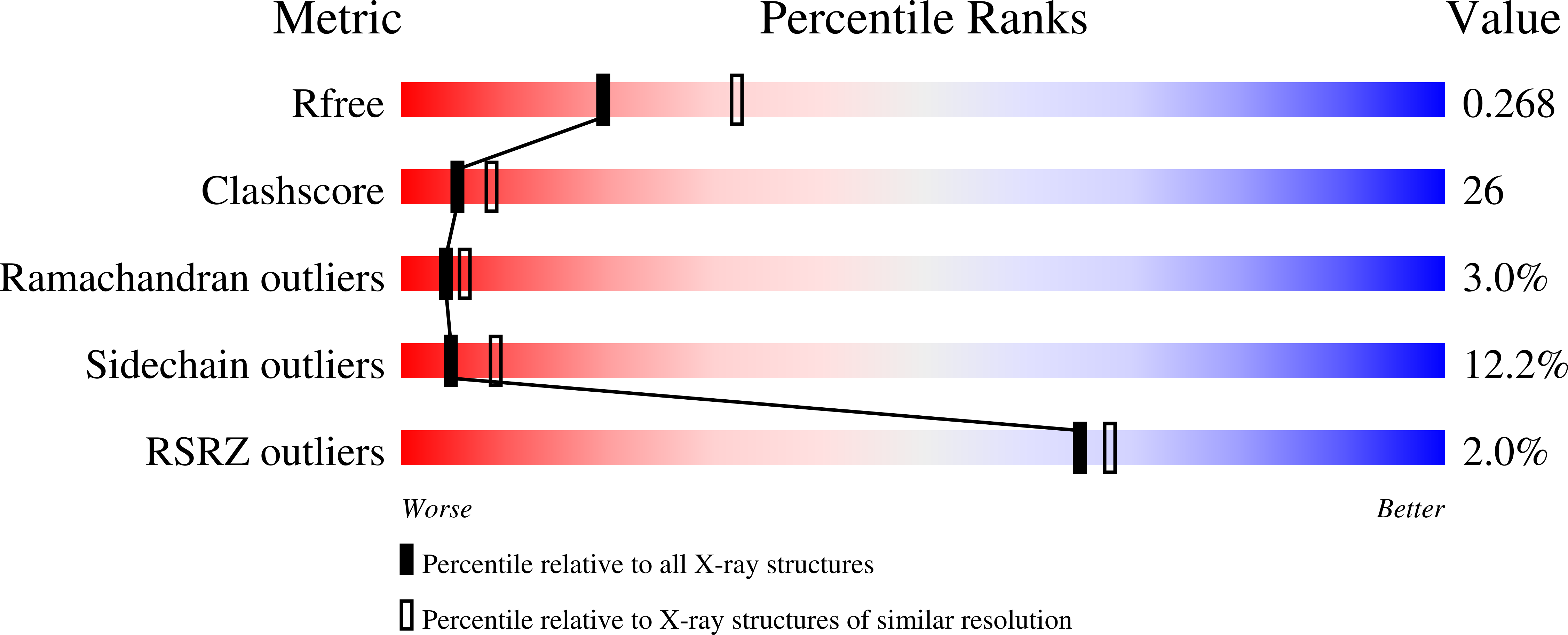
Resolution:
2.50 Å
R-Value Free:
0.26
R-Value Work:
0.23
R-Value Observed:
0.23
Space Group:
P 21 21 2
Macromolecular Entities
Structures with similar UniProt ID
Protein Blast
Polymer Type:polypeptide(L)
Molecule:Spastin
Gene (Uniprot):SPAST
Chain IDs:A, B, C, D, E, F
Chain Length:89
Number of Molecules:6
Biological Source:Homo sapiens
Structures with similar UniProt ID
Protein Blast
Polymer Type:polypeptide(L)
Molecule:CHMP1b
Chain IDs:G, H, I, J, K, L
Chain Length:50
Number of Molecules:6
Biological Source:Homo sapiens
Ligand Molecules
Primary Citation
Structural basis for midbody targeting of spastin by the ESCRT-III protein CHMP1B.
Nat. Struct. Mol. Biol. 15 1278 1286 (2008)
PMID: 18997780 DOI: 10.1038/nsmb.1512

Abstact

The endosomal sorting complex required for transport (ESCRT) machinery, including ESCRT-III, localizes to the midbody and participates in the membrane-abscission step of cytokinesis. The ESCRT-III protein charged multivesicular body protein 1B (CHMP1B) is required for recruitment of the MIT domain-containing protein spastin, a microtubule-severing enzyme, to the midbody. The 2.5-A structure of the C-terminal tail of CHMP1B with the MIT domain of spastin reveals a specific, high-affinity complex involving a noncanonical binding site between the first and third helices of the MIT domain. The structural interface is twice as large as that of the MIT domain of the VPS4-CHMP complex, consistent with the high affinity of the interaction. A series of unique hydrogen-bonding interactions and close packing of small side chains discriminate against the other ten human ESCRT-III subunits. Point mutants in the CHMP1B binding site of spastin block recruitment of spastin to the midbody and impair cytokinesis.

Legend

Protein

Chemical

Disease

Primary Citation of related structures
Feedback Form
Name
Email
Institute
Feedback