

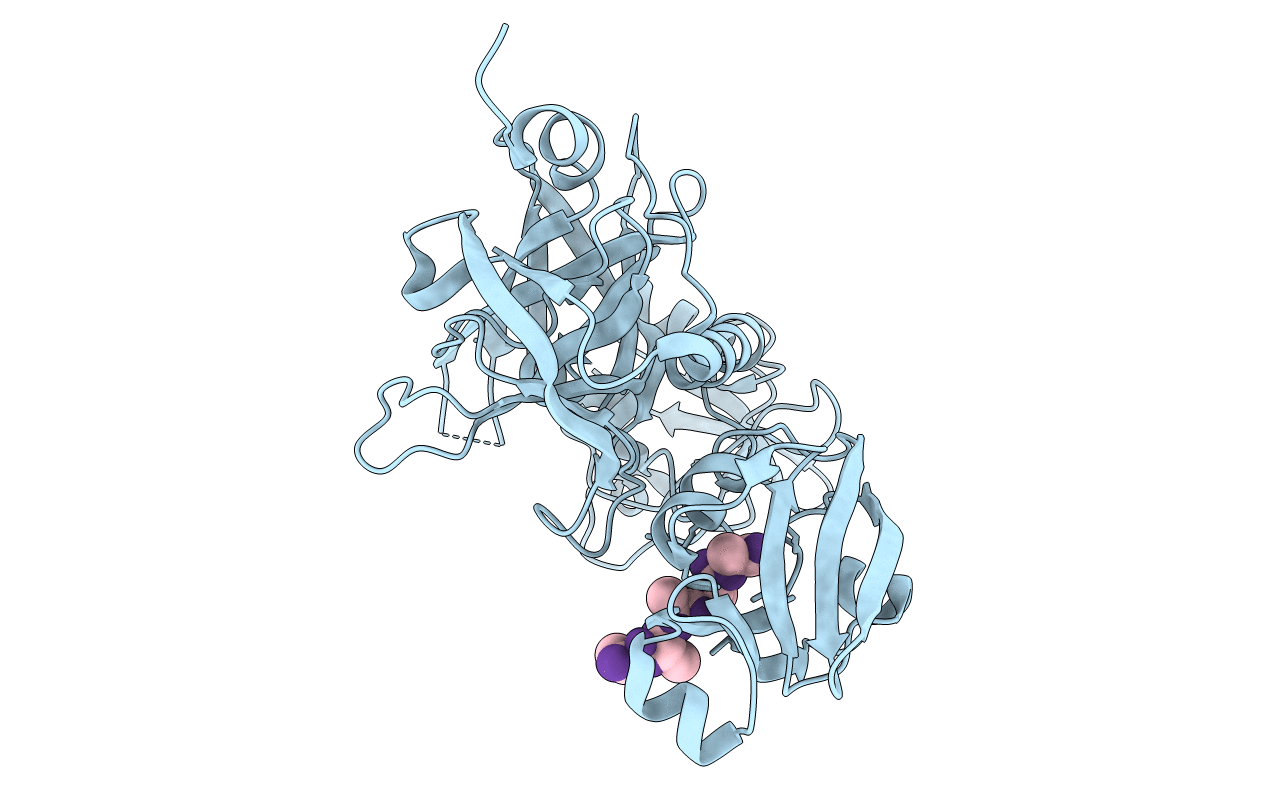
3CS0 image
Deposition Date 2008-04-08
Release Date 2008-05-27
Last Version Date 2024-10-30
Entry Detail
PDB ID:
3CS0
Keywords:
Title:
Crystal structure of DegP24
Biological Source:
Source Organism(s):
Expression System(s):
Method Details:
Experimental Method:
Resolution:
3.00 Å
R-Value Free:
0.27
R-Value Work:
0.21
Space Group:
F 4 3 2

Macromolecular Entities
Structures with similar UniProt ID
Protein Blast
Polymer Type:polypeptide(L)
Molecule:Periplasmic serine endoprotea
Gene (Uniprot):degP
Mutagens:S210A
Chain IDs:A
Chain Length:448
Number of Molecules:1
Biological Source:Escherichia coli (strain K12)
Structures with similar UniProt ID
Protein Blast
Polymer Type:polypeptide(L)
Molecule:pentapeptide
Chain IDs:B
Chain Length:5
Number of Molecules:1
Biological Source:Escherichia coli (strain K12)
Modified Residue
Compound ID Chain ID Parent Comp ID Details 2D Image
MSE A MET modified residue
Ligand Molecules
Primary Citation
Structural basis for the regulated protease and chaperone function of DegP
Nature 453 885 890 (2008)
PMID: 18496527 DOI: 10.1038/nature07004

Abstact

All organisms have to monitor the folding state of cellular proteins precisely. The heat-shock protein DegP is a protein quality control factor in the bacterial envelope that is involved in eliminating misfolded proteins and in the biogenesis of outer-membrane proteins. Here we describe the molecular mechanisms underlying the regulated protease and chaperone function of DegP from Escherichia coli. We show that binding of misfolded proteins transforms hexameric DegP into large, catalytically active 12-meric and 24-meric multimers. A structural analysis of these particles revealed that DegP represents a protein packaging device whose central compartment is adaptable to the size and concentration of substrate. Moreover, the inner cavity serves antagonistic functions. Whereas the encapsulation of folded protomers of outer-membrane proteins is protective and might allow safe transit through the periplasm, misfolded proteins are eliminated in the molecular reaction chamber. Oligomer reassembly and concomitant activation on substrate binding may also be critical in regulating other HtrA proteases implicated in protein-folding diseases.

Legend

Protein

Chemical

Disease

Primary Citation of related structures
Feedback Form
Name
Email
Institute
Feedback