

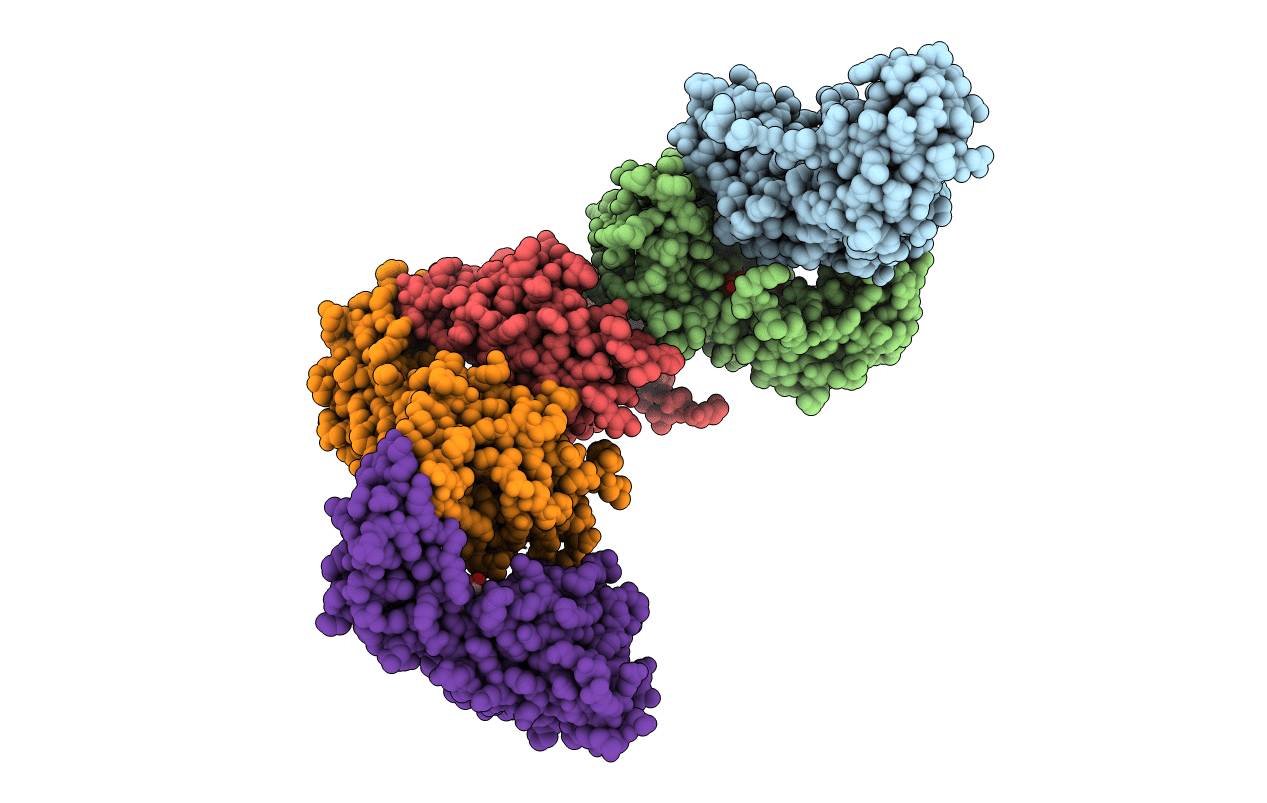
2R65 image
Deposition Date 2007-09-05
Release Date 2008-09-09
Last Version Date 2023-10-25
Entry Detail
PDB ID:
2R65
Keywords:
Title:
Crystal structure of Helicobacter pylori ATP dependent protease, FtsH ADP complex
Biological Source:
Source Organism(s):
Expression System(s):
Method Details:
Experimental Method:
Resolution:
3.30 Å
R-Value Free:
0.33
R-Value Work:
0.28
R-Value Observed:
0.28
Space Group:
C 2 2 21

Macromolecular Entities
Structures with similar UniProt ID
Protein Blast
Polymer Type:polypeptide(L)
Molecule:Cell division protease ftsH h
Gene (Uniprot):ftsH
Mutagens:N170K
Chain IDs:A, B, C, D, E
Chain Length:268
Number of Molecules:5
Biological Source:Helicobacter pylori
Ligand Molecules
Primary Citation
Structural studies on Helicobacter pyloriATP-dependent protease, FtsH
J Synchrotron Radiat 15 208 210 (2008)
PMID: 18421140 DOI: 10.1107/S090904950706846X

Abstact

The ATP-dependent protease, FtsH, degrades misassembled membrane proteins for quality control like SecY, subunit a of FoF1-ATPase, and YccA, and digests short-lived soluble proteins in order to control their cellular regulation, including sigma32, LpxC and lambdacII. The FtsH protein has an N-terminal transmembrane segment and a large cytosolic region that consists of two domains, an ATPase and a protease domain. To provide a structural basis for the nucleotide-dependent domain motions and a better understanding of substrate translocation, the crystal structures of the Helicobacter pylori (Hp) FtsH ATPase domain in the nucleotide-free state and complexed with ADP, were determined. Two different structures of HpFtsH ATPase were observed, with the nucleotide-free state in an asymmetric unit, and these structures reveal the new forms and show other conformational differences between the nucleotide-free and ADP-bound state compared with previous structures. In particular, one HpFtsH Apo structure has a considerable rotation difference compared with the HpFtsH ADP complex, and this large conformational change reveals that FtsH may have the mechanical force needed for substrate translocation.

Legend

Protein

Chemical

Disease

Primary Citation of related structures
Feedback Form
Name
Email
Institute
Feedback