

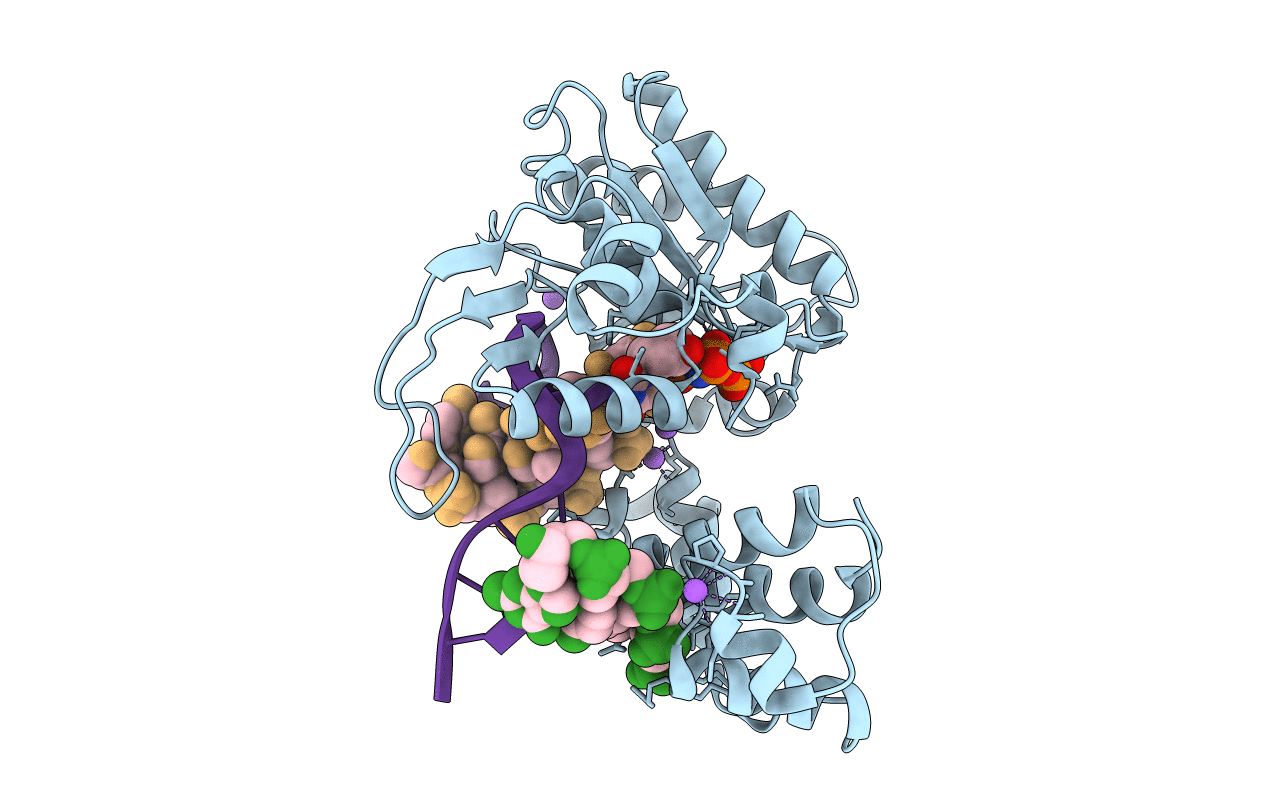
2PFN image
Deposition Date 2007-04-05
Release Date 2007-05-15
Last Version Date 2023-08-30
Entry Detail
PDB ID:
2PFN
Title:
Na in the active site of DNA Polymerase lambda
Biological Source:
Source Organism(s):
Homo sapiens (Taxon ID: 9606)
Expression System(s):
Method Details:
Experimental Method:
Resolution:
1.90 Å
R-Value Free:
0.23
R-Value Work:
0.21
Space Group:
P 21 21 21

Macromolecular Entities
Structures with similar UniProt ID
Protein Blast
Polymer Type:polypeptide(L)
Molecule:DNA polymerase lambda
Gene (Uniprot):POLL
Mutagens:C543A
Chain IDs:D (auth: A)
Chain Length:335
Number of Molecules:1
Biological Source:Homo sapiens
Primary Citation
Role of the catalytic metal during polymerization by DNA polymerase lambda.
DNA Repair (Amst.) 6 1333 1340 (2007)
PMID: 17475573 DOI: 10.1016/j.dnarep.2007.03.005

Abstact

The incorporation of dNMPs into DNA by polymerases involves a phosphoryl transfer reaction hypothesized to require two divalent metal ions. Here we investigate this hypothesis using as a model human DNA polymerase lambda (Pol lambda), an enzyme suggested to be activated in vivo by manganese. We report the crystal structures of four complexes of human Pol lambda. In a 1.9 A structure of Pol lambda containing a 3'-OH and the non-hydrolyzable analog dUpnpp, a non-catalytic Na+ ion occupies the site for metal A and the ribose of the primer-terminal nucleotide is found in a conformation that positions the acceptor 3'-OH out of line with the alpha-phosphate and the bridging oxygen of the pyrophosphate leaving group. Soaking this crystal in MnCl2 yielded a 2.0 A structure with Mn2+ occupying the site for metal A. In the presence of Mn2+, the conformation of the ribose is C3'-endo and the 3'-oxygen is in line with the leaving oxygen, at a distance from the phosphorus atom of the alpha-phosphate (3.69 A) consistent with and supporting a catalytic mechanism involving two divalent metal ions. Finally, soaking with MnCl2 converted a pre-catalytic Pol lambda/Na+ complex with unreacted dCTP in the active site into a product complex via catalysis in the crystal. These data provide pre- and post-transition state information and outline in a single crystal the pathway for the phosphoryl transfer reaction carried out by DNA polymerases.

Legend

Protein

Chemical

Disease

Primary Citation of related structures
Feedback Form
Name
Email
Institute
Feedback