

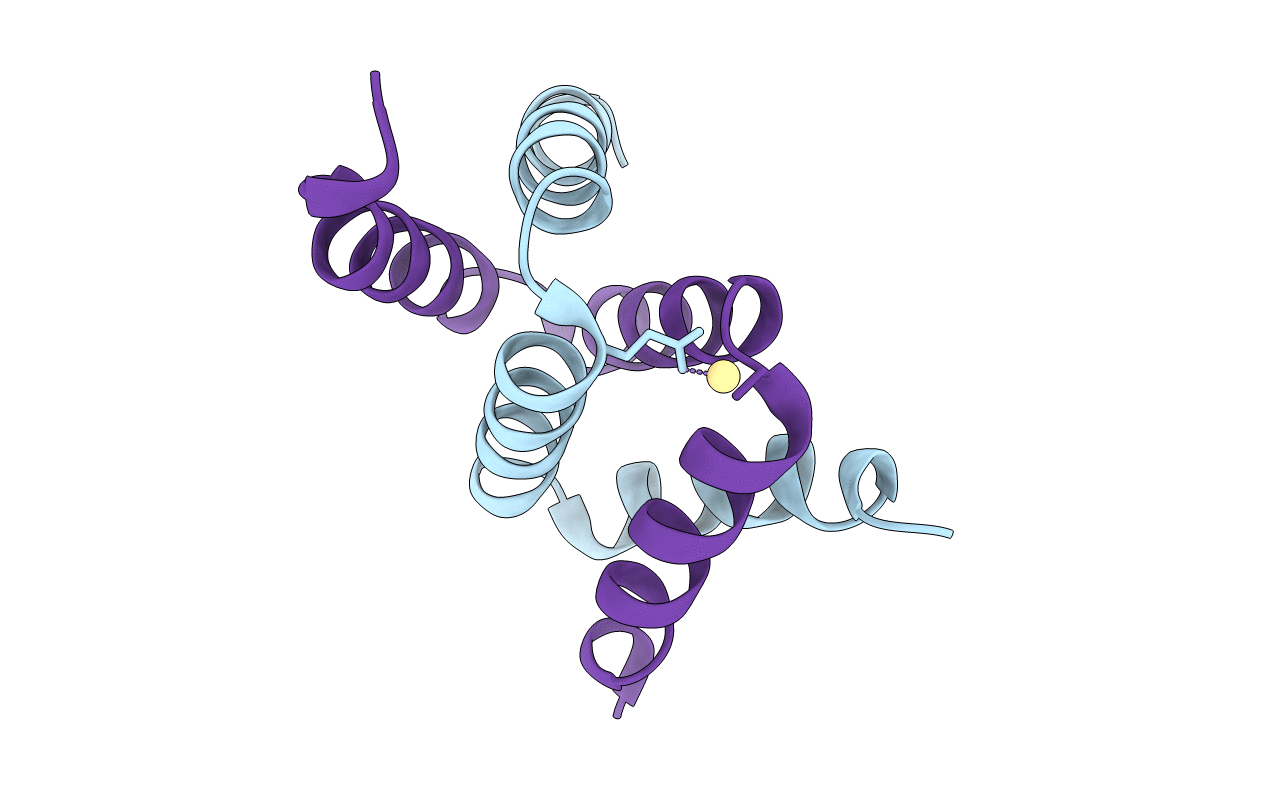
2P64 image
Deposition Date 2007-03-16
Release Date 2007-06-19
Last Version Date 2024-10-30
Entry Detail
PDB ID:
2P64
Keywords:
Title:
D domain of b-TrCP
Biological Source:
Source Organism(s):
Homo sapiens (Taxon ID: 9606)
Expression System(s):
Method Details:
Experimental Method:
Resolution:
2.50 Å
R-Value Free:
0.26
R-Value Work:
0.23
R-Value Observed:
0.23
Space Group:
P 43 21 2
Macromolecular Entities
Structures with similar UniProt ID
Protein Blast
Polymer Type:polypeptide(L)
Molecule:F-box/WD repeat protein 1A
Gene (Uniprot):BTRC
Chain IDs:A, B
Chain Length:52
Number of Molecules:2
Biological Source:Homo sapiens
Modified Residue
Compound ID Chain ID Parent Comp ID Details 2D Image
MSE A MET SELENOMETHIONINE
Ligand Molecules
Primary Citation
Suprafacial orientation of the SCFCdc4 dimer accommodates multiple geometries for substrate ubiquitination.
Cell(Cambridge,Mass.) 129 1165 1176 (2007)
PMID: 17574027 DOI: 10.1016/j.cell.2007.04.042

Abstact

SCF ubiquitin ligases recruit substrates for degradation via F box protein adaptor subunits. WD40 repeat F box proteins, such as Cdc4 and beta-TrCP, contain a conserved dimerization motif called the D domain. Here, we report that the D domain protomers of yeast Cdc4 and human beta-TrCP form a superhelical homotypic dimer. Disruption of the D domain compromises the activity of yeast SCF(Cdc4) toward the CDK inhibitor Sic1 and other substrates. SCF(Cdc4) dimerization has little effect on the affinity for Sic1 but markedly stimulates ubiquitin conjugation. A model of the dimeric holo-SCF(Cdc4) complex based on small-angle X-ray scatter measurements reveals a suprafacial configuration, in which substrate-binding sites and E2 catalytic sites lie in the same plane with a separation of 64 A within and 102 A between each SCF monomer. This spatial variability may accommodate diverse acceptor lysine geometries in both substrates and the elongating ubiquitin chain and thereby increase catalytic efficiency.

Legend

Protein

Chemical

Disease

Primary Citation of related structures
Feedback Form
Name
Email
Institute
Feedback