

2OAT image
Deposition Date 1998-05-07
Release Date 1998-12-09
Last Version Date 2024-05-22
Entry Detail
PDB ID:
2OAT
Title:
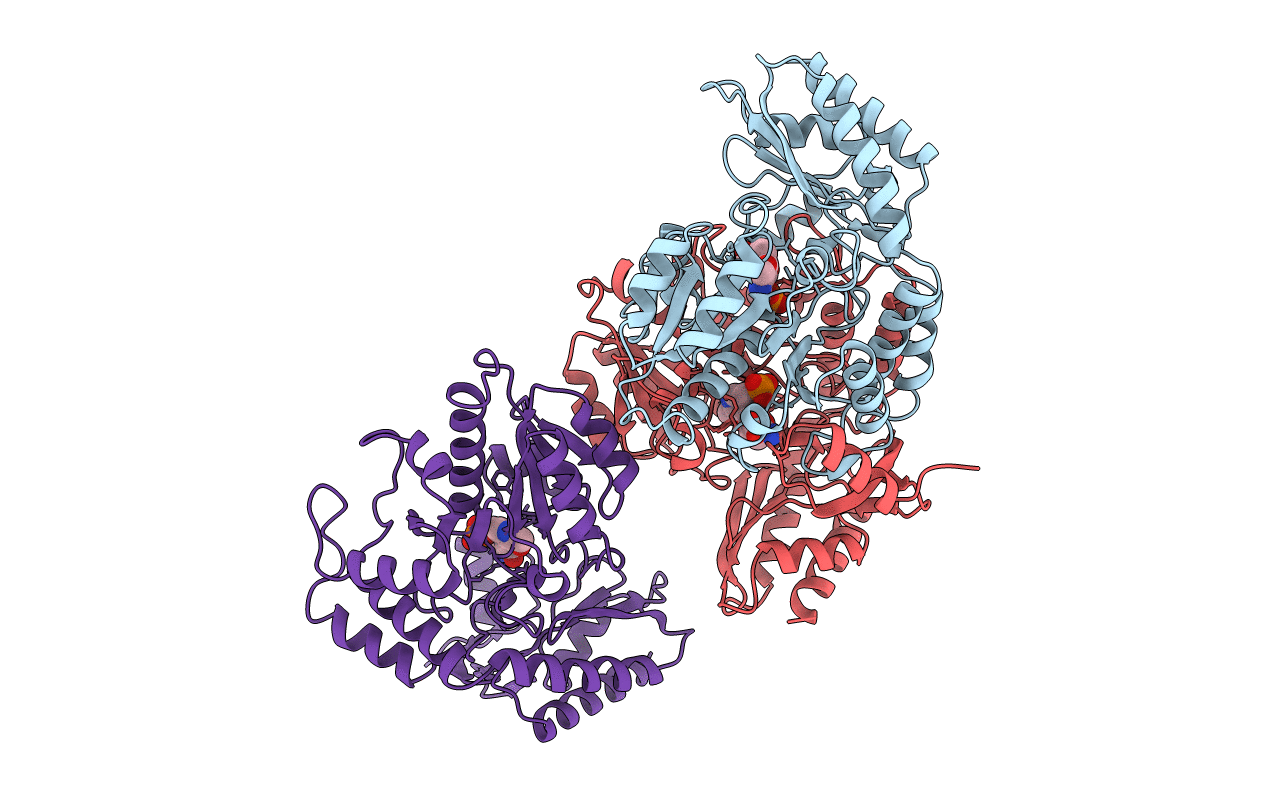
ORNITHINE AMINOTRANSFERASE COMPLEXED WITH 5-FLUOROMETHYLORNITHINE
Biological Source:
Source Organism(s):
Homo sapiens (Taxon ID: 9606)
Expression System(s):
Method Details:
Experimental Method:
Resolution:
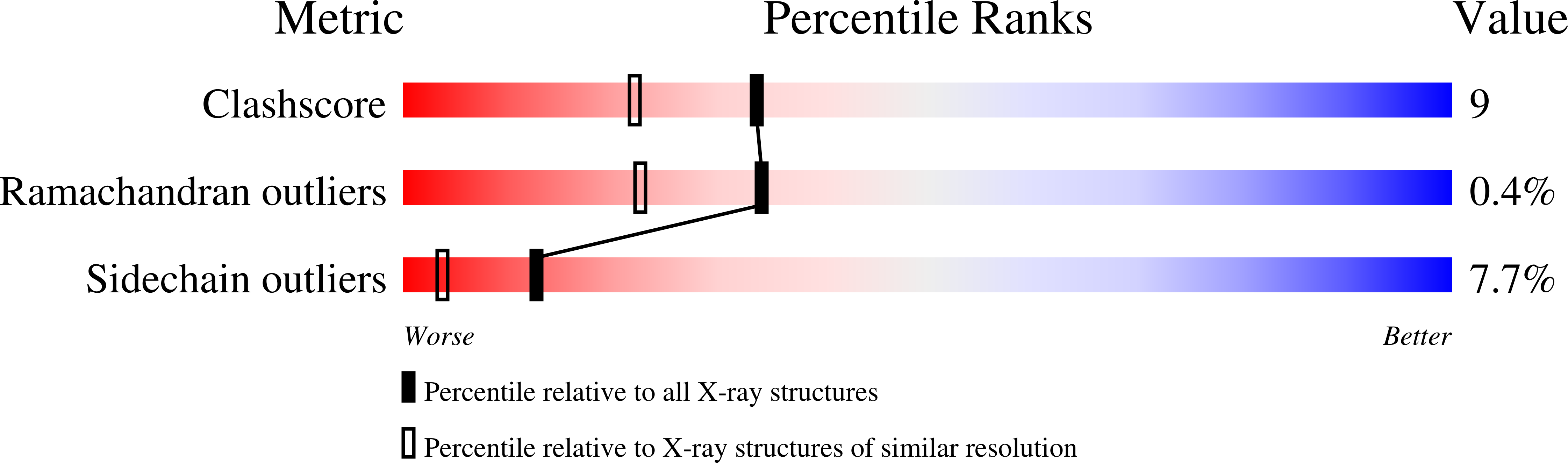
1.95 Å
R-Value Free:
0.23
R-Value Work:
0.20
R-Value Observed:
0.20
Space Group:
P 32 2 1
Macromolecular Entities
Structures with similar UniProt ID
Protein Blast
Polymer Type:polypeptide(L)
Molecule:ORNITHINE AMINOTRANSFERASE
Gene (Uniprot):OAT
Chain IDs:A, B, C
Chain Length:439
Number of Molecules:3
Biological Source:Homo sapiens
Ligand Molecules
Primary Citation
Crystal structure of human ornithine aminotransferase complexed with the highly specific and potent inhibitor 5-fluoromethylornithine.
J. Mol. Biol. 285 297 309 (1999)
PMID: 9878407 DOI: 10.1006/jmbi.1998.2289

Abstact

Ornithine aminotransferase (l-ornithine:2-oxoacid delta-aminotransferase; EC 2.6.1.13), a pyridoxal-5'-phosphate-dependent mitochondrial enzyme controls the l-ornithine level in tissues by catalyzing the transfer of the delta-amino group of l-ornithine to 2-oxoglutarate, producing l-glutamate- gamma-semialdehyde and l-glutamate. (2S, 5S)-5-Fluoromethylornithine is the only inhibitor exclusively specific for ornithine aminotransferase known to date. Both in vitro and in vivo, it blocks the enzyme by a suicide reaction leading to a covalent adduct with the cofactor. The crystal structure of the enzyme-inhibitor complex was solved at a resolution of 1.95 A. No significant conformational changes compared with the native enzyme structure were observed. The structure reveals the atomic details of the cofactor-inhibitor adduct and its interactions with the active site of the enzyme. The main residues responsible for specific binding of the inhibitor are Arg180, which forms a strong salt bridge with the alpha-carboxylate and Tyr55, which is involved in a short hydrogen bond with the alpha-amino group. The experimental observation that in the racemic mixture, (2S, 5S)-5-fluoromethylornithine is exclusively responsible for the enzyme inhibition can be explained on the basis of the active site topology. Model building studies strongly suggest that the natural substrate l-ornithine, in its external aldimine adduct with the enzyme, makes use of the same recognition site as the inhibitor. It is proposed that the neutralization of the active site Arg413 by a salt bridge with Glu235 also plays an important role in productive binding of both 5-fluoromethylornithine and l-ornithine. Arg180 and Arg413 are believed to be instrumental in recognition of l-glutamate, by binding its gamma and alpha-carboxylate groups, respectively. This requires a different side-chain conformation of Glu235. Lys292 is the only obvious candidate for catalyzing the rate-limiting proton transfer steps in the transamination reaction.

Legend

Protein

Chemical

Disease

Primary Citation of related structures
Feedback Form
Name
Email
Institute
Feedback