

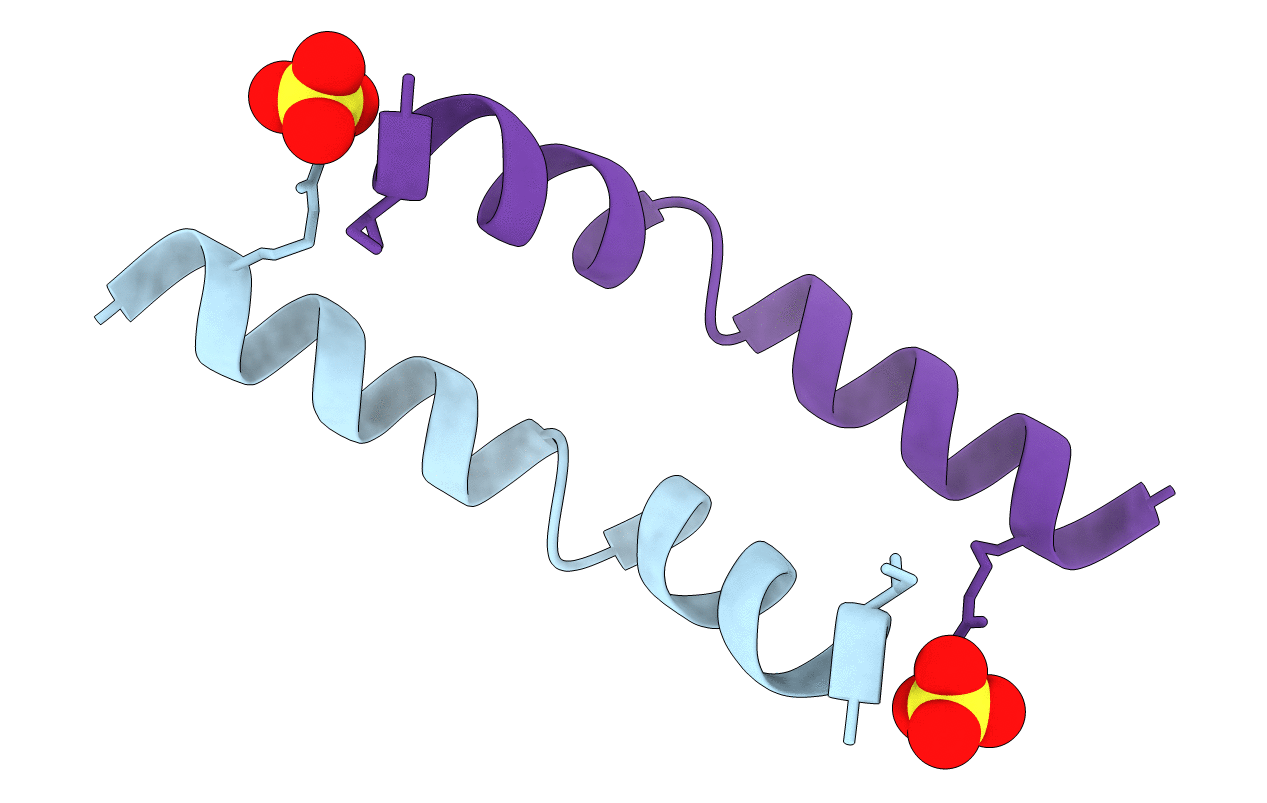
2MLT image
Deposition Date 1990-10-04
Release Date 1990-10-15
Last Version Date 2024-11-20
Entry Detail
PDB ID:
2MLT
Title:
MELITTIN
Biological Source:
Source Organism(s):
Apis mellifera (Taxon ID: 7460)
Method Details:
Experimental Method:
Resolution:
2.00 Å
R-Value Observed:
0.19
Space Group:
C 2 2 21
Macromolecular Entities
Structures with similar UniProt ID
Protein Blast
Polymer Type:polypeptide(L)
Molecule:MELITTIN
Gene (Uniprot):MELT
Chain IDs:A, B
Chain Length:27
Number of Molecules:2
Biological Source:Apis mellifera
Ligand Molecules
Primary Citation
The structure of melittin. I. Structure determination and partial refinement.
J Biol Chem 257 6010 ? (1982)
PMID: 7076661 DOI: .

Abstact

Melittin is the principal protein component of bee venom and is thought to function as a lytic agent. Despite its predominantly hydrophobic character, melittin is soluble as a tetramer in aqueous salt solutions. We report here on the determination of the crystal structure of tetrameric melittin at 2.8-A resolution by the method of multiple isomorphous replacement, followed by partial atomic refinement at 2.0-A resolution. The melittin tetramer contains a noncrystallographic 2-fold axis of symmetry in addition to a crystallographic 2-fold axis, so that the four polypeptide chains have nearly identical structures. The noncrystallographic 2-fold axis was utilized twice during the determination of the structure. The multiple isomorphous replacement electron density map was averaged over this 2-fold axis before model building and strict noncrystallographic symmetry was assumed during the initial stages of atomic refinement. The 2.8-A resolution electron density map suggests that the melittin monomer contains two alpha-helical regions separated by a non-alpha-helical segment at residues 11 and 12. Difference maps at 2.0-A resolution tend to confirm this structure and reveal that at least six solvent molecules are bound to the melittin tetramer in the crystal. The relatively high occupancies of four of these suggest that they are ions of crystallization rather than water molecules.

Legend

Protein

Chemical

Disease

Primary Citation of related structures
Feedback Form
Name
Email
Institute
Feedback