

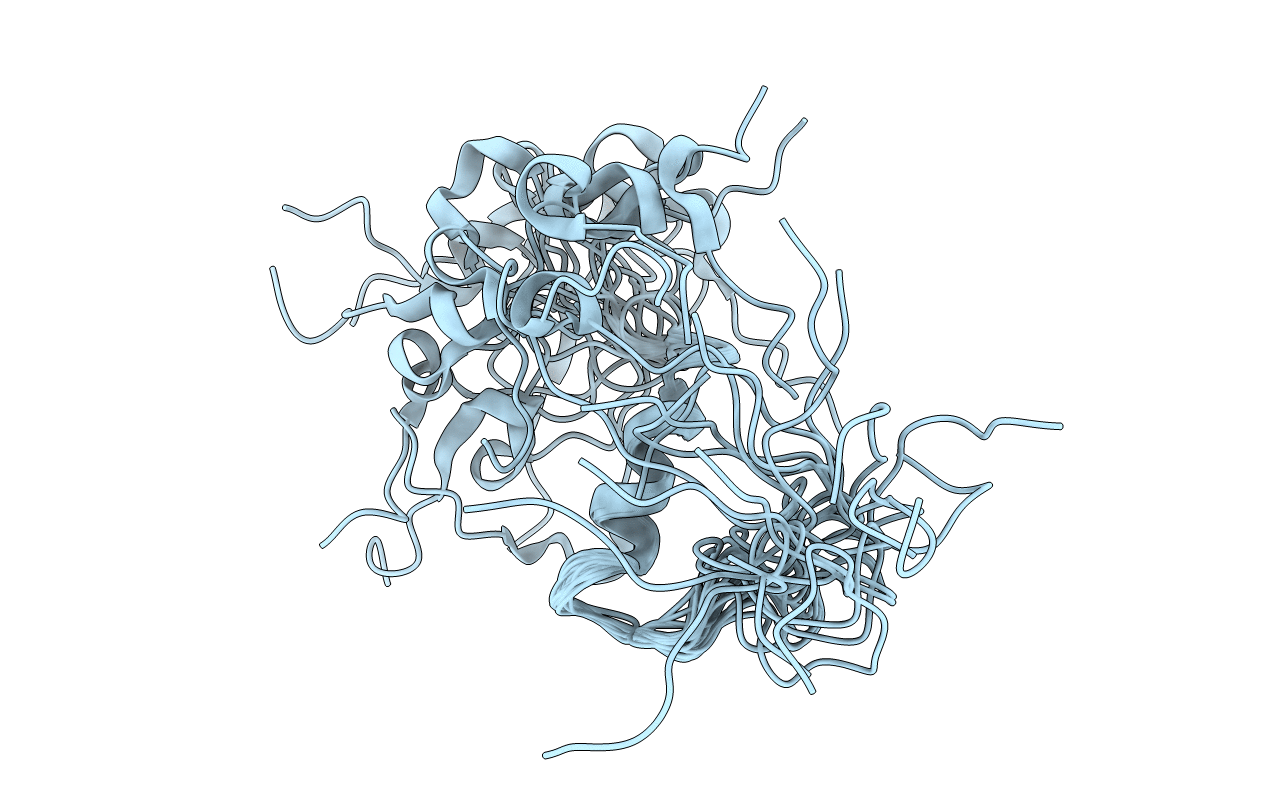
2L7S image
Deposition Date 2010-12-21
Release Date 2011-09-28
Last Version Date 2024-11-20
Entry Detail
PDB ID:
2L7S
Keywords:
Title:
Determination of the three-dimensional structure of adrenomedullin, a first step towards the analysis of its interactions with receptors and small molecules
Biological Source:
Source Organism(s):
Homo sapiens (Taxon ID: 9606)
Method Details:
Experimental Method:
Conformers Calculated:
100
Conformers Submitted:
20
Selection Criteria:
structures with the lowest energy

Macromolecular Entities
Structures with similar UniProt ID
Protein Blast
Polymer Type:polypeptide(L)
Molecule:Adrenomedullin
Gene (Uniprot):ADM
Chain IDs:A
Chain Length:53
Number of Molecules:1
Biological Source:Homo sapiens
Ligand Molecules
Primary Citation
Structure of micelle-bound adrenomedullin: a first step toward the analysis of its interactions with receptors and small molecules.
Biopolymers 97 45 53 (2012)
PMID: 21830197 DOI: 10.1002/bip.21700

Abstact

Adrenomedullin (AM) is a regulatory peptide which plays many physiological roles including vasodilatation, bronchodilatation, hormone secretion regulation, growth, apoptosis, angiogenesis, and antimicrobial activities, among others. These regulatory activities make AM a relevant player in the pathophysiology of important diseases such as cardiovascular and renal conditions, cancer, and diabetes. Therefore, molecules that target the AM system have been proposed as having therapeutic potential. To guide the design and characterization of such molecules, we elucidated the three-dimensional structure of AM in a membrane mimicking medium using NMR spectroscopy methods. Under the employed experimental conditions, the structure can be described as composed by a central α-helical region, spanning about one third of its total length, flanked by two disordered segments at both N- and C-termini. The structure of AM in water is completely disordered. The 22-34 region of AM has a general tendency to adopt a helical structure under the employed experimental conditions. Furthermore, the study of the interaction of AM with two of its modulators has also been performed by using chemical shift perturbation analysis NMR methods with two-dimensional (2D)-TOCSY experiments, assisted with molecular modeling protocols. We expect these results will help in better understanding the interactions of AM with its receptor and binding proteins/molecules and in the development of novel modulators of AM activities.

Legend

Protein

Chemical

Disease

Primary Citation of related structures
Feedback Form
Name
Email
Institute
Feedback