

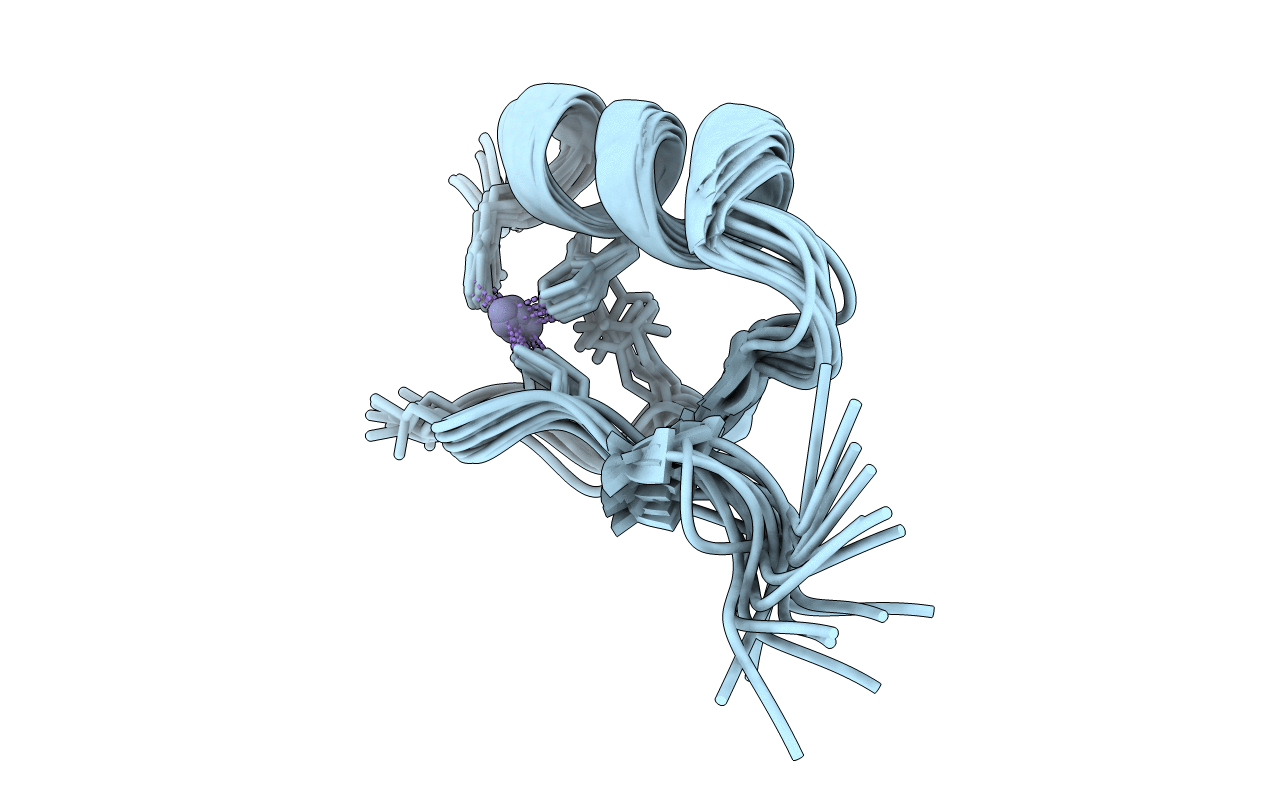
2KVH image
Deposition Date 2010-03-15
Release Date 2010-04-14
Last Version Date 2024-11-20
Entry Detail
PDB ID:
2KVH
Keywords:
Title:
Structure of the three-Cys2His2 domain of mouse testis zinc finger protein
Biological Source:
Source Organism(s):
Mus musculus (Taxon ID: 10090)
Expression System(s):
Method Details:
Experimental Method:
Conformers Calculated:
50
Conformers Submitted:
15
Selection Criteria:
structures with the lowest energy

Macromolecular Entities
Structures with similar UniProt ID
Protein Blast
Polymer Type:polypeptide(L)
Molecule:Zinc finger and BTB domain-co
Gene (Uniprot):Zbtb32
Chain IDs:A
Chain Length:27
Number of Molecules:1
Biological Source:Mus musculus
Ligand Molecules
Primary Citation
Structure and DNA binding characteristics of the three-Cys(2)His(2) domain of mouse testis zinc finger protein.
Proteins 78 2202 2212 (2010)
PMID: 20544958 DOI: 10.1002/prot.22732

Abstact

The C-terminal three-Cys(2)His(2) zinc-finger domain (TZD) of mouse testis zinc-finger protein binds to the 5'-TGTACAGTGT-3' at the Aie1 (aurora-C) promoter with high specificity. Interestingly, the primary sequence of TZD is unique, possessing two distinct linkers, TGEKP and GAAP, and distinct residues at presumed DNA binding sites at each finger, especially finger 3. A K(d) value of approximately 10(-8) M was obtained from surface plasmon resonance analysis for the TZD-DNA complex. NMR structure of the free TZD showed that each zinc finger forms a typical beta beta alpha fold. On binding to DNA, chemical shift perturbations and the R(2) transverse relaxation rate in finger 3 are significantly smaller than those in fingers 1 and 2, which indicates that the DNA binding affinity in finger 3 is weaker. Furthermore, the shift perturbations between TZD in complex with the cognate DNA and its serial mutants revealed that both ADE7 and CYT8, underlined in 5'-ATATGTACAGTGTTAT-3', are critical in specific binding, and the DNA binding in finger 3 is sequence independent. Remarkably, the shift perturbations in finger 3 on the linker mutation of TZD (GAAP mutated to TGEKP) were barely detected, which further indicates that finger 3 does not play a critical role in DNA sequence-specific recognition. The complex model showed that residues important for DNA binding are mainly located on positions -1, 2, 3, and 6 of alpha-helices in fingers 1 and 2. The DNA sequence and nonsequence-specific bindings occurring simultaneously in TZD provide valuable information for better understanding of protein-DNA recognition.

Legend

Protein

Chemical

Disease

Primary Citation of related structures
Feedback Form
Name
Email
Institute
Feedback