

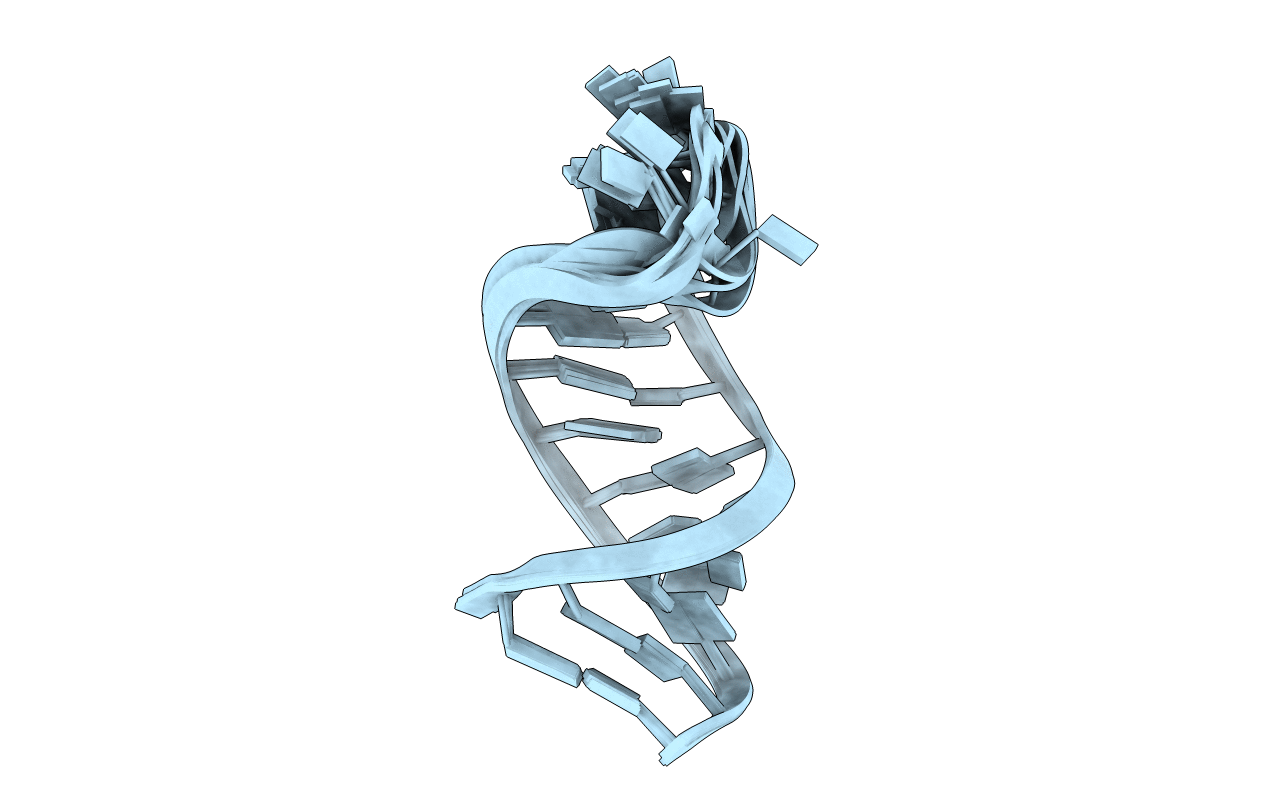
2KEZ image
Deposition Date 2009-02-08
Release Date 2009-07-21
Last Version Date 2024-05-22
Entry Detail
PDB ID:
2KEZ
Keywords:
Title:
NMR structure of U6 ISL at pH 8.0
Method Details:
Experimental Method:
Conformers Calculated:
12
Conformers Submitted:
10
Selection Criteria:
structures with the lowest energy
Macromolecular Entities
Polymer Type:polyribonucleotide
Molecule:RNA (5'-R(*GP*GP*UP*UP*CP*CP*
Mutagens:A62G
Chain IDs:A
Chain Length:24
Number of Molecules:1
Biological Source:
Ligand Molecules
Primary Citation
Minimum-energy path for a u6 RNA conformational change involving protonation, base-pair rearrangement and base flipping.
J. Mol. Biol. 391 894 905 (2009)
PMID: 19591840 DOI: 10.1016/j.jmb.2009.07.003

Abstact

The U6 RNA internal stem-loop (U6 ISL) is a highly conserved domain of the spliceosome that is important for pre-mRNA splicing. The U6 ISL contains an internal loop that is in equilibrium between two conformations controlled by the protonation state of an adenine (pK(a)=6.5). Lower pH favors formation of a protonated C-A(+) wobble pair and base flipping of the adjacent uracil. Higher pH favors stacking of the uracil and allows an essential metal ion to bind at this position. Here, we define the minimal-energy path for this conformational transition. To do this, we solved the U6 ISL structure at higher pH (8.0) in order to eliminate interference from the low-pH conformer. This structure reveals disruption of the protonated C-A(+) pair and formation of a new C-U pair, which explains the preference for a stacked uracil at higher pH. Next, we used nudged elastic band molecular dynamics simulations to calculate the minimum-energy path between the two conformations. Our results indicate that the C-U pair is dynamic, which allows formation of the more stable C-A(+) pair upon adenine protonation. After formation of the C-A(+) pair, the unpaired uracil follows a minor-groove base-flipping pathway. Molecular dynamics simulations suggest that the extrahelical uracil is stabilized by contacts with the adjacent helix.

Legend

Protein

Chemical

Disease

Primary Citation of related structures
Feedback Form
Name
Email
Institute
Feedback