

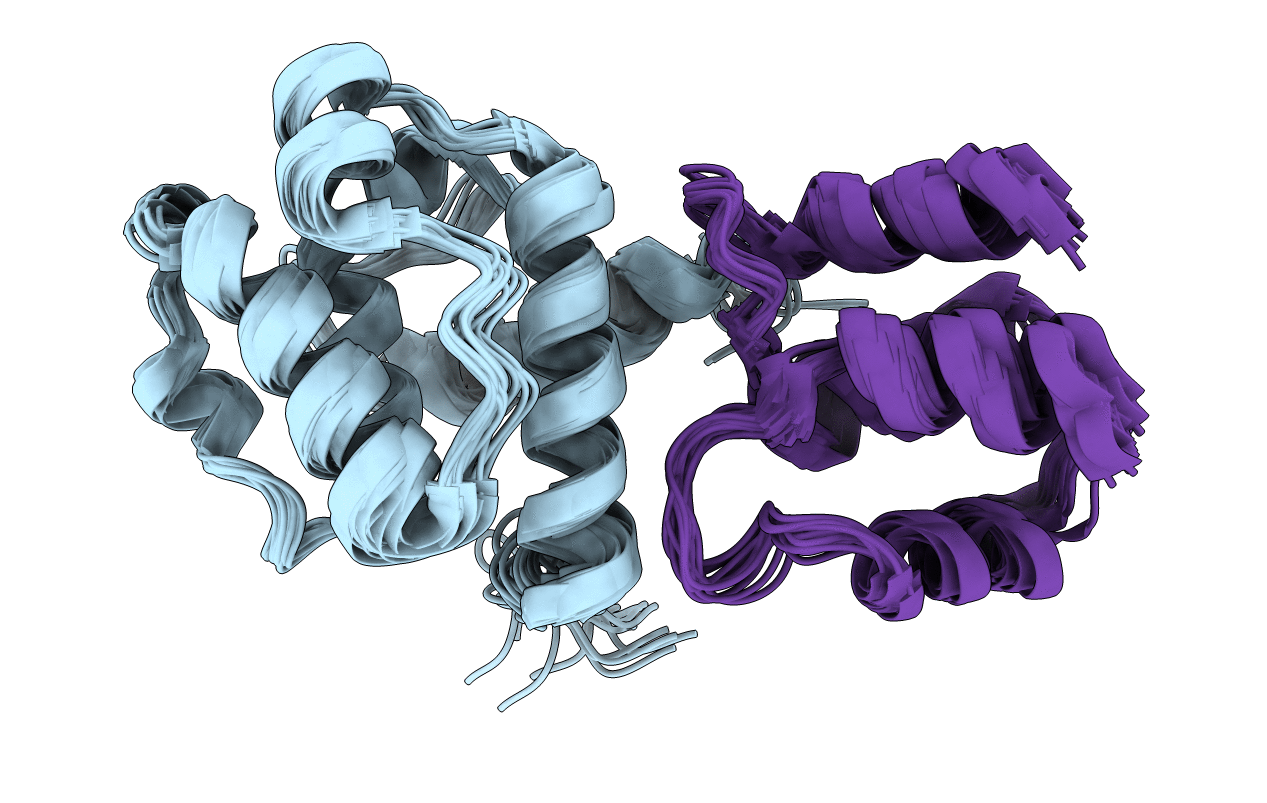
2K3S image
Deposition Date 2008-05-15
Release Date 2008-05-27
Last Version Date 2024-05-29
Entry Detail
PDB ID:
2K3S
Keywords:
Title:
HADDOCK-derived structure of the CH-domain of the smoothelin-like 1 complexed with the C-domain of apocalmodulin
Biological Source:
Source Organism(s):
Mus musculus (Taxon ID: )
Expression System(s):
Method Details:
Experimental Method:
Conformers Calculated:
1000
Conformers Submitted:
15
Selection Criteria:
structures with the lowest energy
Macromolecular Entities
Structures with similar UniProt ID
Protein Blast
Polymer Type:polypeptide(L)
Molecule:Smoothelin-like protein 1
Gene (Uniprot):Smtnl1
Chain IDs:A
Chain Length:119
Number of Molecules:1
Biological Source:Mus musculus
Structures with similar UniProt ID
Protein Blast
Polymer Type:polypeptide(L)
Molecule:Calmodulin
Chain IDs:B
Chain Length:67
Number of Molecules:1
Biological Source:Xenopus laevis
Ligand Molecules
Primary Citation
Solution structure of the calponin homology (CH) domain from the smoothelin-like 1 protein: a unique apocalmodulin-binding mode and the possible role of the C-terminal type-2 CH-domain in smooth muscle relaxation.
J. Biol. Chem. 283 20569 20578 (2008)
PMID: 18477568 DOI: 10.1074/jbc.M800627200

Abstact

The SMTNL1 protein contains a single type-2 calponin homology (CH) domain at its C terminus that shares sequence identity with the smoothelin family of smooth muscle-specific proteins. In contrast to the smoothelins, SMTNL1 does not associate with F-actin in vitro, and its specific role in smooth muscle remains unclear. In addition, the biological function of the C-terminal CH-domains found in the smoothelin proteins is also poorly understood. In this work, we have therefore determined the solution structure of the CH-domain of mouse SMTNL1 (SMTNL1-CH; residues 346-459). The secondary structure and the overall fold for the C-terminal type-2 CH-domain is very similar to that of other CH-domains. However, two clusters of basic residues form a unique surface structure that is characteristic of SMTNL1-CH. Moreover, the protein has an extended C-terminal alpha-helix, which contains a calmodulin (CaM)-binding IQ-motif, that is also a distinct feature of the smoothelins. We have characterized the binding of apo-CaM to SMTNL1-CH through its IQ-motif by isothermal titration calorimetry and NMR chemical shift perturbation studies. In addition, we have used the HADDOCK protein-protein docking approach to construct a model for the complex of apo-CaM and SMTNL1-CH. The model revealed a close interaction of SMTNL1-CH with the two Ca(2+) binding loop regions of the C-terminal domain of apo-CaM; this mode of apo-CaM binding is distinct from previously reported interactions of apo-CaM with IQ-motifs. Finally, we comment on the putative role of the CH-domain in the biological function of SMTNL1.

Legend

Protein

Chemical

Disease

Primary Citation of related structures
Feedback Form
Name
Email
Institute
Feedback