

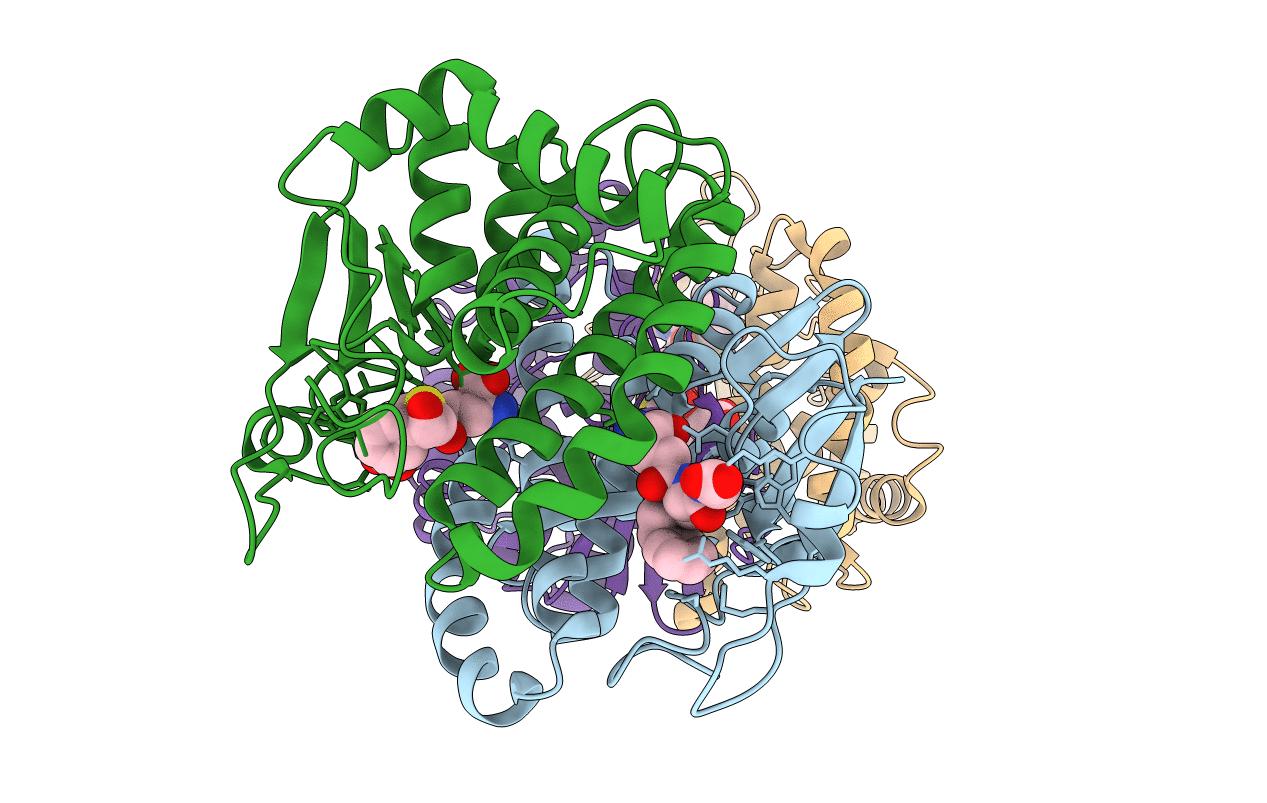
2C4J image
Deposition Date 2005-10-20
Release Date 2005-10-26
Last Version Date 2023-12-13
Entry Detail
PDB ID:
2C4J
Keywords:
Title:
Human glutathione-S-transferase M2-2 T210S mutant in complex with glutathione-styrene oxide conjugate
Biological Source:
Source Organism(s):
HOMO SAPIENS (Taxon ID: 9606)
Expression System(s):
Method Details:
Experimental Method:
Resolution:
1.35 Å
R-Value Free:
0.21
R-Value Work:
0.19
R-Value Observed:
0.19
Space Group:
P 1 21 1

Macromolecular Entities
Structures with similar UniProt ID
Protein Blast
Polymer Type:polypeptide(L)
Molecule:GLUTATHIONE S-TRANSFERASE MU
Gene (Uniprot):GSTM2
Mutagens:YES
Chain IDs:A, B, C, D
Chain Length:218
Number of Molecules:4
Biological Source:HOMO SAPIENS
Ligand Molecules
Primary Citation
Alternative Mutations of a Positively Selected Residue Elicit Gain or Loss of Functionalities in Enzyme Evolution.
Proc. Natl. Acad. Sci. U.S.A. 103 4876 ? (2006)
PMID: 16549767 DOI: 10.1073/PNAS.0600849103

Abstact

All molecular species in an organism are connected physically and functionally to other molecules. In evolving systems, it is not obvious to what extent functional properties of a protein can change to selective advantage and leave intact favorable traits previously acquired. This uncertainty has particular significance in the evolution of novel pathways for detoxication, because an organism challenged with new xenobiotics in the environment may still require biotransformation of previously encountered toxins. Positive selection has been proposed as an evolutionary mechanism for facile adaptive responses of proteins to changing conditions. Here, we show, by saturation mutagenesis, that mutations of a hypervariable residue in human glutathione transferase M2-2 can differentially change the enzyme's substrate-activity profile with alternative substrates and, furthermore, enable or disable dissimilar chemical reactions. Crystal structures demonstrate that activity with epoxides is enabled through removal of steric hindrance from a methyl group, whereas activities with an orthoquinone and a nitroso donor are maintained in the variant enzymes. Given the diversity of cellular activities in which a single protein can be engaged, the selective transmutation of functional properties has general significance in molecular evolution.

Legend

Protein

Chemical

Disease

Primary Citation of related structures
Feedback Form
Name
Email
Institute
Feedback