

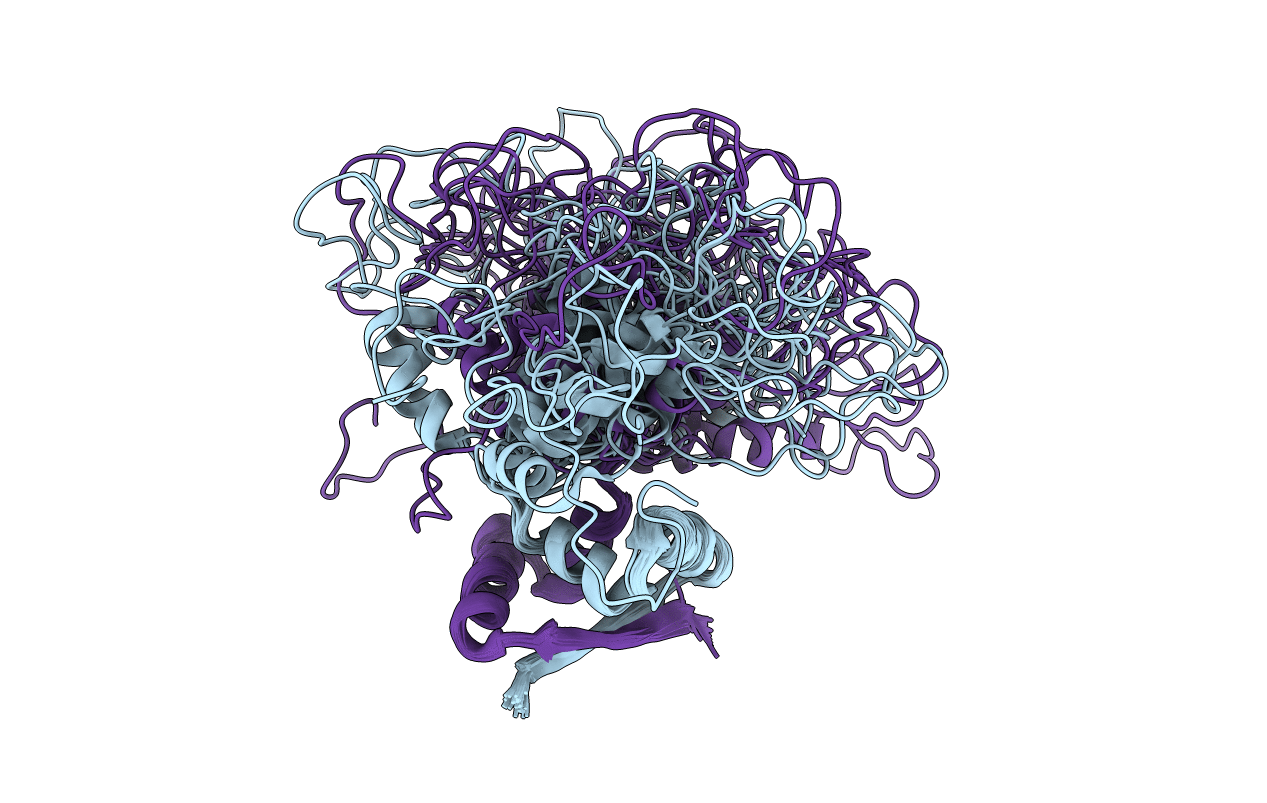
2AN7 image
Deposition Date 2005-08-11
Release Date 2006-09-05
Last Version Date 2024-05-15
Entry Detail
PDB ID:
2AN7
Title:
Solution structure of the bacterial antidote ParD
Biological Source:
Source Organism(s):
Escherichia coli (Taxon ID: 562)
Expression System(s):
Method Details:
Experimental Method:
Conformers Calculated:
150
Conformers Submitted:
24
Selection Criteria:
structures with the lowest energy
Macromolecular Entities
Structures with similar UniProt ID
Protein Blast
Polymer Type:polypeptide(L)
Molecule:Protein parD
Gene (Uniprot):parD
Chain IDs:A, B
Chain Length:83
Number of Molecules:2
Biological Source:Escherichia coli
Ligand Molecules
Primary Citation
The solution structure of ParD, the antidote of the ParDE toxin antitoxin module, provides the structural basis for DNA and toxin binding.
Protein Sci. 16 1676 1688 (2007)
PMID: 17656583 DOI: 10.1110/ps.062680707

Abstact

ParD is the antidote of the plasmid-encoded toxin-antitoxin (TA) system ParD-ParE. These modules rely on differential stabilities of a highly expressed but labile antidote and a stable toxin expressed from one operon. Consequently, loss of the coding plasmid results in loss of the protective antidote and poisoning of the cell. The antidote protein usually also exhibits an autoregulatory function of the operon. In this paper, we present the solution structure of ParD. The repressor activity of ParD is mediated by the N-terminal half of the protein, which adopts a ribbon-helix-helix (RHH) fold. The C-terminal half of the protein is unstructured in the absence of its cognate binding partner ParE. Based on homology with other RHH proteins, we present a model of the ParD-DNA interaction, with the antiparallel beta-strand being inserted into the major groove of DNA. The fusion of the N-terminal DNA-binding RHH motif to the toxin-binding unstructured C-terminal domain is discussed in its evolutionary context.

Legend

Protein

Chemical

Disease

Primary Citation of related structures
Feedback Form
Name
Email
Institute
Feedback