

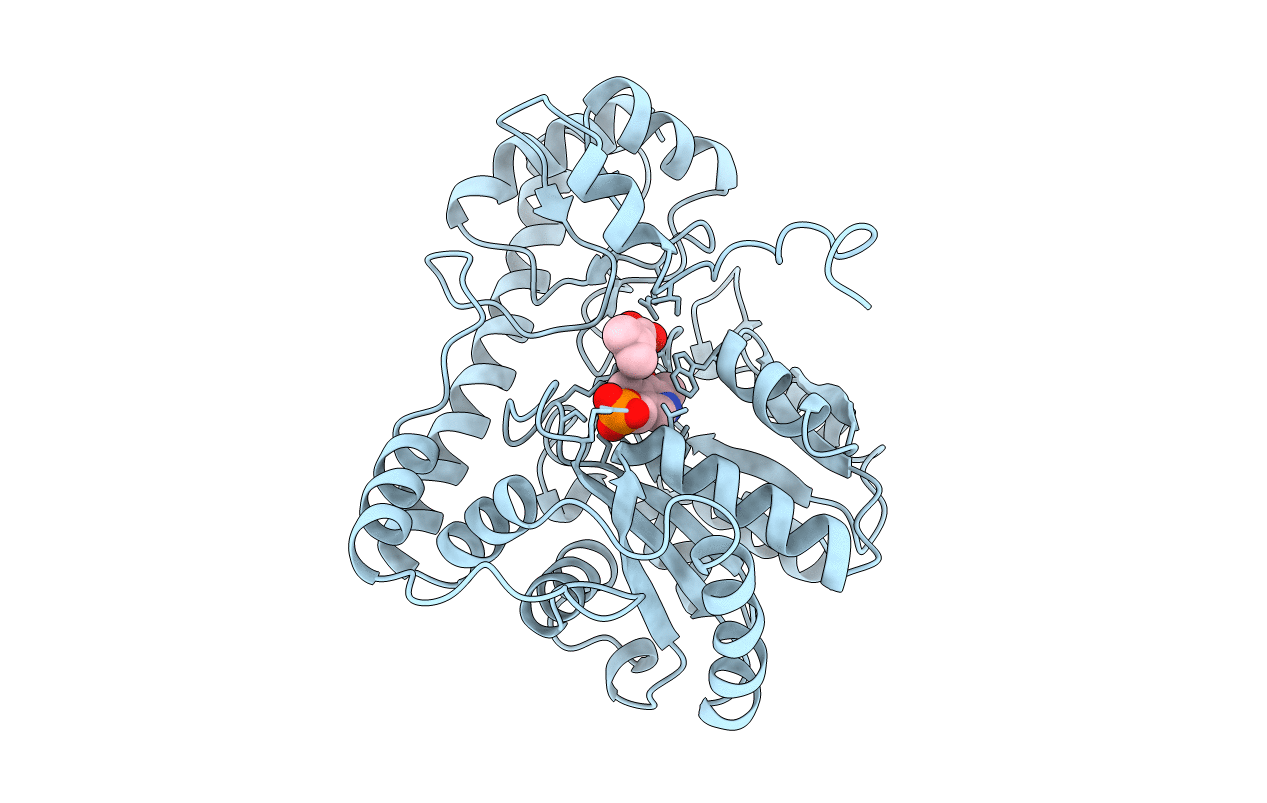
1YOO image
Deposition Date 1998-06-26
Release Date 1999-02-02
Last Version Date 2023-08-09
Entry Detail
PDB ID:
1YOO
Title:
ASPARTATE AMINOTRANSFERASE MUTANT ATB17 WITH ISOVALERIC ACID
Biological Source:
Source Organism(s):
Escherichia coli (Taxon ID: 562)
Expression System(s):
Method Details:
Experimental Method:
Resolution:
2.40 Å
R-Value Free:
0.23
R-Value Work:
0.16
R-Value Observed:
0.16
Space Group:
C 2 2 21

Macromolecular Entities
Structures with similar UniProt ID
Protein Blast
Polymer Type:polypeptide(L)
Molecule:ASPARTATE AMINOTRANSFERASE
Gene (Uniprot):aspC
Mutagens:A11T, F24L, N34D, I37M, K41N, K126R, S139G, N142T, A269T, A293V, N297S, S311G, I353T, S361F, S363G, V387L, M397L
Chain IDs:A
Chain Length:396
Number of Molecules:1
Biological Source:Escherichia coli
Primary Citation
Redesigning the substrate specificity of an enzyme by cumulative effects of the mutations of non-active site residues.
J. Biol. Chem. 274 2344 2349 (1999)
PMID: 9891001 DOI: 10.1074/jbc.274.4.2344

Abstact

Directed evolution was used to change the substrate specificity of aspartate aminotransferase. A mutant enzyme with 17 amino acid substitutions was generated that shows a 2.1 x 10(6)-fold increase in the catalytic efficiency (kcat/Km) for a non-native substrate, valine. The absorption spectrum of the bound coenzyme, pyridoxal 5'-phosphate, is also changed significantly by the mutations. Interestingly, only one of the 17 residues appears to be able to contact the substrate, and none of them interact with the coenzyme. The three-dimensional structure of the mutant enzyme complexed with a valine analog, isovalerate (determined to 2.4-A resolution by x-ray crystallography), provides insights into how the mutations affect substrate binding. The active site is remodeled; the subunit interface is altered, and the enzyme domain that encloses the substrate is shifted by the mutations. The present results demonstrate clearly the importance of the cumulative effects of residues remote from the active site and represent a new line of approach to the redesign of enzyme activity.

Legend

Protein

Chemical

Disease

Primary Citation of related structures
Feedback Form
Name
Email
Institute
Feedback