

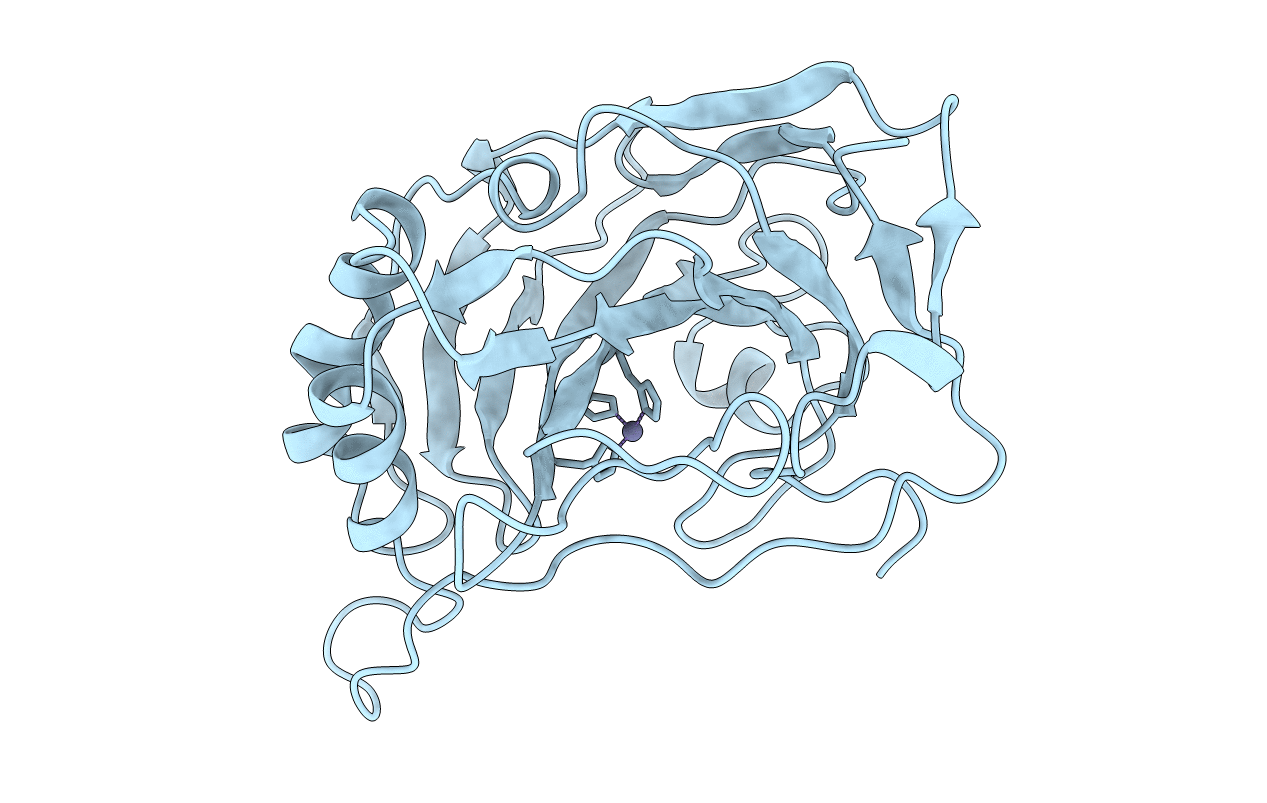
1URT image
Deposition Date 1996-07-03
Release Date 1997-01-11
Last Version Date 2024-02-14
Entry Detail
PDB ID:
1URT
Keywords:
Title:
MURINE CARBONIC ANHYDRASE V
Biological Source:
Source Organism(s):
Mus musculus (Taxon ID: 10090)
Expression System(s):
Method Details:
Experimental Method:
Resolution:
2.80 Å
R-Value Free:
0.24
R-Value Work:
0.13
R-Value Observed:
0.13
Space Group:
C 1 2 1

Macromolecular Entities
Structures with similar UniProt ID
Protein Blast
Polymer Type:polypeptide(L)
Molecule:CARBONIC ANHYDRASE V
Gene (Uniprot):Ca5a
Mutagens:Y64H, F65A, TRUNCATION OF MITOCHONDRIAL LEADER SEQUENCE AND FIRST 21 RESIDUES
Chain IDs:A
Chain Length:248
Number of Molecules:1
Biological Source:Mus musculus
Ligand Molecules
Primary Citation
Structure-based design of an intramolecular proton transfer site in murine carbonic anhydrase V.
Biochemistry 35 11605 11611 (1996)
PMID: 8794740 DOI: 10.1021/bi9608018

Abstact

Carbonic anhydrase V (CA V) is a mitochondrial enzyme that catalyzes the hydration of CO2 to produce bicarbonate and a proton. The catalytic properties of wild-type murine CA V suggest the presence of a proton shuttle residue having pKa = 9.2, the role of which is to transfer a proton from zinc-bound water to solution in the hydration direction to regenerate the zinc hydroxide form of the enzyme. Two likely candidates for shuttle residues are the tyrosines at positions 64 and 131 in the active site cavity. The crystal structure of wild-type carbonic anhydrase V [Boriack-Sjodin et al. (1995) Proc. Natl. Acad. Sci. U.S.A. 92, 10949-10953] shows that the side chain of Tyr 64 is forced into an orientation pointing away from the zinc by Phe 65, although Tyr 131 is oriented toward the zinc. We have prepared mutants of murine CA V replacing both Tyr 64 and Tyr 131 with His and Ala and investigated the proton shuttle mechanism using stopped-flow spectrophotometry and the depletion of 18O from CO2 measured by mass spectrometry. Experiments with both single and double mutations showed that neither position 64 nor position 131 was a prominent site for proton transfer. However, a double mutant of CA V containing the two replacements, Tyr 64-->His and Phe 65-->Ala, demonstrated enhanced proton transfer with an apparent pKa of 6.8 and maximal contribution to kcat of 2.2 x 10(5) s-1. In addition to the altered catalytic properties, the crystal structure of the His 64/Ala 65 double mutant strongly suggested proton transfer by His 64 after removal of the steric hindrance of Phe 65. This is the first structure-based design of an efficient proton transfer site in an enzyme.

Legend

Protein

Chemical

Disease

Primary Citation of related structures
Feedback Form
Name
Email
Institute
Feedback