

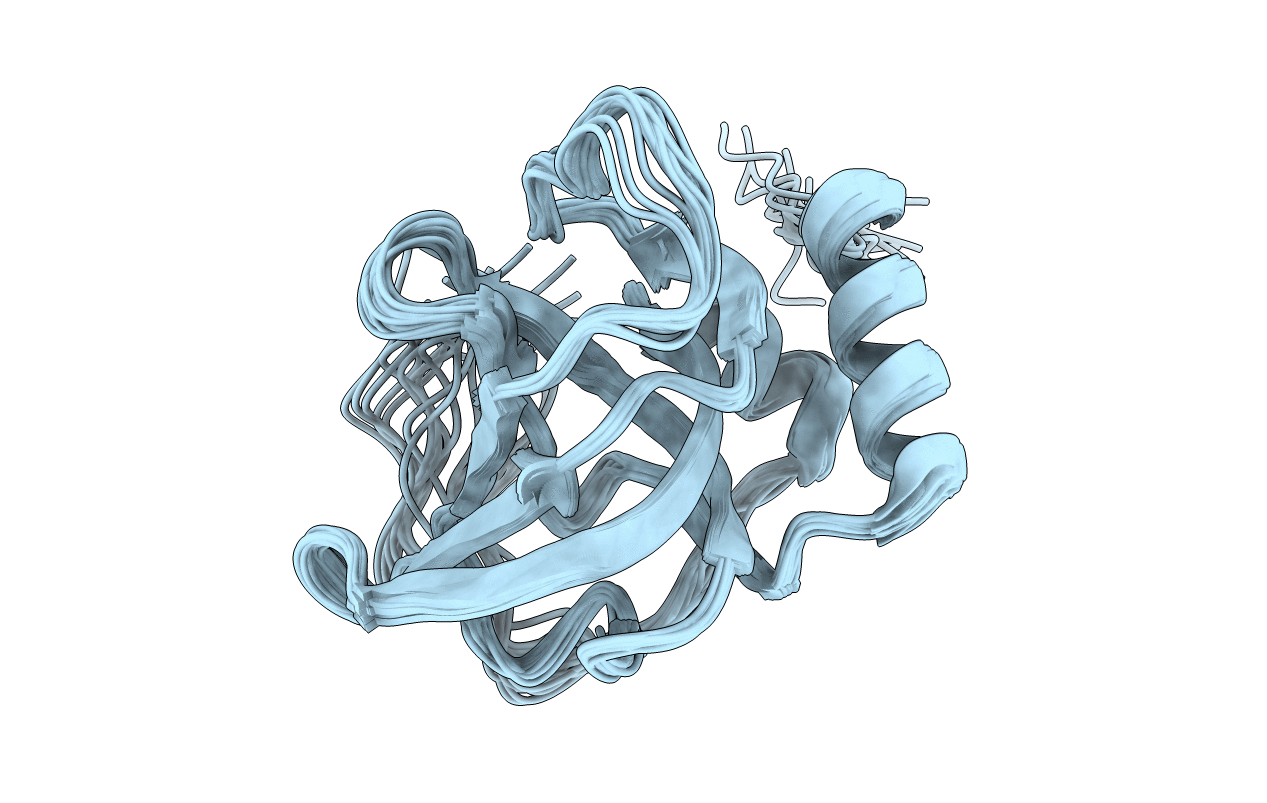
1UAP image
Deposition Date 2003-03-14
Release Date 2003-07-15
Last Version Date 2024-11-20
Entry Detail
PDB ID:
1UAP
Keywords:
Title:
NMR structure of the NTR domain from human PCOLCE1
Biological Source:
Source Organism(s):
Homo sapiens (Taxon ID: 9606)
Expression System(s):
Method Details:
Experimental Method:
Conformers Calculated:
50
Conformers Submitted:
20
Selection Criteria:
target function
Macromolecular Entities
Structures with similar UniProt ID
Protein Blast
Polymer Type:polypeptide(L)
Molecule:Procollagen C-proteinase enha
Gene (Uniprot):PCOLCE
Chain IDs:A
Chain Length:154
Number of Molecules:1
Biological Source:Homo sapiens
Ligand Molecules
Primary Citation
NMR Structure of the Netrin-like Domain (NTR) of Human Type I Procollagen C-Proteinase Enhancer Defines Structural Consensus of NTR Domains and Assesses Potential Proteinase Inhibitory Activity and Ligand Binding.
J.Biol.Chem. 278 25982 25989 (2003)
PMID: 12670942 DOI: 10.1074/jbc.M302734200

Abstact

Procollagen C-proteinase enhancer (PCOLCE) proteins are extracellular matrix proteins that enhance the activities of procollagen C-proteinases by binding to the C-propeptide of procollagen I. PCOLCE proteins are built of three structural modules, consisting of two CUB domains followed by a C-terminal netrin-like (NTR) domain. While the enhancement of proteinase activity can be ascribed solely to the CUB domains, sequence homology of the NTR domain with tissue inhibitors of metalloproteinases suggest proteinase inhibitory activity for the NTR domain. Here we present the three-dimensional structure of the NTR domain of human PCOLCE1 as the first example of a structural domain with the canonical features of an NTR module. The structure rules out a binding mode to metalloproteinases similar to that of tissue inhibitors of metalloproteinases but suggests possible inhibitory function toward specific serine proteinases. Sequence conservation between 13 PCOLCE proteins from different organisms suggests a conserved binding surface for other protein partners.

Legend

Protein

Chemical

Disease

Primary Citation of related structures
Feedback Form
Name
Email
Institute
Feedback