

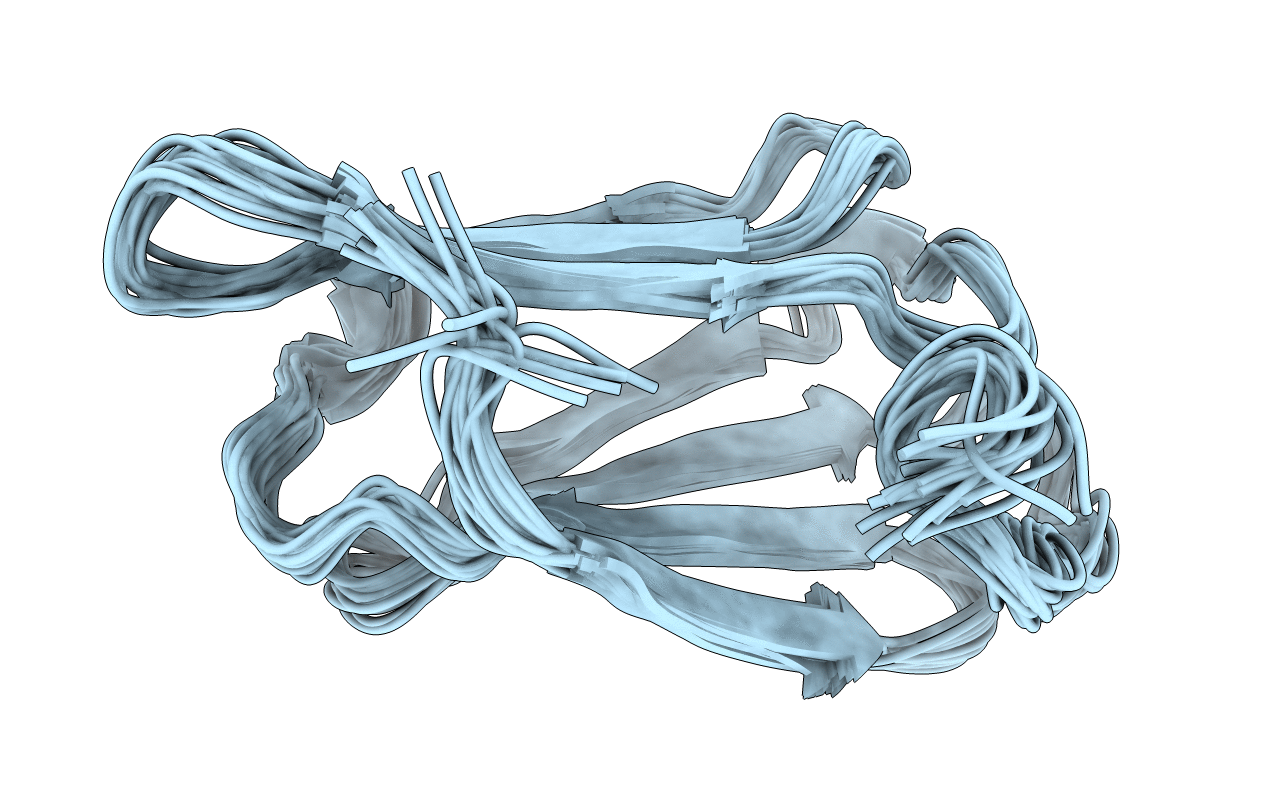
1RL1 image
Deposition Date 2003-11-24
Release Date 2004-05-04
Last Version Date 2024-05-22
Entry Detail
PDB ID:
1RL1
Title:
Solution structure of human Sgt1 CS domain
Biological Source:
Source Organism(s):
Homo sapiens (Taxon ID: 9606)
Expression System(s):
Method Details:
Experimental Method:
Conformers Calculated:
50
Conformers Submitted:
20
Selection Criteria:
structures with the lowest energy

Macromolecular Entities
Structures with similar UniProt ID
Protein Blast
Polymer Type:polypeptide(L)
Molecule:Suppressor of G2 allele of SK
Gene (Uniprot):SUGT1
Chain IDs:A
Chain Length:114
Number of Molecules:1
Biological Source:Homo sapiens
Ligand Molecules
Primary Citation
Human Sgt1 Binds HSP90 through the CHORD-Sgt1 Domain and Not the Tetratricopeptide Repeat Domain
J. Biol. Chem. 279 16511 16517 (2004)
PMID: 14761955 DOI: 10.1074/jbc.M400215200

Abstact

Sgt1 has been identified as a subunit of both core kinetochore and SCF (Skp1-Cul1-F-box) ubiquitin ligase complexes and is also implicated in plant disease resistance. Sgt1 has two putative HSP90 binding domains, a tetratricopeptide repeat and a p23-like CHORD and Sgt1 (CS) domain. Using NMR spectroscopy, we show that only the CS domain of human Sgt1 physically interacts with HSP90. The tetratricopeptide repeat domain does not bind to either HSP90 or HSP70. Determination of the three-dimensional structure showed that the Sgt1-CS domain shares the same beta-sandwich fold as p23 but lacks the last highly conserved beta-strand in p23. Analysis of the structures of Sgt1-CS and p23 revealed a similar charge distribution on one of two opposing surfaces that suggests that it is the binding region for HSP90 in Sgt1. Although ATP is absolutely required for p23 binding to HSP90, Sgt1 binds to HSP90 also in the absence of the non-hydrolyzable analog ATPgammaS. Our findings suggest the CS domain is a binding module for HSP90 distinct from p23-like domains, which implies that Sgt1 and related proteins function in recruiting heat shock protein activities to multiprotein assemblies.

Legend

Protein

Chemical

Disease

Primary Citation of related structures
Feedback Form
Name
Email
Institute
Feedback