

1R5U image
Deposition Date 2003-10-13
Release Date 2004-02-17
Last Version Date 2024-11-06
Entry Detail
PDB ID:
1R5U
Keywords:
Title:
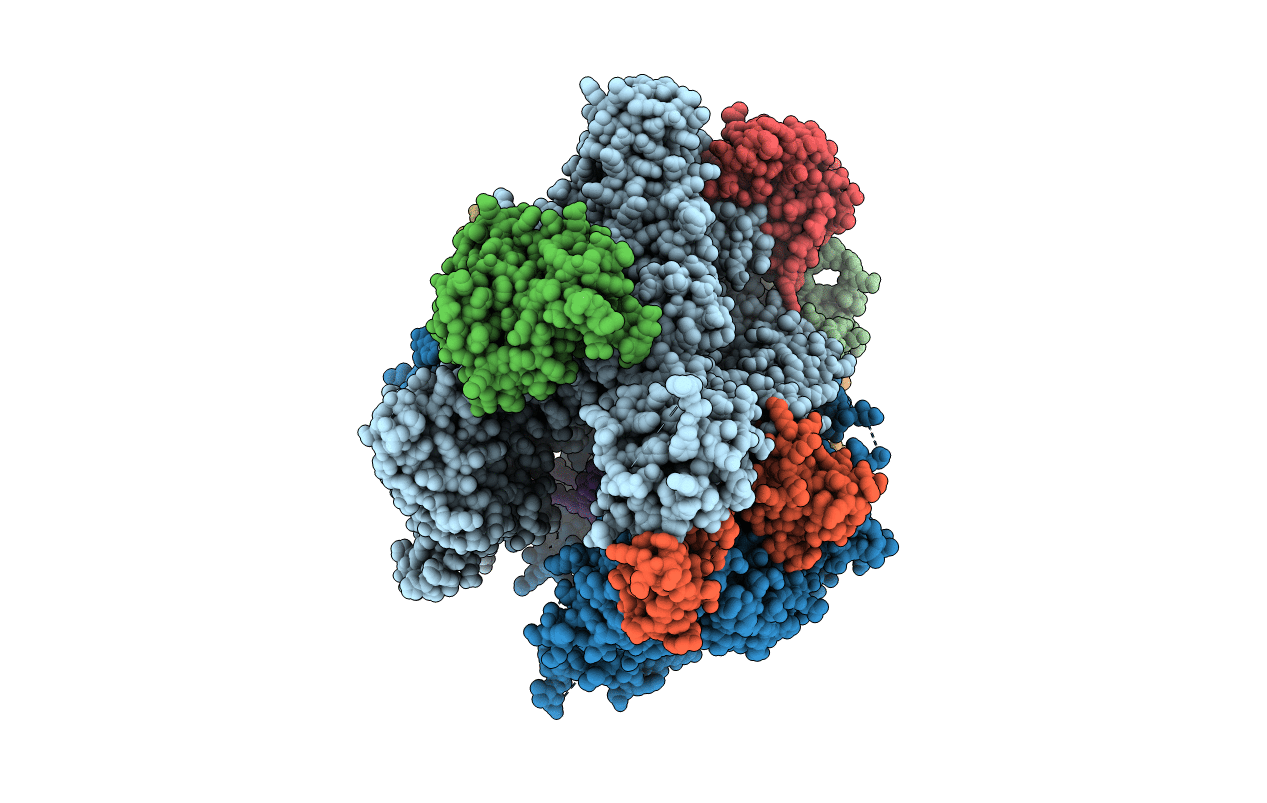
RNA POLYMERASE II TFIIB COMPLEX
Biological Source:
Source Organism(s):
Expression System(s):
Method Details:
Experimental Method:
Resolution:
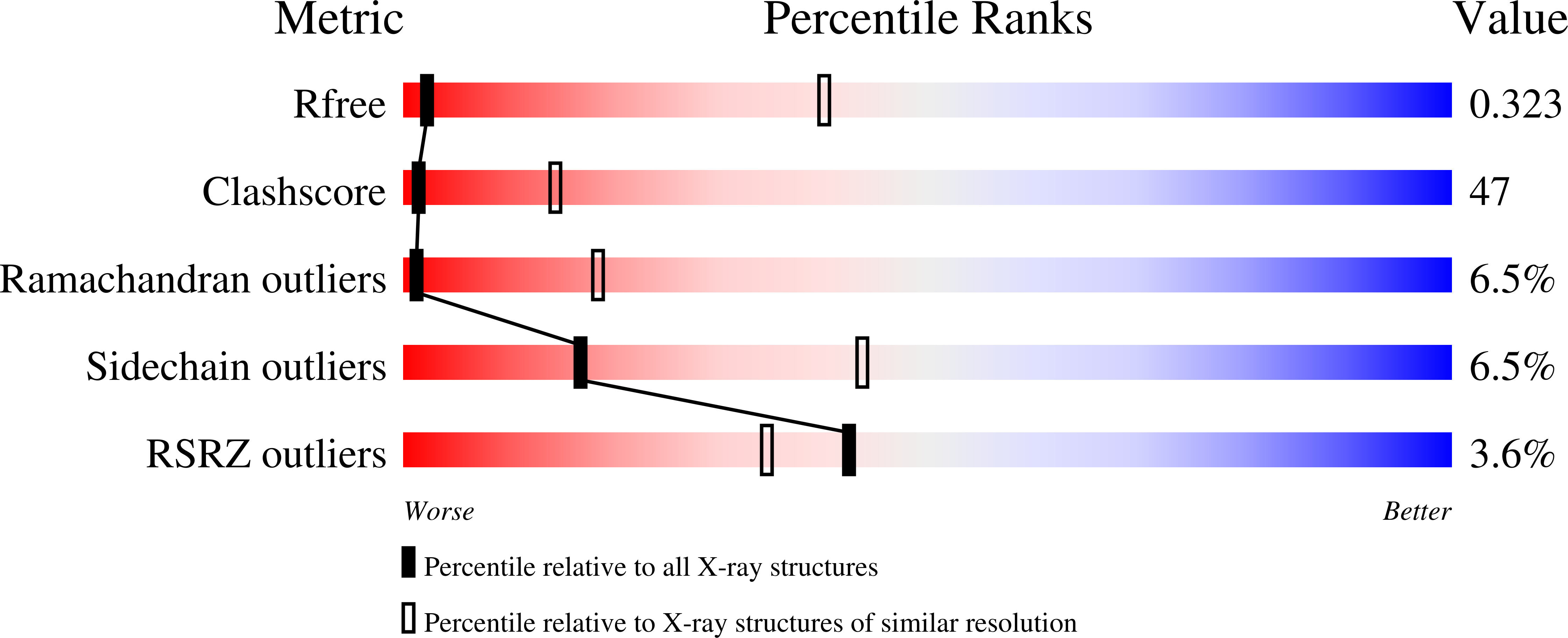
4.50 Å
R-Value Free:
0.37
R-Value Work:
0.34
R-Value Observed:
0.34
Space Group:
I 2 2 2
Macromolecular Entities
Structures with similar UniProt ID
Protein Blast
Polymer Type:polypeptide(L)
Molecule:DNA-directed RNA polymerase I
Gene (Uniprot):RPO21
Chain IDs:A
Chain Length:1733
Number of Molecules:1
Biological Source:Saccharomyces cerevisiae
Structures with similar UniProt ID
Protein Blast
Polymer Type:polypeptide(L)
Molecule:DNA-directed RNA polymerase I
Gene (Uniprot):RPB2
Chain IDs:B
Chain Length:1224
Number of Molecules:1
Biological Source:Saccharomyces cerevisiae
Structures with similar UniProt ID
Protein Blast
Polymer Type:polypeptide(L)
Molecule:DNA-directed RNA polymerase I
Gene (Uniprot):RPB3
Chain IDs:C
Chain Length:318
Number of Molecules:1
Biological Source:Saccharomyces cerevisiae
Structures with similar UniProt ID
Protein Blast
Polymer Type:polypeptide(L)
Molecule:DNA-directed RNA polymerases
Gene (Uniprot):RPB5
Chain IDs:D (auth: E)
Chain Length:215
Number of Molecules:1
Biological Source:Saccharomyces cerevisiae
Structures with similar UniProt ID
Protein Blast
Polymer Type:polypeptide(L)
Molecule:DNA-directed RNA polymerases
Gene (Uniprot):RPO26
Chain IDs:E (auth: F)
Chain Length:155
Number of Molecules:1
Biological Source:Saccharomyces cerevisiae
Structures with similar UniProt ID
Protein Blast
Polymer Type:polypeptide(L)
Molecule:DNA-directed RNA polymerases
Gene (Uniprot):RPB8
Chain IDs:F (auth: H)
Chain Length:146
Number of Molecules:1
Biological Source:Saccharomyces cerevisiae
Structures with similar UniProt ID
Protein Blast
Polymer Type:polypeptide(L)
Molecule:DNA-directed RNA polymerase I
Gene (Uniprot):RPB9
Chain IDs:G (auth: I)
Chain Length:122
Number of Molecules:1
Biological Source:Saccharomyces cerevisiae
Structures with similar UniProt ID
Protein Blast
Polymer Type:polypeptide(L)
Molecule:DNA-directed RNA polymerases
Gene (Uniprot):RPB10
Chain IDs:H (auth: J)
Chain Length:70
Number of Molecules:1
Biological Source:Saccharomyces cerevisiae
Structures with similar UniProt ID
Protein Blast
Polymer Type:polypeptide(L)
Molecule:DNA-directed RNA polymerase I
Gene (Uniprot):RPB11
Chain IDs:I (auth: K)
Chain Length:120
Number of Molecules:1
Biological Source:Saccharomyces cerevisiae
Structures with similar UniProt ID
Protein Blast
Polymer Type:polypeptide(L)
Molecule:DNA-directed RNA polymerases
Gene (Uniprot):RPC10
Chain IDs:J (auth: L)
Chain Length:70
Number of Molecules:1
Biological Source:Saccharomyces cerevisiae
Structures with similar UniProt ID
Protein Blast
Polymer Type:polypeptide(L)
Molecule:TRANSCRIPTION FACTOR II B (TF
Chain IDs:K (auth: M)
Chain Length:86
Number of Molecules:1
Biological Source:Saccharomyces cerevisiae
Primary Citation
Structural basis of transcription: an RNA polymerase II-TFIIB cocrystal at 4.5 Angstroms.
Science 303 983 988 (2004)
PMID: 14963322 DOI: 10.1126/science.1090838

Abstact

The structure of the general transcription factor IIB (TFIIB) in a complex with RNA polymerase II reveals three features crucial for transcription initiation: an N-terminal zinc ribbon domain of TFIIB that contacts the "dock" domain of the polymerase, near the path of RNA exit from a transcribing enzyme; a "finger" domain of TFIIB that is inserted into the polymerase active center; and a C-terminal domain, whose interaction with both the polymerase and with a TATA box-binding protein (TBP)-promoter DNA complex orients the DNA for unwinding and transcription. TFIIB stabilizes an early initiation complex, containing an incomplete RNA-DNA hybrid region. It may interact with the template strand, which sets the location of the transcription start site, and may interfere with RNA exit, which leads to abortive initiation or promoter escape. The trajectory of promoter DNA determined by the C-terminal domain of TFIIB traverses sites of interaction with TFIIE, TFIIF, and TFIIH, serving to define their roles in the transcription initiation process.

Legend

Protein

Chemical

Disease

Primary Citation of related structures
Feedback Form
Name
Email
Institute
Feedback