

1QKZ image
Deposition Date 1999-08-17
Release Date 2000-02-06
Last Version Date 2024-11-20
Entry Detail
PDB ID:
1QKZ
Keywords:
Title:
Fab fragment (MN14C11.6) in complex with a peptide antigen derived from Neisseria meningitidis P1.7 serosubtype antigen and domain II from Streptococcal protein G
Biological Source:
Source Organism(s):
Expression System(s):
Method Details:
Experimental Method:
Resolution:
1.95 Å
R-Value Free:
0.26
R-Value Work:
0.20
R-Value Observed:
0.20
Space Group:
P 1 21 1
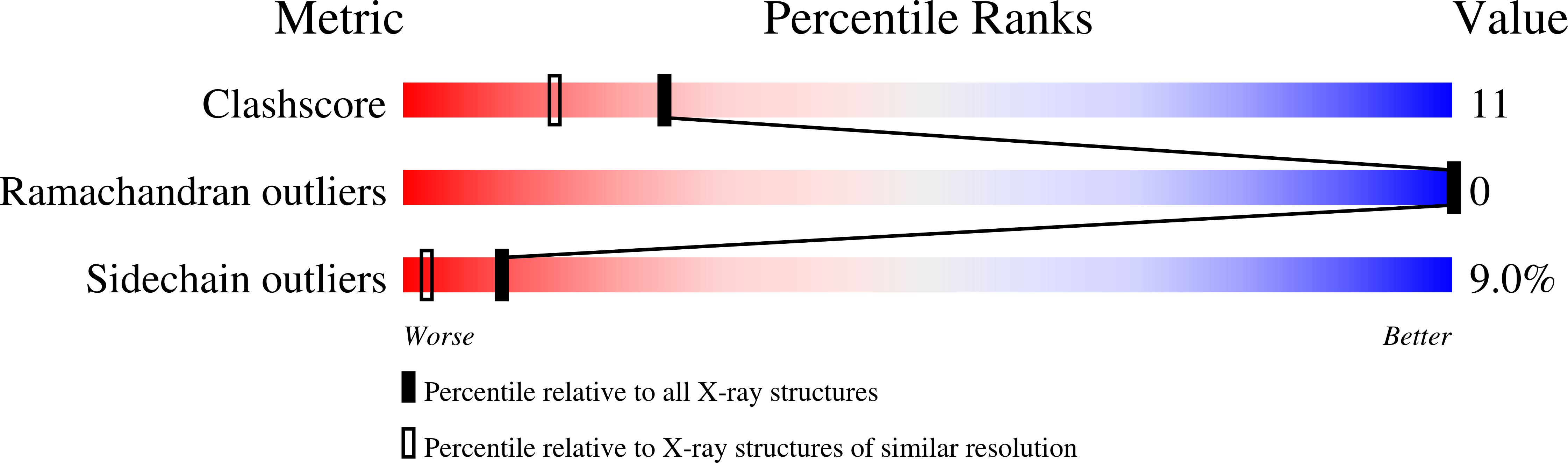
Macromolecular Entities
Structures with similar UniProt ID
Protein Blast
Polymer Type:polypeptide(L)
Molecule:PROTEIN G-PRIME
Mutagens:YES
Chain IDs:A
Chain Length:64
Number of Molecules:1
Biological Source:STREPTOCOCCUS SP.
Protein Blast
Polymer Type:polypeptide(L)
Molecule:ANTIBODY
Chain IDs:B (auth: H)
Chain Length:219
Number of Molecules:1
Biological Source:MUS MUSCULUS
Protein Blast
Polymer Type:polypeptide(L)
Molecule:ANTIBODY
Chain IDs:C (auth: L)
Chain Length:217
Number of Molecules:1
Biological Source:MUS MUSCULUS
Structures with similar UniProt ID
Protein Blast
Polymer Type:polypeptide(L)
Molecule:MAJOR OUTER MEMBRANE PROTEIN
Chain IDs:D (auth: P)
Chain Length:10
Number of Molecules:1
Biological Source:NEISSERIA MENINGITIDIS
Primary Citation
Crystal Structure of an Fab Fragment in Complex with a Meningococcal Serosubtype Antigen and a Protein G Domain
J. Mol. Biol. 293 81 ? (1999)
PMID: 10512717 DOI: 10.1006/JMBI.1999.3144

Abstact

Many pathogens present highly variable surface proteins to their host as a means of evading immune responses. The structure of a peptide antigen corresponding to the subtype P1.7 variant of the porin PorA from the human pathogen Neisseria meningitidis was determined by solution of the X-ray crystal structure of the ternary complex of the peptide (ANGGASGQVK) in complex with a Fab fragment and a domain from streptococcal protein G to 1.95 A resolution. The peptide adopted a beta-hairpin structure with a type I beta-turn between residues Gly4P and Gly7P, the conformation of the peptide being further stabilised by a pair of hydrogen bonds from the side-chain of Asn2P to main-chain atoms in Val9P. The antigen binding site within the Fab formed a distinct crevice lined by a high proportion of apolar amino acids. Recognition was supplemented by hydrogen bonds from heavy chain residues Thr50H, Asp95H, Leu97H and Tyr100H to main-chain and side-chain atoms in the peptide. Complementarity-determining region (CDR) 3 of the heavy chain was responsible for approximately 50 % of the buried surface area formed by peptide-Fab binding, with the remainder made up from CDRs 1 and 3 of the light chain and CDRs 1 and 2 of the heavy chain. Knowledge of the structures of variable surface antigens such as PorA is an essential prerequisite to a molecular understanding of antigenic variation and its implications for vaccine design.

Legend

Protein

Chemical

Disease

Primary Citation of related structures
Feedback Form
Name
Email
Institute
Feedback