

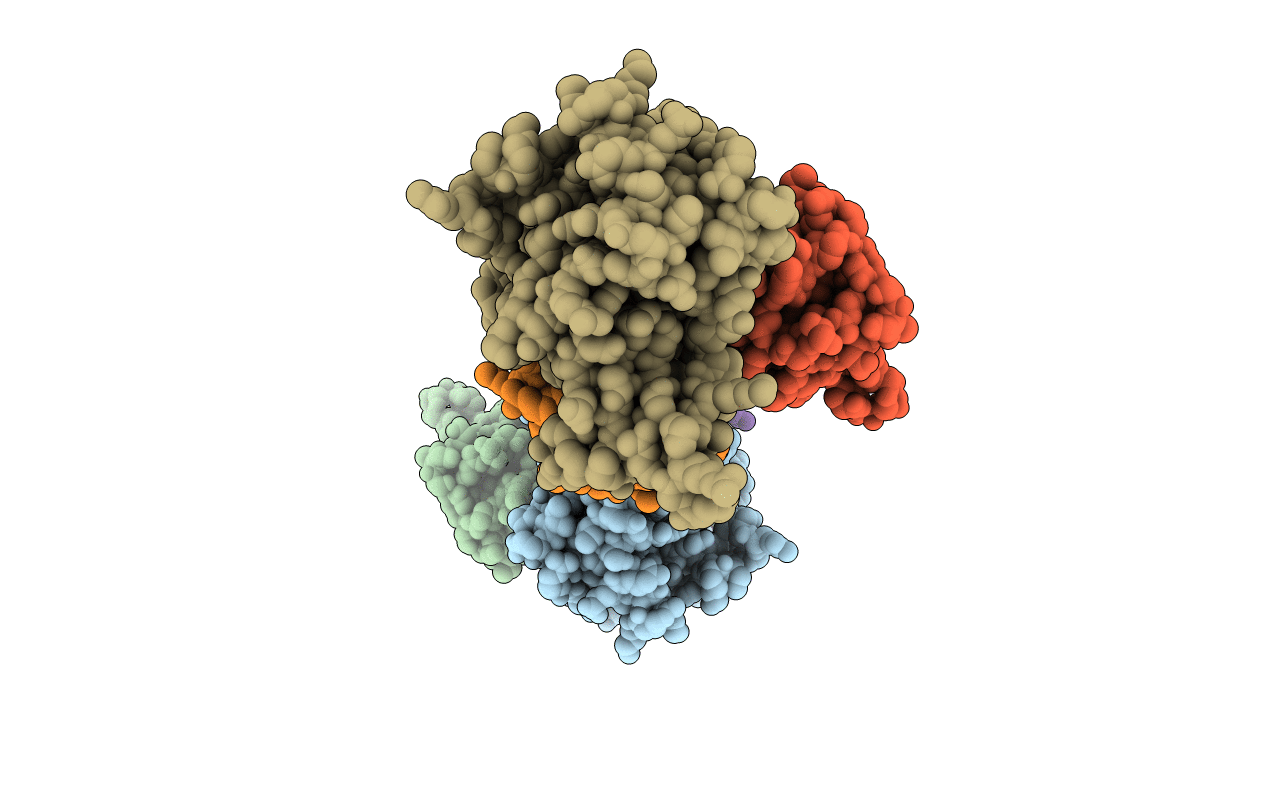
1NFI image
Deposition Date 1998-08-25
Release Date 1998-11-18
Last Version Date 2024-02-14
Entry Detail
PDB ID:
1NFI
Title:
I-KAPPA-B-ALPHA/NF-KAPPA-B COMPLEX
Biological Source:
Source Organism(s):
Homo sapiens (Taxon ID: 9606)
Expression System(s):
Method Details:
Experimental Method:
Resolution:
2.70 Å
R-Value Free:
0.26
R-Value Work:
0.22
R-Value Observed:
0.22
Space Group:
P 1 21 1
Macromolecular Entities
Structures with similar UniProt ID
Protein Blast
Polymer Type:polypeptide(L)
Molecule:NF-KAPPA-B P65
Gene (Uniprot):RELA
Chain IDs:A, C
Chain Length:301
Number of Molecules:2
Biological Source:Homo sapiens
Structures with similar UniProt ID
Protein Blast
Polymer Type:polypeptide(L)
Molecule:NF-KAPPA-B P50
Gene (Uniprot):NFKB1
Chain IDs:B, D
Chain Length:107
Number of Molecules:2
Biological Source:Homo sapiens
Structures with similar UniProt ID
Protein Blast
Polymer Type:polypeptide(L)
Molecule:I-KAPPA-B-ALPHA
Gene (Uniprot):NFKBIA
Chain IDs:E, F
Chain Length:213
Number of Molecules:2
Biological Source:Homo sapiens
Primary Citation
Structure of an IkappaBalpha/NF-kappaB complex.
Cell 95 749 758 (1998)
PMID: 9865693 DOI: 10.1016/S0092-8674(00)81698-0

Abstact

The inhibitory protein, IkappaBalpha, sequesters the transcription factor, NF-kappaB, as an inactive complex in the cytoplasm. The structure of the IkappaBalpha ankyrin repeat domain, bound to a partially truncated NF-kappaB heterodimer (p50/ p65), has been determined by X-ray crystallography at 2.7 A resolution. It shows a stack of six IkappaBalpha ankyrin repeats facing the C-terminal domains of the NF-kappaB Rel homology regions. Contacts occur in discontinuous patches, suggesting a combinatorial quality for ankyrin repeat specificity. The first two repeats cover an alpha helically ordered segment containing the p65 nuclear localization signal. The position of the sixth ankyrin repeat shows that full-length IkappaBalpha will occlude the NF-kappaB DNA-binding cleft. The orientation of IkappaBalpha in the complex places its N- and C-terminal regions in appropriate locations for their known regulatory functions.

Legend

Protein

Chemical

Disease

Primary Citation of related structures
Feedback Form
Name
Email
Institute
Feedback